

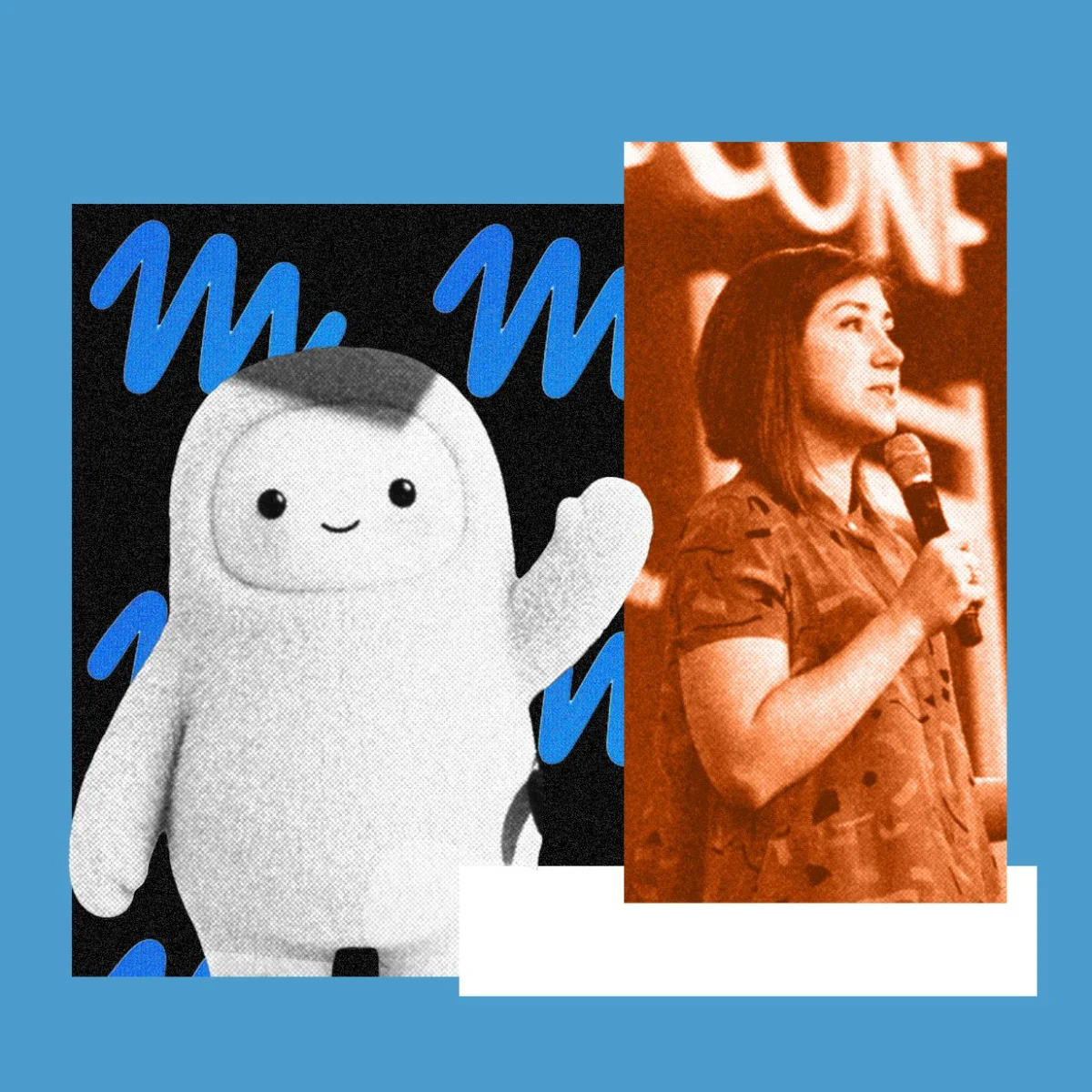
Bay Area lettering artist Jessica Hische found herself at the center of a digital storm after designing the "M" logo for Meta’s new AI assistant, Muse. The project, which she took on as a freelance gig to support her small businesses, ignited a swift and intense backlash from designers and the wider online community, highlighting the deeply polarized views surrounding artificial intelligence and Meta’s role in its development. Hische, a respected independent artist and small business owner, expressed her surprise at the vitriol, emphasizing the financial necessity behind accepting the commission and her belief that hiring human artists for such projects should be commended, not condemned.
The Genesis of a Controversy: A Freelancer’s Financial Realities
Jessica Hische, an acclaimed lettering artist based in Oakland, California, has built a reputation for her distinctive typographic work, contributing to rebrands for notable entities such as Squier (from Fender) and Jeni’s Splendid Ice Creams. Her freelance income is crucial for sustaining her two brick-and-mortar businesses: an art and stationery shop and a children’s art store called Drawling, which also hosts classes and workshops. These ventures, while passion projects, operate on thin margins, with Hische reporting only $10,000 in profit across both shops in the previous year. This financial reality, coupled with a significant investment of $100,000 in Studioworks, an administrative platform for creatives, and $30,000 in Drawling, created a pressing need for stable income to meet payroll for her four employees, including her mother.
The opportunity to design the logo for Meta’s AI assistant, Muse, presented a substantial financial lifeline. Hische acknowledged the controversial nature of both artificial intelligence and Meta, stating to WIRED, "AI is such a third rail, and Meta is such a third rail." Despite this awareness, the financial imperative led her to accept the project. In her newsletter, she announced the work with a preemptive plea, "New Work! (Don’t be mad at me)." She elaborated, "I know folks have big feelings about both AI and Meta, but this has been a really fun project for so many reasons."
The Online Firestorm: Accusations of "Selling Out" and Ethical Debates
The announcement quickly reverberated across social media platforms, particularly on Threads, a Meta-owned platform. Dozens of fellow designers voiced their criticism, with many accusing Hische of "selling out" and compromising her artistic integrity for corporate gain. The discourse rapidly escalated beyond professional critique, venturing into personal attacks and accusations of ethical failings.
One user commented, "Disgusted. It’s not about money, it’s about ethics." Another drew a stark parallel, stating, "Doing this job is like doing a hit for the mob, and being surprised later when the mob takes you out too." The intensity of the backlash was further amplified by instances where users allegedly posted photos of Hische’s home and engaged in speculation about her wealth and financial standing, fueling a narrative of a privileged artist disregarding the broader ethical implications of her work.
Hische attempted to explain her position, detailing her financial commitments and the precariousness of running a small business. She wrote on Threads, "For the past year, I pretty much have 2-4 payrolls in my account at any given time, which if you own a small business, you know is pretty precarious." She further elaborated on her investments and the need to provide for her employees. However, these explanations failed to quell the criticism, with many dismissing financial necessity as a valid justification for collaborating with a company and technology they deeply distrust.
Meta’s Muse AI Assistant: Context and Design Considerations
Meta’s introduction of Muse represents a significant step into the burgeoning field of personal AI assistants. While the specific functionalities of Muse were not detailed in the original report, its positioning as an AI agent suggests a move towards integrating advanced AI capabilities into users’ daily lives. The company’s ambition in this space places it in direct competition with other major tech players developing similar AI-powered tools.
Regarding the design of the "M" logo for Muse, Hische clarified her role. She was not tasked with creating the logo from scratch but rather with refining an existing internal exploration by Meta’s product designers and engineers. These internal efforts, while sometimes involving skilled typography, lacked the specialized finesse of a dedicated letterform designer. Hische described her process as a "huge sprint," completing the logo variations in two days and the logotype over an additional two weeks.
Her approach to logo refreshes involves breathing new life into existing designs, aiming for a subtle yet impactful transformation. She likens it to giving a logo a "spa weekend," rather than drastic plastic surgery, allowing it to feel refreshed and improved without losing its core identity. For the Muse "M," the team’s primary directive was to move away from a rigid, engineered, and cold perception towards something that felt "inspiring and creative" and encouraged users to view Muse as a tool for play and exploration.
Hische also addressed a notable comment from Meta’s Chief AI Officer, Alexandr Wang, who reportedly expressed relief that the logo did not resemble the "butthole" logos of some competitors. Hische indicated that while this might have been an internal consideration for Meta, her design process was more focused on aligning the Muse logo with the established visual language of the Meta brand, particularly its infinity loop logo.
The Artist’s Defense and the Broader Implications of AI in Creative Industries
Hische expressed her disappointment with the level of vitriol, which she found unexpected. She had anticipated some pushback but not the intensity of the personal attacks. Her rationale for taking the project extended beyond financial gain; she believed that Meta should be lauded for commissioning an independent artist rather than relying on generative AI for its logo design. This stance underscored her concern about the growing dominance of AI in creative fields and her desire to advocate for human artistry.
She explained her decision to discuss the project publicly: "I wanted to share it because I like sharing about my work. Within my newsletter group, everybody knows that my husband worked for Meta for ages, so they know that I have an association with the company. I also wanted to acknowledge that AI is a very sensitive topic for people, but acknowledge it to an audience that understands my relationship to both Meta and AI."
Hische’s attempts to engage with her critics were met with further misunderstanding and misrepresentation. When she mentioned that the fee, which she described as "an amazing fee for a two-day sprint for a big company," amounting to $12,500, would help her avoid carrying $50,000 in credit card debt through the holidays due to inventory purchases, her comment was twisted into an accusation of extravagant holiday spending. This distortion fueled a narrative of a wealthy artist disconnected from the struggles of ordinary creatives.
The emotional toll of the backlash was significant. Hische confessed to spending two days "sobbing" in bed, feeling deeply misunderstood and questioning the value of her past efforts to support the artistic community. She felt as though her commitment to making good decisions and providing free resources had been rendered meaningless by the public outcry.
Navigating the AI Landscape: Fear, Ethics, and the Future of Commercial Art
The controversy surrounding Hische’s involvement with Meta’s Muse logo design reflects a broader anxiety within the creative industries regarding the rapid advancement and integration of artificial intelligence. Designers and artists are grappling with fears about job displacement, the devaluation of human creativity, and the ethical implications of AI models trained on vast datasets of existing artwork, often without explicit consent.
Hische acknowledged these fears, stating, "The fear is real. There’s real fears about AI’s impact on commercial art." She recounted a personal debate with her husband, who was initially enthusiastic about AI while she was vehemently opposed. Her perspective evolved as she began to understand the underlying data-processing aspects of AI and its potential utility outside of pure creative generation, leading her to see "silver linings."
However, she maintained a critical stance on AI’s application in commercial art, countering the argument that AI solely enhances creativity by making human-made art more valuable. "Maybe in fine art, but that’s not how commercial art works," she asserted. She also acknowledged the validity of the "anti-AI purists" who argue that AI is built on "theft," citing her own expectation to benefit from the Anthropic settlement due to her books being scraped by AI models.
Hische clarified her personal use of AI, stating she does not employ it for generative art but rather for administrative tasks and assistance with coding and web development. Her primary concern lies with instances where AI replaces human labor or performs tasks requiring human creativity, which she deems "problematic."
The incident serves as a stark reminder of the complex ethical and financial tightropes that independent artists must navigate in an increasingly AI-driven world. While Hische’s decision was rooted in the practical necessities of small business ownership and a belief in supporting human artists, the intense public reaction underscores the deep-seated concerns and polarized opinions surrounding AI technology and its impact on creative professions. The debate over whether to engage with companies developing AI, and how to do so ethically and transparently, is likely to continue to shape the landscape for artists and designers for the foreseeable future.
