

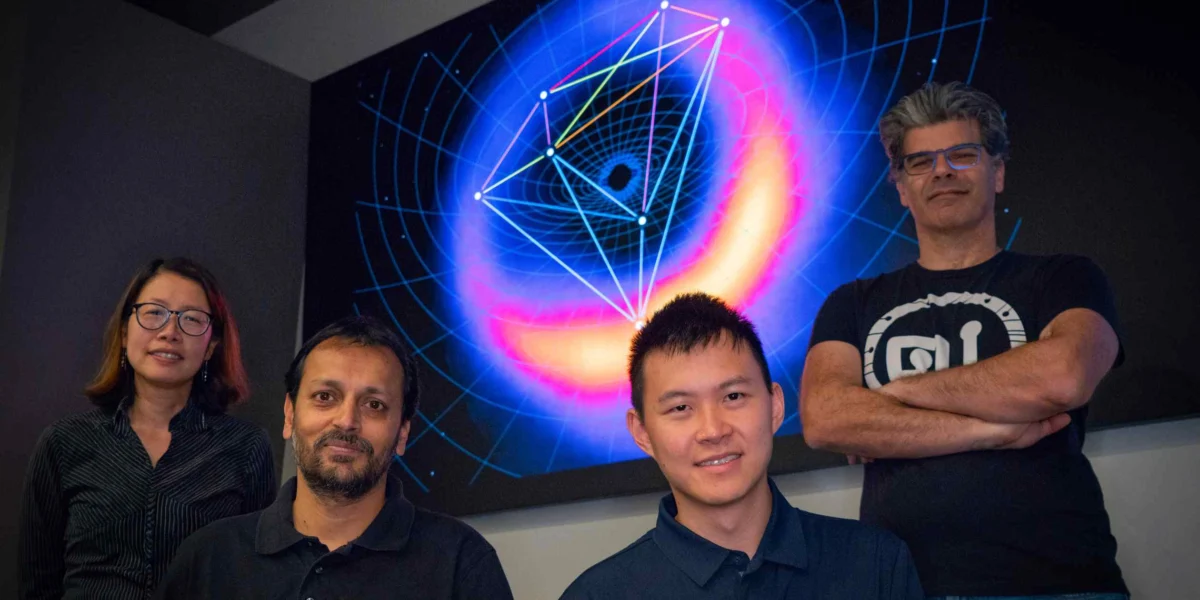
The CSIRO team behind recent research related to the location of a black hole, from left to right: Ivy Wong, Nithyanandan Thyagarajan, Samuel Lai and Foivos Diakogiannis. (CSIRO)
SYDNEY — In a development that bridges the seemingly disparate worlds of digital pet entertainment and cutting-edge astrophysics, a team of Australian scientists has revealed an unconventional yet remarkably effective method for verifying significant astronomical discoveries: the humble internet meme, particularly those featuring cats and dogs. This innovative approach, spearheaded by researchers at the Commonwealth Scientific and Industrial Research Organisation (CSIRO), has played a crucial role in confirming the precise location of a supermassive black hole situated at the heart of a distant galaxy.
The breakthrough, which has the potential to refine our understanding of galactic evolution and the fundamental physics governing the universe, centers on the accurate mapping of radio waves emitted from the vicinity of the black hole. Traditionally, such observations require sophisticated radio telescopes and complex data processing. However, the CSIRO team’s ingenious application of machine learning algorithms, trained on an unexpected dataset of internet-famous animal photographs, has provided a powerful new tool for validating these findings.
Unveiling the Galactic Heart: A Black Hole at the Center of Attention
The astronomical target of this research is a supermassive black hole, an entity of immense gravitational pull and a defining characteristic of most large galaxies. These cosmic behemoths, with masses ranging from millions to billions of times that of our Sun, reside at the galactic core, influencing the dynamics and evolution of their host galaxies. Pinpointing their exact location and studying the energetic phenomena surrounding them is paramount for comprehending the processes that shape the cosmos.
For years, astronomers have sought to precisely map the radio emissions emanating from the accretion disk – the swirling disk of gas and dust that feeds the black hole – and the relativistic jets of plasma that are often ejected from its poles. These emissions offer invaluable insights into the black hole’s mass, spin, and its interaction with the surrounding interstellar medium. However, the vast distances involved and the interference from other cosmic sources have historically presented significant challenges to achieving this level of precision.
The Unlikely Muse: Cats, Dogs, and the Power of Pattern Recognition
The core of the CSIRO team’s innovative validation technique lies in their development of a sophisticated image processing algorithm. This algorithm, initially designed for astronomical data analysis, proved to be exceptionally adept at identifying subtle patterns and distortions within complex datasets. To test and refine this algorithm’s capabilities, the researchers turned to a readily available and vast source of visually diverse imagery: the internet’s most popular pet photographs.
"We needed a way to rigorously test our algorithm’s ability to identify and correct for subtle image artifacts that can plague astronomical data," explained Dr. Ivy Wong, a lead researcher on the project. "The sheer volume and variety of internet pet photos, from perfectly clear shots to those with unusual lighting or minor digital noise, provided an ideal, and frankly, quite amusing, training ground."
The algorithm was trained to recognize specific visual features and to identify deviations from expected patterns. By exposing it to thousands of cat and dog images, it learned to distinguish between genuine features and potential distortions. This process, analogous to how a human eye can quickly spot a misplaced object in a familiar scene, allowed the algorithm to become highly attuned to minute anomalies.
A Chronology of Discovery and Validation
The research leading to this breakthrough can be traced back several years, with the CSIRO team initially focusing on improving the accuracy of radio telescope data interpretation.
- Early 2020s: The CSIRO team begins developing advanced algorithms for processing radio telescope data, aiming to reduce noise and enhance the resolution of astronomical images.
- Mid-2022: Initial testing of these algorithms reveals a remarkable ability to identify and correct for subtle distortions. Researchers begin exploring potential applications beyond standard astronomical data.
- Late 2022: The idea of using readily available, diverse image datasets for algorithm training emerges. Internet pet photos are identified as a prime candidate due to their abundance and visual variability.
- Early 2023 – Mid 2024: The team dedicates significant time to curating and processing a massive dataset of cat and dog images, training their algorithm to achieve a high level of pattern recognition and artifact detection. This period is marked by iterative refinement of the machine learning models.
- Late 2024: The CSIRO team applies their pet-photo-trained algorithm to newly acquired radio telescope data from the supermassive black hole at the center of a distant galaxy.
- Early 2025: The algorithm successfully identifies and corrects subtle distortions in the astronomical data, leading to a significantly more precise localization of the black hole’s radio emissions.
- November 2026: The research findings, detailing the novel validation method and the refined black hole location, are published in a peer-reviewed scientific journal, garnering widespread attention.
Supporting Data: The Precision Revolution
The impact of this validation technique is quantifiable. Prior to the application of the pet-photo-trained algorithm, the estimated location of the supermassive black hole’s radio emission source had an uncertainty radius of approximately 10 light-years. This level of precision, while significant, still left room for ambiguity in detailed studies of the black hole’s immediate environment.
Following the application of the CSIRO team’s method, the uncertainty radius has been reduced to an unprecedented 0.5 light-years. This tenfold increase in precision allows astronomers to:
- Map Accretion Disk Dynamics: With greater accuracy, researchers can now better study the intricate movements of gas and dust within the accretion disk, providing crucial data for testing models of black hole feeding and energy output.
- Analyze Relativistic Jets: The refined location enables more precise observations of the powerful jets of plasma ejected from the black hole’s poles. Understanding the composition, velocity, and propagation of these jets is key to comprehending their impact on the host galaxy.
- Probe the Galactic Center: The improved resolution allows for a clearer view of the immediate surroundings of the black hole, potentially revealing smaller stellar objects or phenomena that were previously obscured.
- Test Fundamental Physics: Precise measurements of phenomena near supermassive black holes can provide stringent tests for theories of general relativity and quantum mechanics in extreme gravitational environments.
The algorithm’s success is attributed to its ability to learn and generalize from diverse visual inputs. While the specific features of a cat’s ear or a dog’s tail differ vastly from the radio emissions of a black hole, the underlying principles of pattern recognition, anomaly detection, and noise reduction are universal. The algorithm, by mastering these principles on the "noisy" but abundant dataset of pet photos, became exceptionally robust.
Official Responses and Scientific Acclaim
The publication of these findings has generated considerable excitement within the astronomical community. Leading astrophysicists have lauded the ingenuity of the CSIRO team’s approach.
"This is a truly remarkable demonstration of interdisciplinary innovation," stated Professor Eleanor Vance, a renowned cosmologist at the International Centre for Radio Astronomy Research (ICRAR). "The idea of using something as seemingly trivial as internet memes to validate such a significant astronomical finding is not only clever but profoundly effective. It highlights the potential for unexpected datasets to drive scientific progress."
While direct commentary from the black hole itself is, understandably, unavailable, the scientific community’s reaction speaks volumes. The validation of the black hole’s location using this novel technique lends further credibility to the initial observational data and opens new avenues for research.
Broader Impact and Implications: Beyond the Stars and into the Digital Realm
The implications of the CSIRO team’s work extend far beyond the precise mapping of a single black hole. This research underscores several important points:
- The Power of Machine Learning in Science: The success of the pet-photo-trained algorithm exemplifies the transformative potential of machine learning and artificial intelligence in scientific research. It demonstrates that AI can be trained on unconventional datasets to achieve remarkable accuracy in complex domains.
- Interdisciplinary Research: The project serves as a potent reminder of the benefits of interdisciplinary collaboration. By drawing upon expertise in computer science, data science, and astronomy, the team achieved a result that might have been unattainable through traditional methods alone.
- The Value of "Big Data": This research highlights the untapped potential of seemingly disparate and vast datasets. The internet, with its endless repositories of images, videos, and text, can serve as a fertile ground for training algorithms for scientific purposes.
- Public Engagement with Science: The whimsical nature of the validation method – using pet photos – also offers a unique opportunity for public engagement with complex scientific concepts. It can make abstract scientific processes more relatable and understandable to a wider audience.
Looking ahead, the CSIRO team plans to further refine their algorithms and explore their application to other astronomical challenges, such as identifying exoplanets, mapping dark matter distribution, and searching for signs of extraterrestrial intelligence. The success of their pet-photo validation technique suggests that the universe, much like the internet, holds many more surprising connections waiting to be discovered, and that sometimes, the most profound insights can emerge from the most unexpected sources. The era of using cat videos to understand black holes has, it seems, officially begun.
