

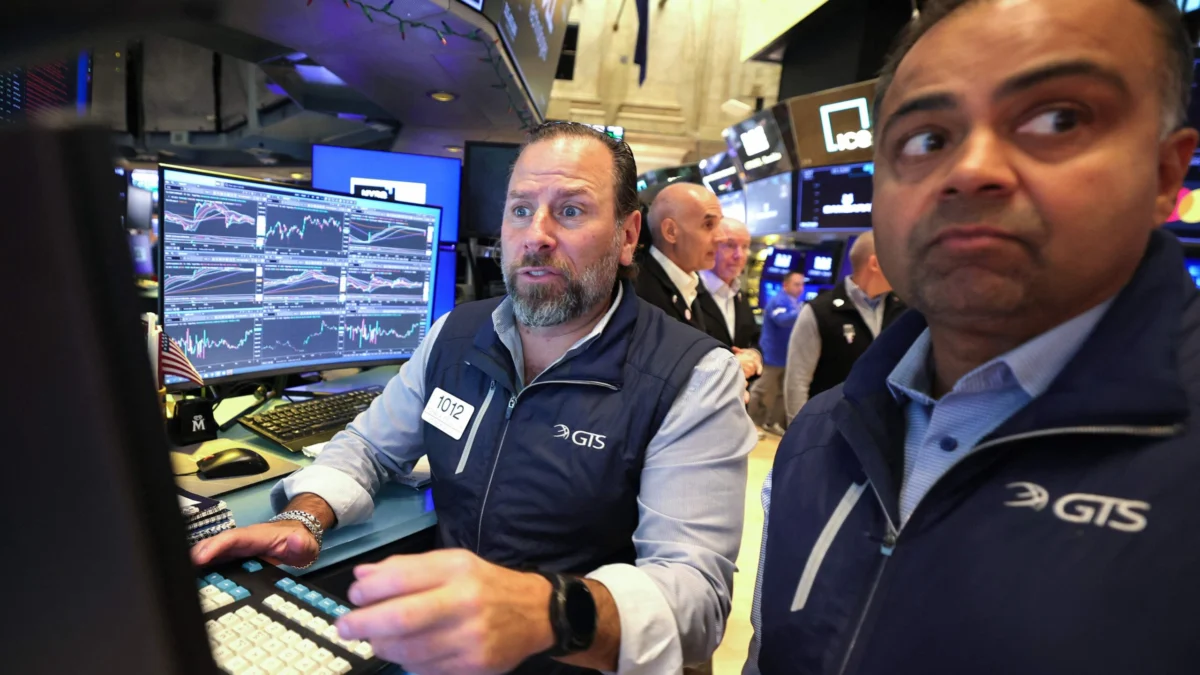
New York, Düsseldorf – The financial markets experienced a seismic shock in the wake of the recent US midterm elections, with stock indices plummeting across the board. Financial publications like Barron’s have described the event as an "AI bloodbath," while the Kobeissi Letter platform characterized it as "absolute madness." The sell-off, which occurred just two days after the elections, saw a staggering loss of market value, marking one of the most significant downturns in recent history.
Historic Market Collapse: Billions Erased in a Single Trading Day
On Thursday, companies within the S&P 500 index collectively lost approximately three trillion dollars in market capitalization, an unprecedented figure for a single trading day. The Nasdaq index, heavily weighted towards technology companies, fared even worse, with a total loss of around 2.5 trillion dollars, also a record.
The Nasdaq Composite Index closed down a dramatic 5.5 percent. This decline pushed the index more than ten percent below its all-time high, officially placing it in correction territory. Other major US indices also experienced substantial losses. The Dow Jones Industrial Average, after gaining 1500 points the previous day, reversed its gains entirely, closing down 3.4 percent. The broader S&P 500 index saw a decline of 4.3 percent, while the Nasdaq 100, a tech-heavy selection index, plunged by 6.4 percent – the largest single-day loss recorded since the onset of the COVID-19 pandemic. These losses continued into after-hours trading, signaling persistent investor unease.
A Day of Unprecedented Volatility
The magnitude of the market’s retreat on Thursday was so profound that it represented the steepest daily loss for the major US indices since April 2025, when former President Donald Trump announced comprehensive import tariffs. This historical parallel underscores the significant market reaction to the election outcomes.
Adding to the palpable investor anxiety, the US Volatility Index (VIX), often referred to as the "fear gauge of Wall Street," surged by approximately 70 percent. This sharp increase in the VIX indicates a heightened level of uncertainty and fear among investors regarding future market movements.
The AI Connection: Election Results Spark Fears of Regulatory Headwinds
The primary catalyst for this market upheaval appears to be the surprisingly strong performance of the Democratic Party in the US Congress. A significant concern rippling through the market is the potential for Democrats to significantly impede the expansion of infrastructure for Artificial Intelligence (AI). The development and deployment of AI technologies, particularly the construction of large-scale data centers, has become a central theme in political discourse and a key driver of recent market growth.
Indeed, resistance to the proliferation of data centers was a prominent campaign issue in many districts, making it a direct contributor to the subsequent stock price declines. Investors, particularly those heavily invested in AI-related companies and the infrastructure that supports them, interpreted the election results as a potential signal of increased regulatory scrutiny and slower development in the AI sector. This sentiment led to a broad-based sell-off of technology stocks and companies heavily reliant on AI advancements.
Deep Dive into the AI Infrastructure Investment Landscape
The rapid ascent of Artificial Intelligence has been fueled by massive investments in computing power, data storage, and network infrastructure. Companies at the forefront of AI development, from chip manufacturers like NVIDIA and AMD to cloud service providers such as Amazon Web Services, Microsoft Azure, and Google Cloud, have seen their valuations soar in recent years. The demand for specialized hardware, including Graphics Processing Units (GPUs), has outstripped supply, driving significant revenue growth for these firms.
Furthermore, the construction and operation of data centers, which house the servers and networking equipment necessary for AI processing, have become a critical component of this ecosystem. Companies specializing in real estate investment trusts (REITs) focused on data centers, as well as the construction and engineering firms involved in building these facilities, have also benefited from this boom. The potential for political intervention in the siting, permitting, or operational aspects of these data centers has therefore become a significant concern for investors in this sector.
Beyond AI: A Multifaceted Market Reaction
While the potential impact on AI infrastructure development is a primary driver, it is important to acknowledge that the market reaction is likely influenced by a confluence of factors. The post-election uncertainty itself can trigger volatility, as investors recalibrate their expectations for economic policy and regulatory environments.
The midterm elections typically set the stage for the political landscape of the subsequent two years, influencing legislative agendas and the potential for bipartisan cooperation or gridlock. In this instance, the results may have created a perception of a more challenging environment for certain business sectors, leading to a reassessment of investment strategies.
Historical Precedents of Election-Related Market Swings
Market reactions to US elections are not uncommon. Historically, periods of uncertainty leading up to and immediately following elections have often been characterized by increased volatility. Investors tend to scrutinize election outcomes for potential shifts in fiscal policy, trade relations, and regulatory frameworks that could impact corporate earnings and overall economic growth.
For example, the announcement of significant trade tariffs has historically led to sharp market declines, as seen in the parallel drawn to the April 2025 event. Similarly, shifts in regulatory policy concerning sectors like technology, healthcare, or energy can trigger significant price adjustments as market participants factor in new operational costs or market access challenges. The current sell-off, while particularly severe, fits within this broader historical pattern of market sensitivity to political developments.
Investor Sentiment and the "Fear Gauge"
The dramatic surge in the VIX index is a critical indicator of market sentiment. A rising VIX signifies increasing investor nervousness and a greater perceived risk of significant price declines. This heightened volatility can lead to a cascade effect, as investors, fearful of further losses, rush to sell their holdings, thereby exacerbating the downward pressure on stock prices.
The VIX is calculated based on the implied volatility of S&P 500 index options. When investors anticipate greater price swings, they are willing to pay more for options that protect against such movements, driving up the VIX. The nearly 70 percent increase observed indicates a significant shift in investor psychology, moving from a position of relative calm to one of heightened alert and apprehension.
Potential Implications for the Tech Sector and Beyond
The ramifications of this market correction extend beyond the immediate stock price declines. A sustained downturn in the technology sector, particularly in AI-related companies, could have broader economic consequences. These include:
- Reduced Investment in Innovation: If investor confidence wanes and capital becomes harder to access, companies may scale back their research and development efforts, potentially slowing the pace of technological advancement.
- Impact on Employment: A slowdown in growth for tech companies could lead to hiring freezes or even layoffs, affecting the job market, especially in tech hubs.
- Consumer Confidence: Significant market declines can impact household wealth through retirement accounts and investments, potentially affecting consumer spending and overall economic activity.
- Global Market Contagion: As major US indices are closely watched and traded globally, a prolonged downturn in the US market can have ripple effects on international stock exchanges.
Expert Analysis and Market Outlook
While the immediate reaction has been one of panic, financial analysts are now working to assess the long-term implications. Some experts suggest that the market may have overreacted, driven by speculation rather than concrete policy changes. They point out that the Democratic Party’s platform is not monolithic, and the extent to which they might pursue restrictive policies on AI infrastructure remains to be seen.
Others, however, argue that the election results have introduced a significant element of regulatory uncertainty that could persist for some time. This uncertainty, they contend, is sufficient to warrant a cautious approach from investors and could lead to a period of subdued growth or even a prolonged bear market for technology stocks.
The coming weeks and months will be crucial in determining the market’s trajectory. Investors will be closely watching for any signals from policymakers regarding their intentions for AI development and regulation. Furthermore, the broader economic environment, including inflation, interest rates, and global geopolitical events, will continue to play a significant role in shaping market sentiment.
The unprecedented market sell-off following the US midterm elections serves as a stark reminder of the interconnectedness between political developments and financial markets. The "AI bloodbath" underscores the sensitivity of high-growth sectors to shifts in the political landscape and highlights the critical need for investors to remain informed and adaptable in navigating an increasingly complex global economy. The events of this past Thursday have undoubtedly etched themselves into financial history, signaling a new chapter of potential challenges and opportunities in the rapidly evolving world of artificial intelligence and its market implications.
