

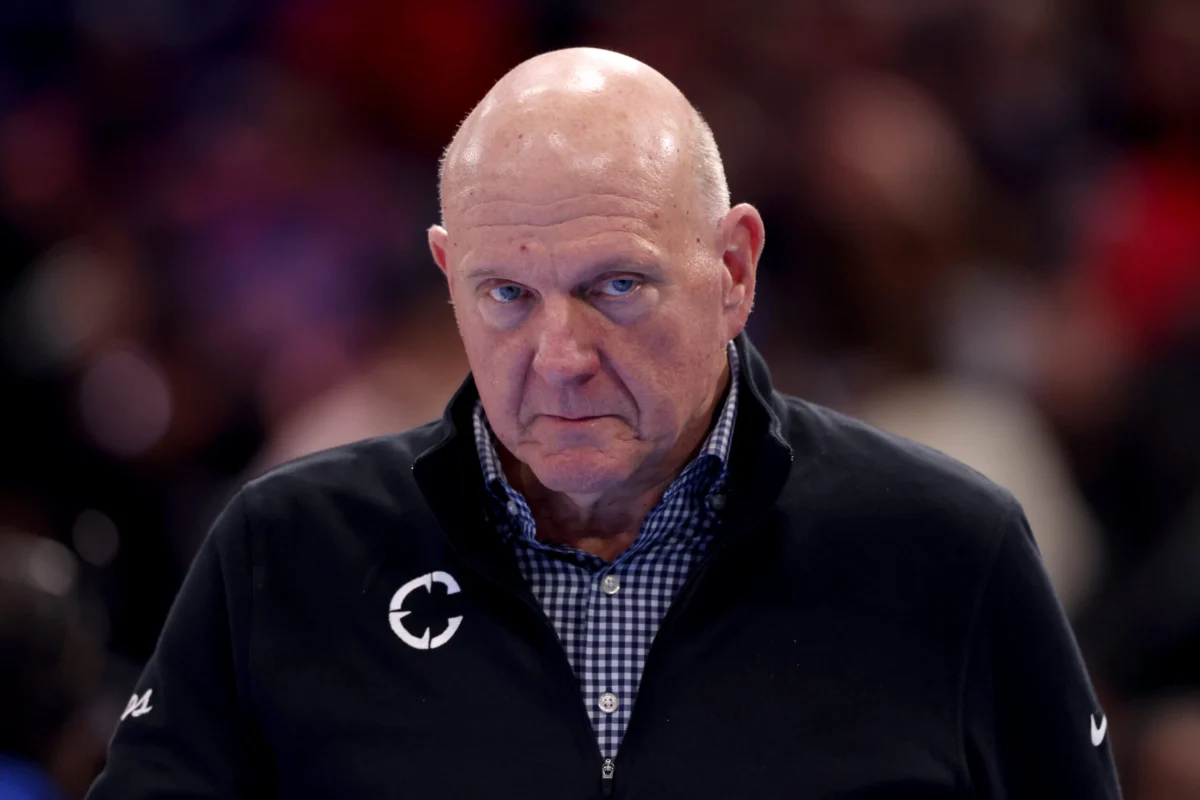
The National Basketball Association (NBA) on Wednesday delivered an unprecedented package of penalties against the Los Angeles Clippers franchise, its owner Steve Ballmer, and two senior executives, citing widespread and knowing violations of the league’s salary cap circumvention rules. Owner Steve Ballmer has been suspended for one year, marking one of the most severe personal sanctions ever levied against a principal owner in league history. The team itself faces a staggering $30 million fine and the forfeiture of five first-round draft picks, a punitive measure designed to significantly impact its future competitive viability. These sweeping sanctions stem from an extensive investigation into the Clippers’ dealings with star player Kawhi Leonard and four companies that allegedly facilitated illicit off-court income opportunities for him.
Comprehensive Penalties Unveiled After Extensive Probe
The league’s ruling, announced after an exhaustive investigation conducted by the law firm Wachtell, Lipton, Rosen & Katz, found a "pattern of misconduct and multiple significant rules violations" by the Clippers organization. Central to the findings was the allegation that Ballmer "knowingly" sought to help Leonard obtain off-court income opportunities worth millions of dollars. Specifically, the NBA stated that Ballmer approved a business deal that he "knew was a precondition for Aspiration Partners to enter into an endorsement agreement with Mr. Leonard."
Beyond Ballmer’s personal suspension, the financial repercussions for the Clippers are substantial. The $30 million fine represents one of the largest financial penalties ever imposed on an NBA franchise. More critically for the team’s long-term health, the forfeiture of five first-round picks, commencing with the 2029 NBA Draft and continuing annually thereafter, deals a severe blow to its ability to acquire young talent and maintain competitiveness through traditional draft channels. Furthermore, the Clippers and their personnel will be subjected to a stringent compliance and monitoring program overseen by the league office for the next five years, indicating a sustained period of heightened scrutiny.
The NBA’s disciplinary actions extended to key members of the Clippers’ executive leadership. Gillian Zucker, President of Business Operations, was suspended without pay for one year. The league’s summary of findings indicated that Zucker provided "false and misleading statements to investigators," exacerbating the severity of her penalty. Lawrence Frank, President of Basketball Operations, received a six-month suspension without pay. The Wachtell, Lipton report, a detailed 36-page document, explicitly identified Ballmer, Zucker, and Frank as "the three individuals most responsible for the Clippers’ rule-breaking."
Kawhi Leonard, the focal point of the circumvention scheme, was not immune to penalties. He was ordered to pay the league $700,000 in connection with his own violations, primarily attributed to the conduct of his then-business manager, Dennis Robertson. Robertson, Leonard’s uncle, was accused of pressuring the team to help Leonard obtain off-court income opportunities and failing to reimburse payments made by the Clippers for personal expenses. As a direct consequence, the NBA banned Robertson from conducting business or otherwise engaging with the league’s teams, their affiliates, players, or personnel for a period of five years.
The Genesis of the Investigation: A Podcast’s Revelations
The extensive probe culminating in these landmark sanctions traces its origins to a series of investigative reports. Nearly a year prior to the NBA’s announcement, the podcast "Pablo Torre Finds Out" began publishing episodes alleging that the Clippers and Steve Ballmer had violated salary cap circumvention rules. These allegations specifically centered on dealings with Aspiration Partners, a now-collapsed green energy financial company. The podcast reported that Aspiration Partners had entered into a four-year, $28 million endorsement agreement with Leonard, an agreement that was purportedly never publicly announced and under which Leonard allegedly performed no services. This revelation sparked significant scrutiny and ultimately triggered the NBA’s formal investigation.
The league’s investigation, spearheaded by Wachtell, Lipton, Rosen & Katz, meticulously examined the Clippers’ practices. The summary of findings detailed that the organization’s violations included "initiating off-court income opportunities between Mr. Leonard and four companies doing business with the team: Aspiration Partners, Boingo Wireless, Daktronics, and Lockton Insurance." The investigation also found that the Clippers actively "facilitated endorsement deals between those companies and Leonard," and critically, "induced those companies to enter into deals with Leonard by offering them business from the team." Further improprieties included the team paying personal expenses for Leonard and his representatives, and a failure "to report improper solicitations for off-court income opportunities made on Mr. Leonard’s behalf through his then-business manager, Dennis Robertson."
The Importance of Salary Cap Integrity and League Rules
NBA Commissioner Adam Silver, in a stern statement accompanying the announcement, underscored the foundational importance of these rules. "The NBA’s collectively bargained system for determining player compensation is a fundamental component of the basketball competition that the league oversees for the benefit of the teams and players and ultimately the fans," Silver stated. He expressed profound disappointment, saying, "I am deeply disappointed by the flagrant violations of our rules and by the Clippers’ institutional and leadership failures that led to this misconduct. The severity of the penalties reflects the seriousness of the violations."
The NBA’s salary cap system is designed to ensure competitive balance across the league, preventing richer teams from simply outspending competitors to assemble super-teams through a combination of official contracts and unofficial payments. Circumvention of these rules undermines the integrity of the game, distorts player markets, and erodes the principle of fair competition that is central to professional sports. The league has historically taken a firm stance against such violations, although the scale and scope of the penalties against the Clippers are largely unprecedented, especially concerning an owner. This serves as a stark reminder that even the most powerful figures in the league are subject to its regulations.
Reactions: Defiance, Responsibility, and an Eye Towards the Future
The immediate reactions from the implicated parties varied significantly. The Los Angeles Clippers issued a defiant statement, vehemently rejecting the NBA’s findings. "We vehemently reject the NBA’s findings," the team declared, adding, "We intend to vigorously challenge these findings and penalties through every avenue available to us and look forward to an ethical and impartial arbitration process." The Clippers further accused the league of conducting a "heavily biased investigation seeking to justify a predetermined narrative rather than facts and evidence." They also claimed a discrepancy between private communications from the league and the public announcement, stating, "What the league told us privately differs from what it announced today publicly, and they have not held themselves close to the standard Commissioner Silver set at the start of this investigation to ensure [its] fairness and accuracy." The team concluded by asserting their full cooperation throughout the year-long investigation and their intention to "fight just as hard to demonstrate our innocence."
Kawhi Leonard, speaking through his new agent, adopted a more measured tone, acknowledging responsibility while denying personal knowledge of intentional circumvention. "Integrity and respect for this game are fundamental to who I am," Leonard stated. "I accept full responsibility for lapses in judgment by people within my inner circle and regret the distraction this situation has caused the fans and my family." He maintained his good faith in his dealings: "I entered into my contract with the Clippers as well as the agreements in question in good faith, fully committed to fulfilling my obligations and with no knowledge of any intent on anyone’s part to circumvent the salary cap."
Broader Implications and a Potential Farewell
The conclusion of this high-profile investigation has significant ramifications for all parties involved and the NBA at large. For the Clippers, the penalties represent a massive setback for a franchise that has invested heavily in recent years to elevate its status. The $30 million fine is a substantial financial hit, but the loss of five first-round draft picks could cripple their ability to build a sustainable contender for the next decade. These picks are vital assets for acquiring future stars, trading for established talent, or simply adding depth. The suspension of key executives, Zucker and Frank, also creates leadership vacuums in critical operational and basketball decision-making roles during a pivotal period for the organization, particularly as the team prepares to move into its new, state-of-the-art Intuit Dome in Inglewood. This ambitious new arena was meant to usher in a new era of Clippers dominance, now overshadowed by this scandal.
Steve Ballmer, known for his energetic and hands-on ownership style since purchasing the team for a then-record $2 billion in 2014, faces a significant reputational blow and a forced absence from league activities. His one-year suspension is a powerful message about owner accountability and sets a strong precedent for future conduct across the league.
For Kawhi Leonard, despite his statement of innocence regarding intent, the $700,000 fine and the cloud of the investigation add another complex layer to his already enigmatic public persona. More immediately, the resolution of the probe has cleared the way for potential seismic shifts in his career. A trade that would send Leonard back to the Toronto Raptors, the team with whom he won an NBA championship in 2019 before joining the Clippers, had reportedly been put on hold during the summer while the investigation concluded. Leonard’s statement subtly hinted at this possibility: "As I return to Toronto, I am focused on what I can control, closing this chapter, and moving forward with a clean slate." This strongly suggests an impending departure from Los Angeles, marking a dramatic end to his tenure with the Clippers.
The NBA’s decisive action underscores Commissioner Silver’s commitment to upholding the integrity of the league’s rules and protecting the competitive balance that underpins its appeal. The severity of the penalties is intended to serve as a powerful deterrent against similar circumvention tactics by other franchises. However, the Clippers’ intent to "vigorously challenge these findings and penalties through every avenue available to us" signals a potentially protracted legal battle, which could test the limits of the Commissioner’s authority and the league’s investigative processes. This saga is far from over, and its ultimate resolution could reshape the landscape of player-team relationships and league oversight for years to come.
