

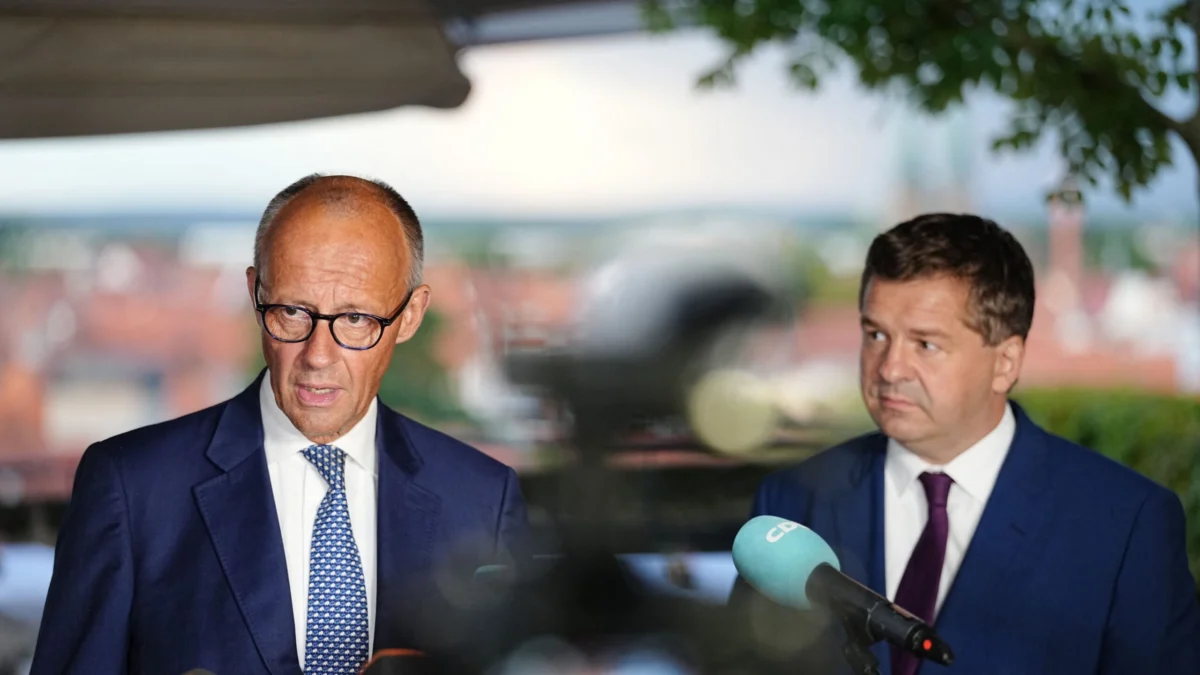
Quedlinburg, Germany – As the crucial state election in Saxony-Anhalt looms, Federal Chancellor Friedrich Merz has issued a stark warning regarding the potential economic ramifications should the Alternative for Germany (AfD) party secure a governing position. During his inaugural campaign visit to the state, Merz emphasized that Saxony-Anhalt must not become an "experimentation ground for angry citizens," a sentiment echoed by CDU’s leading candidate for the state premiership, Sven Schulze, following their joint appearance in the historic town of Quedlinburg.
The core of Merz’s concern centers on the perceived threat to foreign investment. He articulated a strong belief that an outright majority for a "right-wing populist party" would cause international investors to "think twice before investing in Saxony-Anhalt." This statement underscores a broader concern within the conservative bloc about the potential impact of far-right parties on Germany’s economic stability and its attractiveness to global capital. The German economy, a powerhouse within the European Union, relies heavily on foreign direct investment (FDI) to drive innovation, create jobs, and maintain its competitive edge. Any significant downturn in FDI could have cascading effects, impacting not only the regional economy of Saxony-Anhalt but also contributing to broader national economic anxieties.
Historical Context and Electoral Landscape
Merz’s warnings are not made in a vacuum. He invoked the memory of the 2021 state election in Saxony-Anhalt, an election that saw a surprising and decisive victory for the CDU. At that time, pre-election polls had predicted a much closer race, with the CDU and AfD neck-and-neck. However, the final results delivered a stronger mandate for the CDU, which secured 37.1% of the vote, while the AfD garnered 20.8%. This outcome was seen as a significant repudiation of the AfD’s growing influence in the region.
However, the current electoral landscape presents a starkly different picture. As of the latest polling data, the AfD is leading significantly, with projections placing them around the 40% mark. The CDU, in contrast, is polling at approximately 23%. This shift in public sentiment has intensified concerns among established political parties, including the CDU and its federal leadership, about the potential for a substantial change in the state’s political direction. The election, scheduled for September 6th, is therefore viewed as a critical juncture, not just for Saxony-Anhalt, but potentially for the broader political and economic trajectory of eastern Germany.
Investor Confidence and Economic Stability
The argument that a government led by the AfD could deter international investors is rooted in several factors. Political instability, a perceived shift towards protectionist or isolationist policies, and concerns about adherence to democratic norms and the rule of law are all potential deterrents for multinational corporations. These companies often prioritize environments that offer predictability, a stable regulatory framework, and a commitment to open markets.
To illustrate the potential impact, consider the current economic profile of Saxony-Anhalt. The state has been actively working to attract investment in sectors such as renewable energy, automotive supply chains, and advanced manufacturing. For example, recent years have seen significant investments in battery cell production and hydrogen technology. The success of these initiatives is often contingent on Germany’s broader image as a stable and reliable economic partner within the EU and globally. A government perceived as potentially undermining these aspects could jeopardize ongoing projects and future investment prospects.
Furthermore, the economic performance of states with perceived political instability can be measured by various indicators. These include trends in unemployment rates, GDP growth, export figures, and the volume of new business registrations. While specific data for Saxony-Anhalt reflecting a direct impact of political rhetoric is not yet available, historical examples from other regions globally suggest a correlation between political uncertainty and a decline in investor confidence.
CDU’s Campaign Strategy and Hopes for a Turnaround
Despite the challenging poll numbers, Merz expressed optimism about the CDU’s prospects in the final week before the election. He characterized the situation as one where "much is at stake," but conveyed his confidence that the election on Sunday will yield a "good result for Sven Schulze and the CDU." This sentiment reflects a common campaign strategy: to galvanize supporters and persuade undecided voters in the final days of an election cycle, often referred to as a "late surge" or "Aufholjagd" in German.
The CDU’s campaign in Saxony-Anhalt is clearly focused on presenting a stable and pragmatic alternative to the AfD. By highlighting the potential economic risks associated with an AfD government, they aim to appeal to centrist voters and those concerned about the state’s future prosperity. The alliance with Federal Chancellor Merz underscores the national importance the CDU is placing on this regional election.
Minister-President Schulze’s Perspective on Investor Engagement
Sachsen-Anhalt’s Minister-President, Sven Schulze, elaborated on the direct impact of the current political climate on investment discussions. He noted a "huge interest" in the election, not only from the media but also from the general public, evidenced by the high volume of interest in postal voting. This indicates a heightened level of civic engagement and perhaps a sense of urgency among the electorate.
Schulze provided a concrete example of ongoing negotiations with potential investors. He revealed that he is currently in discussions with entities looking to invest "a three-digit million sum" in an industrial park in the vicinity. Crucially, these investors have reportedly communicated a clear condition: "Mr. Schulze, we will do this with you, but we will wait for September 6th because we want to do it with you." This statement directly links their investment decision to the outcome of the election and their confidence in Schulze’s leadership, implicitly suggesting apprehension about a different political outcome.
This anecdotal evidence from Schulze serves as a powerful illustration of Merz’s broader economic warning. It suggests that even at the micro-level of specific investment deals, political uncertainty can lead to delays or cancellations. The willingness of investors to "wait for September 6th" highlights their strategic approach to risk management and their preference for a predictable political environment.
Broader Implications and Future Outlook
The upcoming election in Saxony-Anhalt is more than just a regional contest; it is being watched closely as a barometer of political sentiment in eastern Germany. The AfD’s strong showing in the polls reflects a complex set of factors, including lingering economic disparities, concerns about immigration, and a general dissatisfaction with established political parties.
The implications of the election outcome extend beyond Saxony-Anhalt’s borders. A significant AfD victory could embolden similar parties in other German states and across Europe, potentially influencing national political discourse and policy decisions. For the German federal government, the election represents a challenge to its narrative of stability and economic progress. The CDU, as the leading party in the federal coalition, has a vested interest in demonstrating its ability to maintain economic strength and political consensus.
The coming days will likely see intensified campaigning from all sides, with parties seeking to mobilize their base and sway undecided voters. The debate over economic policy, the future of investment, and the role of populism in German politics will undoubtedly remain at the forefront of public discussion as Saxony-Anhalt approaches its pivotal election day. The outcome will not only shape the future of the state but could also offer significant insights into the evolving political and economic landscape of Germany and the wider European Union.
