

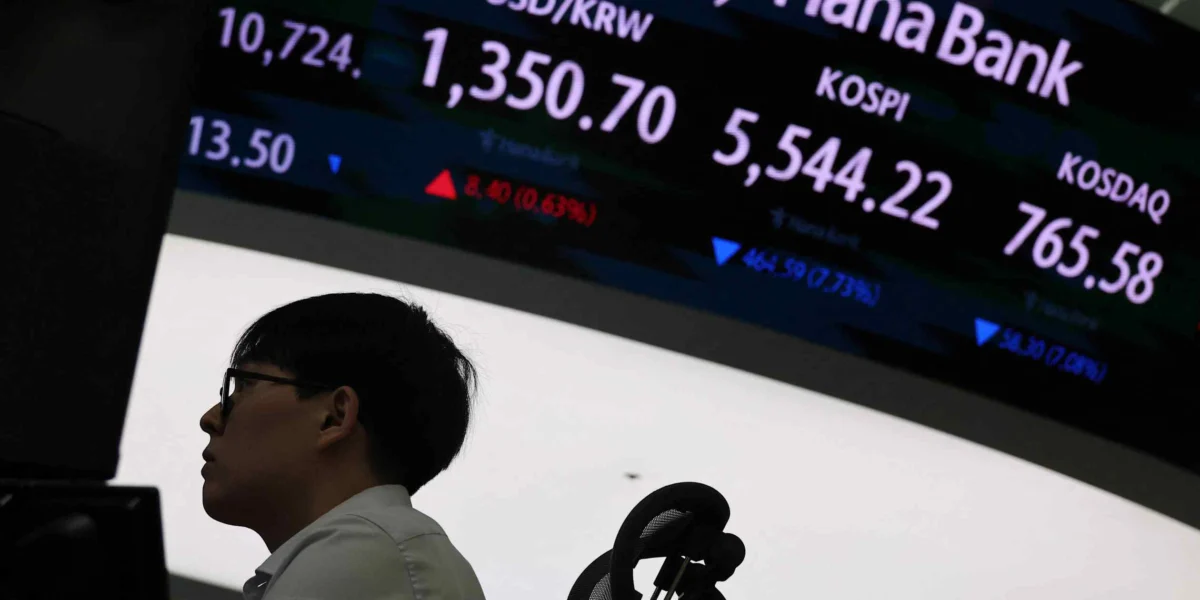
Asian stock markets, heavily influenced by the artificial intelligence (AI) surge, experienced a significant downturn on Friday, mirroring a sharp tech sell-off on Wall Street. Investors reacted with apprehension to the potential implications of a decisive Democratic victory in the U.S. midterm elections, particularly concerning anticipated delays in data center construction. The ripple effect was felt across major indices, with South Korea’s KOSPI leading the decline, triggering circuit breakers in early trading.
Market Meltdown: KOSPI Triggers Circuit Breakers Amidst Broader Asian Sell-off
The Korea Exchange was forced to implement a circuit breaker during morning trading on November 6, 2026, as the KOSPI index plunged by a staggering 8.7% at one point. This drastic measure was enacted to temper the rapid selling pressure and provide a cooling-off period for the market. The sharp decline underscores the heightened sensitivity of AI-linked equities to geopolitical and economic shifts. The sell-off was not isolated to Seoul; other major Asian bourses also registered substantial losses, reflecting a broad investor retreat from technology stocks.
The Nikkei 225 in Japan saw a significant dip, closing down by over 3.5% for the day. The Shanghai Composite Index in China also faced headwinds, shedding approximately 2.8%. Hong Kong’s Hang Seng Index followed suit, declining by 3.1%. This widespread market correction signals a potential recalibration of investor sentiment, moving away from the unchecked optimism that had fueled the AI boom for much of the preceding period.
Roots of the Sell-off: U.S. Midterms and Data Center Anxiety
The immediate catalyst for the Asian market downturn appears to be the overnight tech sell-off on Wall Street, which was itself reacting to the U.S. midterm election results. A comprehensive Democratic victory, as reported, has raised concerns about potential policy shifts that could impact the technology sector, particularly the development and expansion of critical infrastructure like data centers.
Data centers are the backbone of the AI revolution, housing the immense computational power required for training and deploying advanced AI models. Any perceived or actual delays in their construction, expansion, or operational capacity could directly impede the progress and profitability of AI-focused companies. Investors are keenly watching for any signals that the new legislative landscape might introduce regulatory hurdles, increased costs, or a less favorable environment for the rapid build-out of these facilities.
While specific policy proposals from the Democratic party that would directly target data center construction were not immediately detailed, market participants are likely anticipating potential shifts in areas such as environmental regulations, energy policy, or even international trade agreements that could indirectly affect the supply chains and operational costs associated with data centers. The sheer scale of investment required for these facilities, coupled with the pace at which AI technology is evolving, makes any perceived disruption a significant concern.
A Timeline of Market Volatility
The events of November 6, 2026, unfolded rapidly:
- Overnight (U.S. Time): Major U.S. stock indices, particularly those with heavy tech sector weighting, experienced a significant sell-off. Reports emerged of a decisive Democratic victory in the U.S. midterm elections.
- Early Morning (Asian Trading Hours, November 6): Asian markets opened on a weak note, mirroring the overnight U.S. trend.
- Mid-Morning (Seoul Time): The Korea Exchange implemented a circuit breaker as the KOSPI index experienced an 8.7% decline. Similar sharp drops were observed across other Asian indices.
- Throughout the Day: Trading remained volatile as investors digested the election results and their potential implications for the tech sector and AI development.
- Late Afternoon (Asian Trading Hours): While some indices showed slight recoveries from their intraday lows, the overall sentiment remained cautious, with significant losses recorded across the board.
This rapid succession of events highlights the interconnectedness of global financial markets and the speed at which investor sentiment can shift in response to major news.
Supporting Data: A Snapshot of the AI Boom and its Vulnerabilities
The AI boom of recent years has been characterized by unprecedented investment and growth in companies involved in AI research, development, and application. Key areas that have benefited include:
- Semiconductor Manufacturing: Companies producing advanced chips essential for AI processing have seen soaring demand and valuations. The global semiconductor market was projected to reach over $700 billion by 2026, with AI applications being a significant growth driver.
- Cloud Computing and Data Storage: The exponential growth of data generated by AI necessitates massive investments in cloud infrastructure and data storage solutions. Global spending on cloud infrastructure services was anticipated to exceed $300 billion in 2026.
- AI Software and Services: Companies developing AI algorithms, machine learning platforms, and AI-powered applications have experienced rapid adoption and revenue growth. The AI software market alone was projected to be worth hundreds of billions of dollars within the next few years.
However, this growth is intrinsically linked to the availability of computing power and the infrastructure that supports it. Data centers, in particular, represent a massive capital expenditure, often requiring billions of dollars to build and operate. Factors influencing their development include:
- Energy Availability and Cost: Data centers are highly energy-intensive. Policy changes related to energy sources, pricing, or environmental impact could significantly affect operational costs and expansion plans.
- Regulatory Landscape: Zoning laws, environmental impact assessments, and permitting processes can all influence the speed and feasibility of data center construction.
- Supply Chain Stability: The construction of data centers relies on a global supply chain for specialized equipment, materials, and skilled labor. Geopolitical tensions or trade disputes can disrupt these chains.
The current market reaction suggests that investors are reassessing the stability of these foundational elements supporting the AI boom, particularly in light of potential policy shifts stemming from the U.S. election.
Official Responses and Analyst Perspectives
As of Friday afternoon, official statements from major Asian stock exchanges were limited, primarily confirming the activation of circuit breakers and emphasizing their role in market stabilization. However, analysts and market observers were quick to weigh in.
"The market’s reaction is a clear indication of the sensitivity surrounding the infrastructure underpinning the AI revolution," commented a senior strategist at a Tokyo-based investment bank. "Any perceived threat to the rapid expansion of data center capacity, whether through policy or regulatory changes, can trigger a significant reassessment of valuations."
Another analyst, specializing in technology supply chains, noted, "While the direct impact of U.S. election results on specific Asian companies might not be immediate, the fear of potential disruptions to the global flow of capital and resources necessary for large-scale infrastructure projects is a powerful market mover. Investors are looking for certainty, and the current environment has introduced a degree of uncertainty."
Economists are also observing the broader implications. "If the development of AI infrastructure slows, it could have a cascading effect on economic growth projections that have increasingly factored in the productivity gains from AI," stated a researcher at a Seoul-based economic think tank. "This sell-off might be an early indicator of a more cautious approach to investing in the AI narrative until clarity emerges on policy directions."
Broader Impact and Implications: Beyond the Immediate Sell-off
The ramifications of Friday’s market movements extend beyond the immediate trading day.
Re-evaluation of AI Investment Strategies:
Investors may shift their focus from hyper-growth AI companies to those with more established revenue streams or those less reliant on rapid infrastructure expansion. Companies involved in AI-powered software that can run efficiently on existing infrastructure, or those providing essential, non-discretionary AI services, might see increased investor interest.
Impact on Semiconductor and Hardware Sectors:
The semiconductor industry, a direct beneficiary of AI demand, could face headwinds if the pace of AI development slows due to infrastructure constraints. Companies producing high-end AI chips might see a moderation in demand growth. Similarly, hardware manufacturers involved in data center construction and equipment could experience a slowdown in order books.
Geopolitical and Economic Interdependencies:
The event highlights the deep interdependencies between global politics, technological advancement, and financial markets. Policy decisions made in one major economy can have far-reaching consequences for industries and markets worldwide. This underscores the need for businesses and investors to closely monitor geopolitical developments.
Long-Term AI Trajectory:
While the current sell-off reflects short-to-medium term anxieties, the long-term trajectory of AI development is likely to continue. The underlying demand for AI-driven solutions remains strong across various sectors, from healthcare and finance to manufacturing and transportation. However, the pace of this adoption and the magnitude of its economic impact may be subject to the evolving landscape of infrastructure development and regulatory frameworks.
Data Center Investment Landscape:
The concerns raised by this market event could lead to a more strategic and perhaps slower approach to data center investment. Companies might prioritize optimizing existing facilities, exploring more energy-efficient solutions, or diversifying their geographical footprint to mitigate risks associated with localized policy changes.
In conclusion, the sharp downturn in Asian markets on November 6, 2026, serves as a potent reminder of the complex interplay between technological innovation, global politics, and market sentiment. The AI boom, while transformative, is intrinsically linked to the availability and development of critical infrastructure. Any perceived disruption to this foundation, amplified by geopolitical events like the U.S. midterm elections, can trigger significant market corrections and necessitate a recalibration of investment strategies. The coming weeks and months will be crucial in determining the extent to which these concerns translate into sustained shifts in market behavior and the future pace of AI development.
