

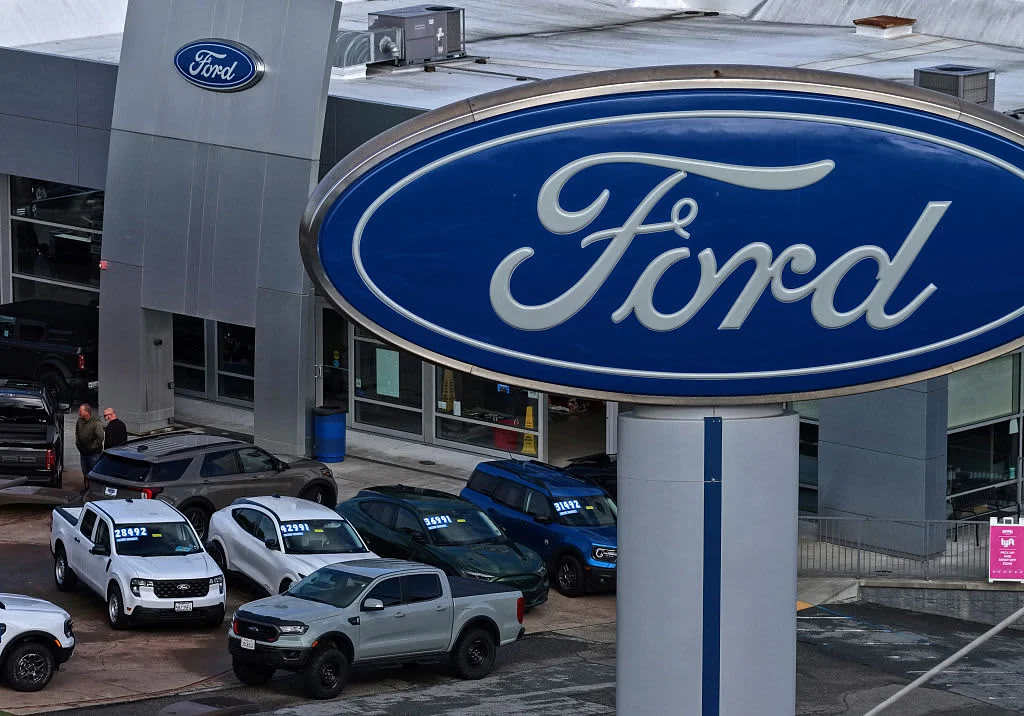
DETROIT — Ford Motor Company managed to hold onto its critical third-place position in the intensely competitive U.S. automotive market during the third quarter of 2026, fending off a robust challenge from the surging Hyundai-Kia Group by an exceptionally slim margin. The Detroit-based automaker reported a total of 507,395 light-duty vehicle sales for the quarter, a 6.6% decline compared to the same period last year. This figure, which notably excludes its robust heavy-duty truck segment, placed Ford just 1,195 units ahead of the South Korean conglomerate, which comprises the Hyundai, Kia, and Genesis brands, collectively reporting 506,200 vehicle sales—a 5.4% year-over-year increase.
The near-overtake by Hyundai-Kia marks a significant moment in the U.S. automotive landscape, as industry analysts had widely predicted a changing of the guard. Cox Automotive, a leading authority on automotive market intelligence, had specifically forecast last week that the Hyundai-Kia Group would surpass Ford in quarterly sales for the first time in history. Both automakers, however, ultimately outperformed these cautious expectations, highlighting the volatile and unpredictable nature of the current market.
A Quarter Defined by Resilience and Competitive Pressure
The third quarter of 2026 presented a mixed bag of challenges and small victories for Ford. While the overall sales decline of 6.6% might appear concerning on its surface, the context reveals a story of an automaker grappling with significant internal and external pressures. A major factor impacting Ford’s performance has been persistent production disruptions affecting its crucial F-Series pickup trucks. These issues stemmed from two distinct supplier fires that occurred in late 2025, severely curtailing the availability of key components and subsequently hampering assembly lines for Ford’s most profitable and high-volume vehicles, particularly the iconic F-150. The ripple effects of these incidents continued to be felt well into 2026, creating inventory shortages at dealerships and impacting sales comparisons.
Despite these significant headwinds, Ford’s F-Series sales, when excluding the now-discontinued F-150 Lightning electric pickup, showed remarkable resilience, declining by only 1.9% during the third quarter. This suggests that demand for the conventional F-Series remains robust, and any sales decline was largely a function of supply constraints rather than diminishing consumer interest. Rob Kaffl, Ford’s head of U.S. sales, addressed the situation during a media call on Friday, expressing optimism for the company’s trajectory. "Some of the headwinds we had early in the year are kind of behind us, and it’s really setting us up for a really strong Q4 as we move in," Kaffl stated, indicating that production levels for the F-Series, including the F-150, were steadily improving and inventory pipelines were beginning to normalize. This recovery is critical for Ford, as the F-Series typically accounts for a substantial portion of the company’s U.S. revenue and profit.
Hyundai-Kia’s Ascendance: A Strategic Masterclass
Conversely, the Hyundai-Kia Group’s impressive 5.4% growth in Q3 is a testament to its aggressive market strategy and product portfolio tailored to current consumer demands. The South Korean automakers have been making substantial inroads into the U.S. market throughout 2026, driven by several key factors. Their product lineup, particularly in the highly sought-after SUV and crossover segments, has resonated strongly with American buyers. Models like the Hyundai Tucson, Santa Fe, Kia Sportage, and Telluride, along with luxury offerings from Genesis, have consistently outperformed expectations.
A crucial element of Hyundai-Kia’s success has been its proactive approach to hybridization. While Ford and other domestic automakers have been perceived as lagging in offering a broad range of hybrid options, Hyundai and Kia have aggressively expanded their hybrid and plug-in hybrid electric vehicle (PHEV) offerings across multiple segments. As consumer demand for fully electric vehicles has plateaued or even softened in some areas due to charging infrastructure concerns, range anxiety, and higher upfront costs, hybrids have emerged as a highly attractive alternative, bridging the gap between traditional internal combustion engines (ICE) and full EVs. This strategic foresight has allowed Hyundai-Kia to capture a significant portion of the market looking for fuel-efficient, lower-emission alternatives without the full commitment to electrification.
Furthermore, the Hyundai-Kia Group has invested heavily in its U.S. manufacturing footprint, including a significant new EV and battery manufacturing plant in Georgia, signaling a long-term commitment to the American market and potentially qualifying for federal incentives. This commitment, coupled with competitive pricing, attractive styling, and a reputation for strong warranties, has collectively propelled the group’s sales performance.
Broader Market Dynamics and the Race for Top Spot
While the Ford-Hyundai battle for third place garnered significant attention, the overall U.S. automotive market in 2026 has been characterized by intense competition among the top players. General Motors (GM) continues to hold the coveted position of the U.S. sales leader for the year through the third quarter. However, Japanese rival Toyota Motor has been aggressively closing the gap, making notable gains against GM. Toyota, like Hyundai-Kia, has benefited from a strong portfolio of hybrids and highly reliable vehicles, leveraging its decades of experience in hybrid technology. The competitive pressure from Toyota indicates that GM cannot rest on its laurels, even as it maintains its leading position.
For the year-to-date through the third quarter, Ford retains a more comfortable, though still significant, lead of approximately 89,700 units over the Hyundai-Kia Group. This broader perspective highlights that while Hyundai-Kia is rapidly gaining ground, Ford’s cumulative sales base throughout the year has provided a buffer. The intense competition is a clear indicator of a market still recovering from supply chain shocks, adapting to evolving consumer preferences, and navigating a complex transition towards electrification.
Ford’s Strategic Adjustments and EV Challenges
Beyond the F-Series production issues, Ford’s year-over-year sales comparisons have also been complicated by strategic portfolio adjustments. The discontinuation of several passenger car models, such as the Ford Escape, in favor of a focus on higher-margin trucks, SUVs, and commercial vehicles, has naturally led to a reduction in overall unit sales compared to previous periods. While this move aligns with Ford’s long-term strategy to streamline its offerings and concentrate on profitable segments, it inevitably creates tougher year-over-year comparisons for total volume.
A more significant challenge for Ford, and indeed many legacy automakers, lies in the electric vehicle (EV) segment. Ford reported a staggering 67.5% decline in year-over-year EV sales through September, including an approximate 80% decline during the third quarter alone. This dramatic drop is partially attributable to difficult comparisons from the previous year. In Q3 2025, Ford had experienced record EV sales as consumer demand spiked significantly ahead of the anticipated end of certain federal incentives, specifically the up to $7,500 tax credit, under the Trump administration. The expiration or modification of these incentives profoundly impacted the purchasing calculus for many consumers, leading to a pull-forward of demand in late 2025 and subsequently softer sales in 2026.
The broader EV market has also shown signs of cooling, with some early adopters having already purchased vehicles, and the mainstream market exhibiting more caution regarding charging infrastructure, range, and upfront costs. Ford, like other manufacturers, is recalibrating its EV strategy, slowing down some production ramps and re-evaluating investment timelines in response to this evolving market reality. The F-150 Lightning, once a symbol of Ford’s EV ambition, saw a 97.1% decline in sales during Q3, largely due to its discontinuation and the impending introduction of updated models. The challenge for Ford will be to find a balance between its ambitious electrification goals and the current realities of consumer demand, possibly by leaning more heavily into hybrid technologies in the interim.
Official Responses and Forward Outlook
Ford’s U.S. sales head, Rob Kaffl, projected confidence for the upcoming fourth quarter, anticipating a strong finish to the year as production stabilizes and inventory levels improve. The company’s ability to navigate the F-Series production hurdles and maintain its third-place standing, even if by a whisker, can be seen as a testament to its operational resilience. However, Ford’s downplaying of Hyundai’s proximity in sales, citing Kia and Hyundai operating as distinct brands in the U.S. despite a shared corporate parent, highlights the defensive posture and intense rivalry. While technically true that Kia and Hyundai are separate sales organizations and brand identities, their combined strength under a single corporate umbrella is a critical competitive factor in the broader market share battle.
The fourth quarter of 2026 is poised to be a pivotal period. For Ford, it will be about consolidating its gains, demonstrating the full recovery of F-Series production, and providing a clearer roadmap for its EV strategy. For the Hyundai-Kia Group, the momentum suggests continued aggressive expansion, particularly as it capitalizes on the robust demand for hybrids and a compelling product lineup. The ongoing dance between these automotive giants, alongside the sustained efforts of market leaders GM and Toyota, promises a dynamic end to the year and sets the stage for even more intense competition in 2027. The U.S. automotive market remains a battleground where innovation, strategic foresight, and operational efficiency are paramount for maintaining, or seizing, a leading position.
