

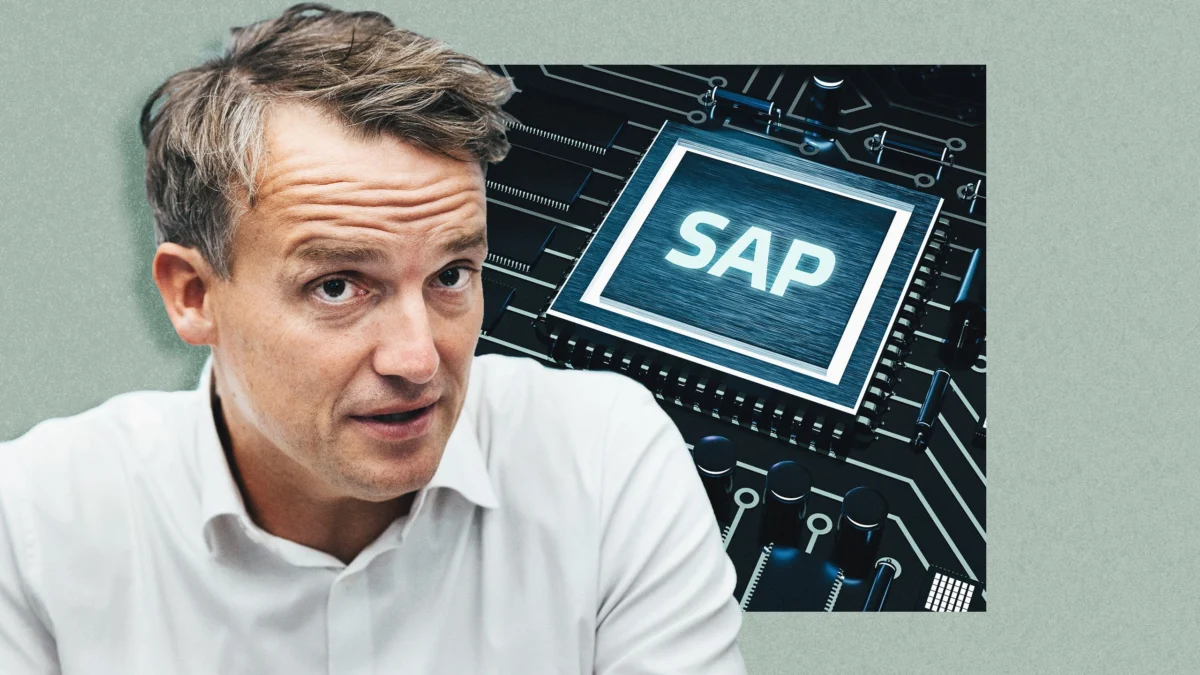
San Francisco, Palo Alto, Düsseldorf – In the heart of San Francisco’s vibrant South of Market district, within the contemporary setting of the Terra Gallery, Philipp Herzig, SAP’s Chief Technology Officer, recounted a pivotal moment from his past. Approximately three years prior, during a supervisory board meeting, a proposal emerged to develop a proprietary, large-scale artificial intelligence (AI) language model, akin to those being rapidly developed by industry titans like OpenAI, Anthropic, and Google. Herzig, then heading SAP’s AI initiatives, vociferously opposed this endeavor, deeming it "the dumbest idea on the planet." His strong dissent, he revealed on stage, nearly cost him his position.
This anecdote serves as a powerful prelude to SAP’s current strategic reorientation in the rapidly evolving landscape of artificial intelligence. The software giant, once Germany’s most valuable company, is now executing a deliberate and ambitious pivot, focusing its substantial resources not on replicating general-purpose AI models, which Herzig dismissively labels "mass-produced goods," but on leveraging AI to enhance its core business. This strategic shift signifies a departure from the initial impulse to directly compete with AI pioneers and a renewed emphasis on areas where SAP can maintain a competitive edge, even with a more measured financial outlay.
The AI Awakening: SAP’s Response to a Disruptive Wave
The global surge in AI capabilities, particularly with the widespread adoption of large language models (LLMs) from late 2023 onwards, presented a significant challenge to SAP’s established business model. The rapid proliferation of these technologies threatened to disrupt traditional enterprise software paradigms, prompting a period of introspection and strategic recalibration within the company. For a considerable time, SAP grappled with its response to this AI boom, facing mounting pressure from customers and consulting partners who grew increasingly impatient with the pace of its AI integration and the perceived delay in delivering on its promises, such as the rollout of its own digital assistant.
The development of a proprietary LLM was initially considered by some within SAP as a necessary step to remain at the forefront of technological innovation. However, the sheer scale of investment, the intense competition, and the rapid pace of advancements in the field led to a strategic reassessment. Herzig’s candid admission underscores the internal debate and the eventual consensus that SAP’s unique strengths lie elsewhere.
A New Era of AI Integration: Prioritizing Business Process Optimization
Instead of pouring vast sums into developing foundational LLMs, SAP is now directing its financial and technical capital towards the nuanced adaptation of existing AI models to specific business processes. This approach, termed "mass customization" in the context of AI, allows SAP to harness the power of AI in a way that directly addresses the complex needs of its enterprise clients. The company is focusing on developing "tabular models," specialized AI systems designed for the rapid and cost-effective processing of business data, a domain where SAP possesses deep expertise and a significant competitive advantage.
This strategic redirection was further solidified with SAP’s acquisition of Prior Labs, a Freiburg-based laboratory specializing in AI solutions. This acquisition, completed in the summer, has provided SAP with cutting-edge technology and talent to accelerate its efforts in developing and deploying specialized AI applications. Herzig’s presentation at the Terra Gallery was instrumental in showcasing the capabilities of the latest models emerging from this integration, signaling a new phase of innovation for the enterprise software giant.
Christian Klein’s Vision: The "All-In on AI" Strategy
Under the leadership of SAP CEO Christian Klein, the company has embarked on a comprehensive strategy to fully embrace the AI revolution. This "All-In on AI" approach is designed to restore SAP’s position at the vanguard of enterprise technology, ensuring its offerings meet the high expectations associated with its premium pricing. The strategy is multi-faceted, encompassing the integration of Prior Labs’ advanced tabular models, the re-establishment of a more agile, "founder-generation" inspired task force, and the relaunch of its AI-powered assistant, Joule.

Joule, reimagined and enhanced, aims to provide a seamless and intuitive user experience for SAP customers, streamlining workflows and enhancing productivity. The company is also investing in novel workshop formats to equip its workforce with the skills and knowledge necessary to navigate and leverage the AI-driven future of business. This focus on internal capability development is crucial for ensuring the successful adoption and integration of AI across SAP’s vast customer base.
Supporting Data and Market Context
The enterprise AI market is experiencing exponential growth. According to recent market research reports, the global AI in the enterprise market size is projected to reach hundreds of billions of dollars in the coming years, driven by the increasing adoption of AI-powered solutions across various industries. Companies are seeking AI applications that can automate tasks, improve decision-making, personalize customer experiences, and optimize operational efficiency.
SAP’s strategic shift aligns with this market trend. By focusing on specialized AI solutions for business processes, SAP is positioning itself to capture a significant share of this expanding market. The company’s existing customer base, comprising thousands of businesses worldwide, provides a ready platform for the deployment of its new AI offerings. Furthermore, the increasing demand for AI solutions that can handle sensitive enterprise data securely and efficiently further bolsters SAP’s focus on tabular models and process-specific AI.
Customer and Partner Perspectives: Navigating the AI Transition
The transition to an AI-centric business model is not without its complexities, and SAP has engaged in extensive research, including interviews with top executives in California and consultations with critical customers, to gauge market sentiment and address concerns. While the initial rollout of AI initiatives may have faced scrutiny, the current strategic direction appears to be gaining traction.
Industry analysts suggest that SAP’s emphasis on practical AI applications, tailored to specific business needs, is a sound strategy. "Instead of trying to build the next ChatGPT from scratch, SAP is wisely leveraging its deep understanding of enterprise workflows," commented a leading technology analyst. "Their focus on tabular models for data processing and the integration of Prior Labs’ expertise is a pragmatic approach that can deliver tangible value to their customers quickly."
However, some customers continue to express a desire for more robust AI capabilities integrated across SAP’s entire product suite. The challenge for SAP will be to demonstrate the immediate benefits of its AI investments and to continuously innovate to stay ahead of the rapidly evolving AI landscape. The success of Joule, in particular, will be a key indicator of SAP’s ability to deliver a compelling AI-powered user experience.
A Timeline of SAP’s AI Evolution
- Early 2020s: Emergence of powerful generative AI models (e.g., GPT-3) sparks industry-wide interest and internal discussions at SAP regarding AI strategy.
- Mid-2021: A pivotal supervisory board meeting discusses the idea of developing a proprietary large-scale AI language model, met with strong opposition from CTO Philipp Herzig.
- 2023: The widespread adoption of LLMs intensifies pressure on enterprise software providers. SAP faces increasing customer impatience regarding its AI progress.
- Summer 2023: SAP acquires Prior Labs, a Freiburg-based AI laboratory, signaling a shift in its AI acquisition strategy.
- Late 2023 – Early 2024: SAP CEO Christian Klein launches the "All-In on AI" strategy, emphasizing practical applications and specialized models.
- Present: SAP actively promotes its new AI initiatives, including Prior Labs’ tabular models and the revamped AI assistant Joule, through events and executive engagements in key tech hubs like San Francisco.
Implications and Future Outlook
SAP’s strategic pivot towards specialized AI solutions for business processes has significant implications for the company and its customers. By focusing on its core strengths, SAP aims to differentiate itself in a crowded AI market and deliver tangible business value. The success of this strategy hinges on several factors:
- Effective Integration of Prior Labs: The seamless integration of Prior Labs’ technology and talent into SAP’s existing product development framework will be critical.
- Performance of Joule: The revamped AI assistant, Joule, needs to demonstrate significant improvements in user experience and functionality to meet customer expectations.
- Customer Adoption: SAP must effectively communicate the value proposition of its AI solutions to its vast customer base and facilitate smooth adoption processes.
- Continued Innovation: The AI landscape is dynamic. SAP must maintain a robust research and development pipeline to adapt to emerging trends and maintain its competitive edge.
The move by SAP to "go all-in" on AI represents a calculated risk and a significant bet on the future of enterprise technology. While the path ahead involves navigating a complex and rapidly evolving technological frontier, the company’s renewed focus on leveraging AI to optimize business processes positions it strategically to meet the demands of the digital age and redefine the future of enterprise software. The coming months and years will be crucial in determining the ultimate success of SAP’s ambitious AI transformation.
