

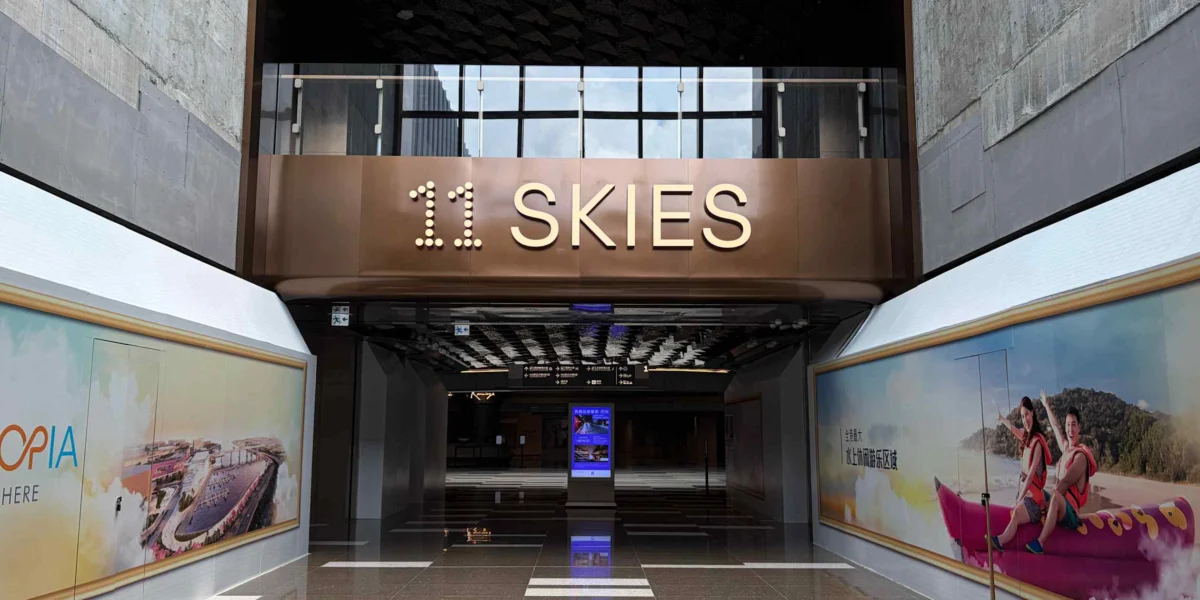
Hong Kong developer New World Development has announced a significant strategic pivot, agreeing to withdraw from the ambitious 11 Skies shopping mall and office complex project near Hong Kong International Airport. While the decision represents a substantial financial write-down for the company, it also signals a deliberate move to shed a considerable financial burden and reallocate resources towards more promising ventures. The news has resonated with investors, leading to a reversal of early gains in New World Development’s shares on Friday, as the market begins to digest the implications of this considerable real estate manoeuvre.
The 11 Skies Project: A Grand Vision and Its Unraveling
The 11 Skies development, envisioned as a colossal retail, dining, and entertainment hub, was designed to capitalize on the burgeoning tourism and transit traffic flowing through Hong Kong’s international gateway. Boasting an impressive 5.3 million square feet of retail space and a further 1.3 million square feet of office space, it was set to be one of the largest single-phase retail developments in the region. The project aimed to transform the area around the airport into a destination in its own right, attracting both local residents and international travellers with its extensive offerings.
However, the path to realizing this grand vision has been fraught with challenges. The initial agreement for New World Development to lead the development of the retail component was struck with Airport Authority Hong Kong (AAHK) in a period of optimistic economic forecasts. The project was lauded for its potential to enhance Hong Kong’s status as a global retail and transit hub. Construction began with considerable fanfare, and the sheer scale of the undertaking underscored the developer’s ambition and the airport authority’s commitment to maximizing the airport’s commercial potential beyond aviation.
The Financial Reckoning: A Costly Withdrawal
The decision to pull out of the 11 Skies project comes with a significant financial cost. While the exact figures of the settlement with AAHK have not been fully disclosed, industry analysts widely anticipate a substantial write-down for New World Development. This likely includes sunk costs in planning, design, initial construction, and potential penalties or compensation agreed upon in the termination of the contract. Sources close to the deal suggest that the financial impact could run into hundreds of millions of Hong Kong dollars, a not insignificant sum even for a developer of New World’s stature.
The financial hit stems from the early stages of the project where considerable capital expenditure would have already been incurred. Furthermore, the cancellation of future revenue streams from the mall and office spaces represents a missed opportunity. However, the rationale behind the withdrawal is rooted in a pragmatic assessment of evolving market conditions and the escalating costs associated with completing such a monumental project.
Shifting Market Dynamics and Strategic Reassessment
The decision to exit 11 Skies is widely seen as a response to a confluence of factors impacting Hong Kong’s property market and broader economic outlook. The COVID-19 pandemic, with its prolonged travel restrictions and disruptions to international tourism, significantly altered the projected footfall and consumer spending patterns that were central to the 11 Skies business case. While travel has resumed, the recovery has been slower and more complex than initially anticipated, leading to a reassessment of long-term demand for large-scale retail and entertainment complexes reliant on international visitors.
Furthermore, the rising cost of construction materials and labour, coupled with potential inflationary pressures, likely contributed to an upward revision of the project’s overall budget. For New World Development, the increasing financial exposure and the uncertain timeline for achieving a profitable return on investment may have outweighed the potential rewards. The company’s leadership has, in recent times, emphasized a more prudent approach to large-scale developments and a focus on optimizing their existing asset portfolio.
A Timeline of the 11 Skies Journey
- Pre-Pandemic Planning and Agreement: New World Development secures the contract to develop the retail component of the 11 Skies project, with initial plans and designs being drawn up. This period is characterized by optimism regarding Hong Kong’s tourism and retail sectors.
- Construction Commences: Ground is broken, and initial construction phases begin, signifying a tangible step towards realizing the ambitious vision for the airport-centric commercial hub.
- Pandemic Disruptions: The global outbreak of COVID-19 brings about unprecedented challenges, including border closures, travel restrictions, and a significant downturn in tourism. This directly impacts the projected viability of a project heavily reliant on international footfall.
- Strategic Reassessment: As the pandemic subsides and the economic landscape shifts, New World Development, along with Airport Authority Hong Kong, begins to re-evaluate the feasibility and financial projections of the 11 Skies project. Discussions regarding potential adjustments or an exit strategy emerge.
- Agreement to Withdraw: New World Development officially announces its agreement with Airport Authority Hong Kong to pull out of the 11 Skies development. The terms of the withdrawal, including financial settlements, are finalized.
- Market Reaction: Shares of New World Development experience volatility as investors digest the news and its financial implications.
Official Statements and Market Interpretations
While a formal statement from New World Development highlighted the agreement with AAHK as a mutual decision to “optimize the development strategy,” the underlying financial implications are undeniable. The company’s press release likely emphasized the "removal of a significant financial burden" and the "opportunity to redirect capital to more promising ventures." This phrasing suggests a proactive, albeit costly, decision to cut losses and pursue a more agile business model.
Airport Authority Hong Kong, as the landowner and partner, would likely have framed the decision as a recalibration of their commercial development plans, potentially exploring alternative development models or partners for the site. Their statements would likely focus on their commitment to enhancing the airport’s commercial ecosystem and ensuring its long-term success, even if the original blueprint for 11 Skies undergoes significant alteration.
Broader Implications for Hong Kong’s Property Sector
The withdrawal of a major developer from such a high-profile project sends ripples through Hong Kong’s already dynamic property market. It underscores the increasing caution among developers in committing to mega-projects, especially those with a strong reliance on international tourism and retail spending. This could lead to a broader trend of more phased developments, a greater emphasis on domestic demand, and a more conservative approach to large-scale retail ventures.
For New World Development, this move signals a strategic re-evaluation of its growth trajectory. The capital freed up from the 11 Skies project can now be deployed into areas with potentially quicker returns or lower risk profiles. This might include focusing on its existing portfolio of residential and commercial properties, exploring niche market opportunities, or investing in sectors beyond traditional real estate. The company’s stock performance will be closely watched as it navigates this strategic shift.
The 11 Skies saga serves as a stark reminder of the volatility inherent in large-scale property development and the need for developers to remain adaptable in the face of evolving economic conditions and consumer behaviour. While the financial cost of withdrawal is significant, the strategic benefit of shedding a potentially underperforming asset and refocusing resources could prove to be a more valuable long-term outcome for New World Development. The future of the 11 Skies site itself remains to be seen, with AAHK likely to explore revised development plans that align with the current market realities. This event marks a pivotal moment for New World Development, signaling a move towards greater financial prudence and strategic flexibility in its pursuit of sustainable growth.
