

The complexity of modern talent acquisition often places a disproportionate burden on small business owners and lean human resources teams. In many small-scale enterprises, a single individual is frequently tasked with the entire recruitment lifecycle, from drafting job descriptions and sourcing candidates to conducting interviews and finalizing offers. When these tasks are performed across disparate, disconnected digital platforms, the resulting "context switching" creates significant operational friction. The integration of Zoho Recruit with LinkedIn Recruiter System Connect (RSC) represents a strategic effort to eliminate these inefficiencies by establishing a seamless data bridge between one of the world’s most prominent professional networks and a leading applicant tracking system (ATS).

The Frictional Costs of Disconnected Hiring Systems
For small businesses, the primary challenge in recruitment is often not a lack of talent, but a lack of time. Industry data suggests that recruiters can spend up to several hours a day switching between various software applications to manage candidate data. A typical workflow involves identifying a prospect on LinkedIn, manually checking the internal ATS to see if a record already exists, downloading resumes, and re-entering notes across both platforms. This manual data entry is not merely a nuisance; it is a point of failure. Each extra step increases the likelihood of duplicate profiles, missed communication, and lost context.
In the competitive labor market, where the Society for Human Resource Management (SHRM) estimates the average cost-per-hire is approximately $4,700, small businesses cannot afford the delays caused by administrative bottlenecks. Speed and candidate experience have become the two most critical variables in securing high-quality talent. When a recruitment team moves slowly, top-tier candidates—who often have multiple competing offers—frequently disengage. The Zoho Recruit and LinkedIn RSC integration addresses this by ensuring that job, candidate, application, and communication data remain synchronized in real-time.

The Strategic Role of Zoho Recruit in SMB Ecosystems
Zoho Recruit serves as the foundational operating system for the hiring process, catering to both in-house corporate teams and third-party staffing agencies. For a small employer, the platform provides a centralized database to manage the "hiring journey" from inception to completion. Key features include the ability to publish openings to multiple job boards, manage candidate pipelines through customizable stages, and utilize automation to handle repetitive tasks such as interview scheduling and offer letter generation.
The platform has increasingly integrated artificial intelligence and automation to assist lean teams. Recruiters can use AI to generate or refine job descriptions and compare candidate profiles against specific role requirements to determine "fit scores." By centralizing these activities, Zoho Recruit ensures that the hiring process is not siloed within a single person’s email inbox or memory, but is instead a transparent, repeatable business process.

Enhancing Sourcing with LinkedIn Recruiter System Connect (RSC)
While Zoho Recruit manages the back-end of the hiring process, LinkedIn Recruiter remains the industry standard for front-end sourcing. LinkedIn RSC is the API-driven bridge that allows these two environments to function as a single unit. The primary value of RSC lies in its ability to provide "shared context." When a recruiter searches for talent on LinkedIn, the integration immediately highlights whether that candidate is already in the Zoho Recruit database.
Furthermore, the integration supports a "1-Click Export" feature, allowing recruiters to move a LinkedIn profile directly into their ATS without manual data entry. Communication history, including LinkedIn InMail activity, becomes visible within the Zoho Recruit candidate record. This prevents the common embarrassment of multiple team members reaching out to the same candidate with redundant or conflicting messages. For the hiring manager or business owner, this means they can review a candidate’s status, notes, and interview feedback without ever leaving their primary workspace.

Advanced Capabilities: RSC+ and the LinkedIn Hiring Assistant
Beyond the standard RSC features, the introduction of RSC+ provides an additional layer of sophistication for teams utilizing the LinkedIn Hiring Assistant. The "Connected Projects" feature allows for the linking of ATS job requisitions directly to LinkedIn Recruiter projects. This ensures that applicants from both sources land in a unified pipeline, allowing for standardized screening and evaluation.
This level of integration is particularly beneficial during "burst hiring" phases—periods where a small business may suddenly need to fill several roles simultaneously due to growth or seasonal demand. By standardizing the early screening process, RSC+ helps maintain a consistent quality of hire even when the volume of applications increases rapidly.

Implementation Chronology: A Seven-Step Activation Framework
The transition to an integrated hiring workflow requires a structured setup process. The following chronology outlines the steps necessary to activate and synchronize Zoho Recruit with LinkedIn RSC:
- Administrative Preparation: Before beginning the technical setup, the organization must ensure that the administrator has active credentials for both Zoho Recruit (Recruiter Admin level) and LinkedIn Recruiter. A review of user email addresses is essential to ensure that "seat holder mapping" functions correctly across both systems.
- Accessing the Marketplace: Within the Zoho Recruit interface, the administrator navigates to the Setup menu, selects Marketplace, and chooses LinkedIn. From here, the LinkedIn Recruiter System Connect option is toggled to initiate the workflow.
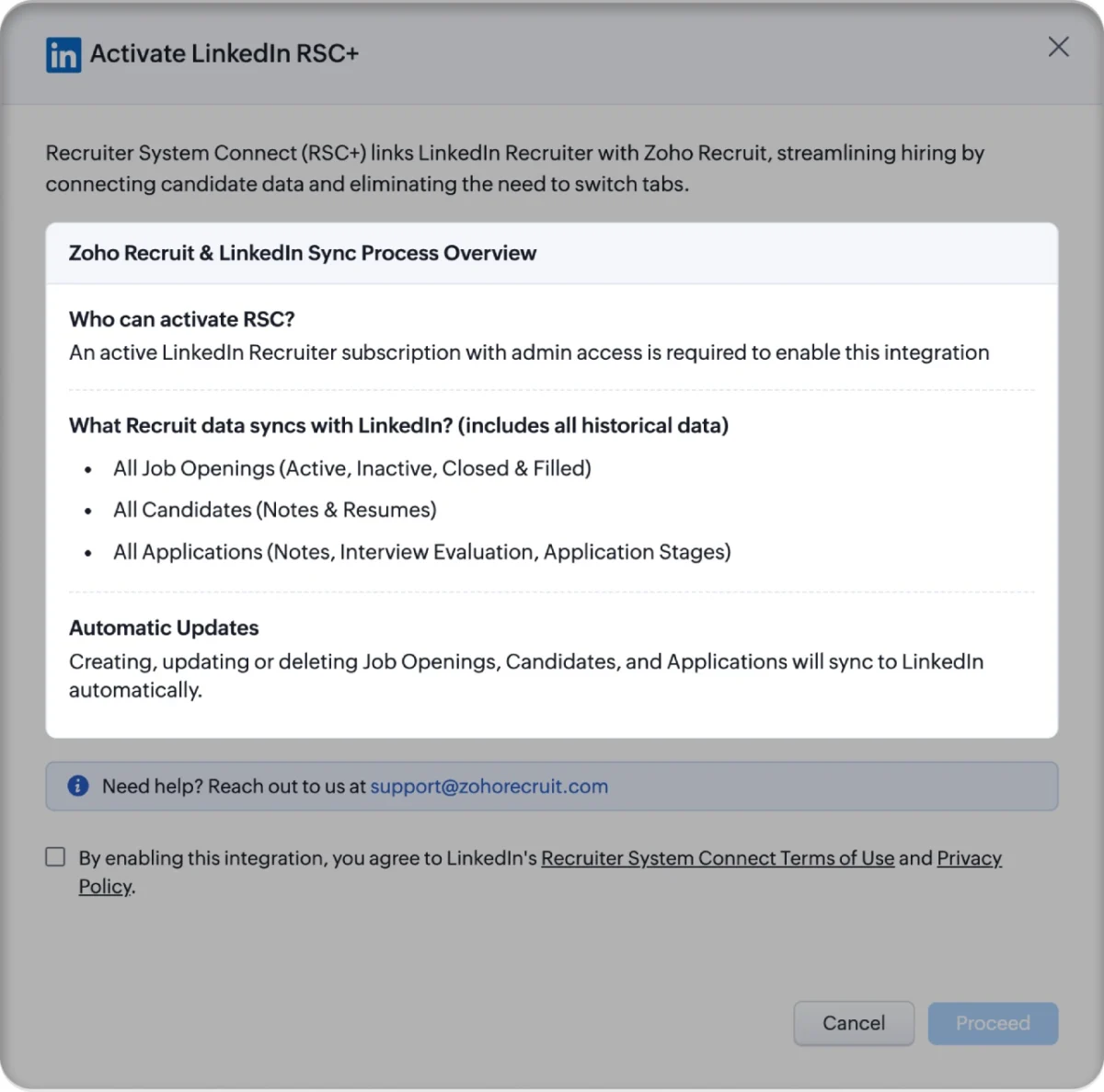
- Terms and Eligibility Review: Zoho Recruit provides an overview of the data synchronization process, including details on synced entities such as jobs, candidates, and notes. The user must accept the LinkedIn terms of service to proceed.
- Credential Authorization: The system prompts the user to sign in with their LinkedIn Recruiter credentials. Once authorized, the user selects the specific integration package corresponding to their LinkedIn contract.
- Feature Configuration: In the integration selection screen, the user enables Recruiter System Connect and any additional reporting packages. This configuration is then saved to establish the initial handshake between the servers.
- LinkedIn Side Configuration: The administrator must then log into LinkedIn Recruiter to confirm that the integration is active at the contract level. This step involves navigating to "Product Settings" and "Integrations" within the LinkedIn profile area to verify that features like "1-Click Export" are enabled.
- Seat Holder Mapping and Initial Sync: Zoho Recruit automatically attempts to match users based on email addresses. Once mapping is verified, the "Begin Sync" command is issued. This process moves historical recruiting data—including jobs, applications, and notes—from Zoho Recruit to LinkedIn.
Data Integrity and Post-Activation Protocols
The completion of the initial sync does not mark the end of the process, but rather the beginning of a more efficient operational phase. It is recommended that teams monitor the "RSC Reports" within Zoho Recruit for the first week following activation. These reports identify any records that failed to sync, allowing the team to resolve data discrepancies before they impact the recruitment process.

Furthermore, small businesses should establish clear internal protocols regarding where specific updates occur. A common best practice is to perform sourcing and initial outreach within LinkedIn Recruiter, while managing interview stages, assessments, and offer negotiations within Zoho Recruit. By defining these boundaries, teams can ensure that the "source of truth" remains consistent across the organization.
Economic and Operational Impact: The Professionalization of SMB Hiring
The broader implications of this integration extend beyond mere convenience. For a small business, professionalizing the recruitment process is a critical step in scaling. An integrated system allows for better data collection, which in turn leads to better decision-making. By analyzing the time-to-hire and the effectiveness of different sourcing channels through integrated reports, business owners can allocate their limited recruiting budgets more effectively.

Moreover, the impact on candidate experience cannot be overstated. In a digital-first world, candidates expect a streamlined application process. A business that uses integrated tools appears more professional, organized, and respectful of the candidate’s time. This perception can be a deciding factor for high-level talent choosing between a disorganized startup and a structured small enterprise.
Future Outlook: AI and the Evolution of Recruitment
As Zoho and LinkedIn continue to iterate on their respective platforms, the integration is expected to incorporate even deeper AI-driven insights. Future updates may include more advanced predictive analytics, suggesting which candidates are most likely to respond based on historical interaction data synced between the platforms.

For the modern small business, the bottom line is clear: recruitment can no longer be treated as a secondary, manual task. By leveraging the integration between Zoho Recruit and LinkedIn RSC, lean teams can achieve a level of operational excellence previously reserved for large enterprises with massive HR departments. This connectivity allows small businesses to spend less time on the mechanics of hiring and more time on the human elements of recruitment—judgment, culture fit, and relationship building. Through this technological synergy, the path to building a high-performing team becomes faster, more accurate, and significantly more manageable.
