

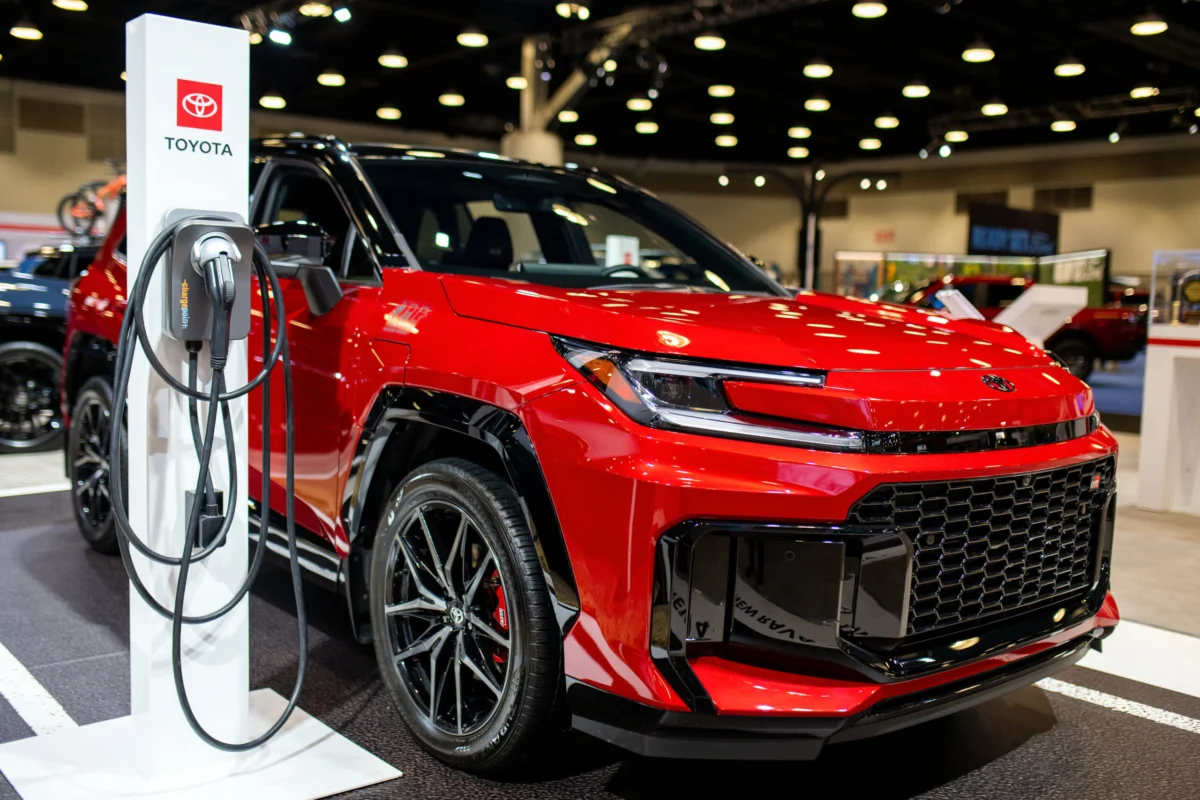
Toyota Motor Corporation is currently navigating a rare paradox for an automotive giant: an overwhelming surge in demand for its redesigned RAV4 models, particularly the new all-hybrid lineup, juxtaposed with severely constrained inventory levels at dealerships across the United States. This imbalance has led to an unprecedented situation where dealerships often have only a few days’ supply, a scenario highly unusual for a mainstream, high-volume vehicle in the compact-to-midsize crossover segment.
The Unprecedented Demand and Dealer Dilemma
The phenomenon of vehicles "flying off the lots" is typically reserved for niche, high-performance, or ultra-luxury models, not practical suburban crossovers. "It is really unusual to see cars fly off the dealers’ lots like this," observed Jessica Caldwell, head of product insight at Edmunds, highlighting the atypical nature of the RAV4’s current market performance. "It is not something that exists in that very practical, very suburban, small-midsize crossover segment."
This supply-demand disparity creates significant challenges for dealerships. Bobby Crabtree, owner of Colonial Toyota in Milford, Connecticut, experiences this firsthand. His expansive lot, capable of accommodating an additional 250 vehicles, currently sits at only about a third of its capacity. While not all vacant spots would typically be filled by new RAV4s, the current scarcity means a noticeable absence of one of Toyota’s most sought-after models. Crabtree articulated the frustration, noting, "This lot can handle another 250 vehicles, so I am probably about a third full of that capacity." The inability to adequately stock the RAV4, a cornerstone of his sales volume, directly impacts potential revenue and customer satisfaction. Dealerships across the nation report similar issues, with waiting lists extending for weeks, if not months, as eager buyers vie for limited allocations.
A Strategic Pivot: The All-Hybrid RAV4
The intense demand for the new RAV4 is intrinsically linked to Toyota’s bold strategic decision to transition the model to an exclusively hybrid powertrain lineup. This move, announced ahead of the 2026 model year rollout, signaled a significant shift for one of the world’s best-selling vehicles. Two critical factors emerged from this announcement: first, the RAV4 crossover utility vehicle (CUV) would henceforth be sold only as a hybrid; and second, initial production would be limited before a gradual ramp-up. This meant that dealerships would not receive their usual allotment of new RAV4s, particularly during the initial launch phase.
This strategic pivot reflects Toyota’s long-standing commitment to hybrid technology, a path it has championed for decades, even as other manufacturers aggressively pursued pure battery electric vehicles (BEVs). The company’s leadership has consistently argued for a "multi-pathway" approach to decarbonization, emphasizing that hybrids, plug-in hybrids (PHEVs), fuel-cell vehicles, and BEVs all have roles to play in different markets and for different consumer needs. The RAV4’s transition to an all-hybrid platform is a testament to this philosophy, leveraging Toyota’s extensive experience and economies of scale in hybrid componentry.
Historical Context and Market Dominance
The Toyota RAV4 has been a consistent powerhouse in the automotive market for years, solidifying its position as a top seller. In 2025, for instance, nearly 480,000 units were sold in the U.S., making it the third best-selling model in the country. This remarkable achievement places it behind only the Ford F-150 and Chevrolet Silverado, two full-size pickup trucks that have historically dominated the American sales charts. The RAV4’s success is not a recent phenomenon; since its introduction in the mid-1990s, it has evolved through multiple generations, consistently setting benchmarks for reliability, practicality, and fuel efficiency within the compact SUV segment. Its consistent high ranking underscores its broad appeal across various demographics, from urban commuters to suburban families.

Toyota’s leadership in hybrid technology also provides a crucial backdrop. The company pioneered mass-market hybrids with the Prius in 1997, and has since sold over 20 million hybrid vehicles globally. This deep well of engineering expertise and manufacturing experience gives Toyota a distinct advantage in producing efficient and reliable hybrid powertrains. The decision to make the RAV4 exclusively hybrid taps directly into this strength, aligning with evolving consumer preferences for fuel-efficient vehicles without the range anxiety or charging infrastructure concerns sometimes associated with pure EVs.
Supply Chain Realities and Production Constraints
The primary reason for the limited availability, despite robust demand, lies in the complexities of automotive production and global supply chains. The transition to an all-hybrid lineup, while strategic, is not without its manufacturing challenges. Hybrid vehicles require specialized components, including nickel-metal hydride or lithium-ion battery packs, electric motors, power control units, and advanced transmission systems, all of which are produced through intricate global supply chains. Scaling up the production of these specific components to meet the demand of a high-volume model like the RAV4 takes time and significant investment.
Industry analysts point to lingering effects of the global semiconductor shortage, which plagued the automotive sector from 2020 to 2023, as a contributing factor. While the most acute phase has passed, ripple effects continue, and the supply of specific chips vital for modern hybrid systems can still be tight. Furthermore, raw material availability for battery components, such as lithium and rare earth elements, and the capacity of battery manufacturing facilities, can also pose bottlenecks. Toyota’s global manufacturing footprint, while vast, must carefully allocate resources to balance production across its diverse portfolio of conventional, hybrid, and electric vehicles. The initial limited production run for the new RAV4 Hybrid was a conscious decision, likely aimed at ensuring quality control and a smooth ramp-up, rather than an underestimation of demand.
Consumer Patience and Brand Loyalty
Despite the extended waiting periods, many consumers exhibit remarkable patience, a testament to Toyota’s strong brand loyalty. Nancy and Ira Berman of Danbury, Connecticut, exemplify this trend. After ordering their RAV4 in March, they anticipated a significant wait. "The wait was a slight annoyance," Nancy Berman admitted, "It didn’t stop us from going and doing this because we do have our other Toyotas to drive." Six months after placing their order, the Bermans are now nearing the delivery of their new RAV4.
This level of consumer patience is not universal but is remarkably prevalent among Toyota buyers. Decades of building a reputation for reliability, durability, and strong resale value have cultivated a fiercely loyal customer base. Many Toyota owners are repeat buyers, often owning multiple vehicles from the brand. This established trust means that even when faced with delays, customers are often willing to wait for a Toyota, rather than defecting to a competitor. This loyalty acts as a buffer against potential lost sales, as customers prioritize getting the specific Toyota model they desire over immediate availability of another brand.
Broader Market Trends: The Rise of Hybrids
The timing of Toyota’s all-hybrid RAV4 strategy aligns perfectly with broader shifts in consumer preferences and market dynamics. Elevated gasoline prices, which have remained persistently high in recent years due to geopolitical events, refinery capacities, and global supply-demand imbalances, have significantly increased the appeal of fuel-efficient vehicles. Consumers are increasingly seeking alternatives to pure internal combustion engine (ICE) vehicles to mitigate fuel costs, but many are not yet ready to commit to pure electric vehicles due to concerns about range, charging infrastructure, and initial purchase price.
Hybrid vehicles occupy a sweet spot in this evolving landscape. They offer significantly better fuel economy than their ICE counterparts, often requiring less frequent refueling, while eliminating range anxiety because they can still be refueled at any gas station. Data from J.D. Power indicates a substantial increase in hybrid adoption. In 2026, over 18% of vehicles sold in the U.S. were hybrids, a notable jump from previous years. While still trailing the 75% market share held by ICE vehicles, this figure far surpasses the approximately 7% share commanded by pure electric vehicles. This trend underscores a growing pragmatism among consumers who value efficiency and environmental benefits but require the convenience and familiarity of traditional fueling. The RAV4 Hybrid, with its established reputation and practical SUV form factor, is perfectly positioned to capture this expanding market segment.

Economic Headwinds and Fuel Costs
Beyond consumer preference, macroeconomic factors are also at play. Inflationary pressures have impacted vehicle pricing across the industry, making efficient vehicles even more attractive. Rising interest rates have increased the cost of financing new vehicles, prompting buyers to seek out models that offer long-term savings through lower fuel consumption. The average price of gasoline, which has fluctuated significantly but generally remained elevated, serves as a constant reminder for consumers about operating costs. For many, the superior miles per gallon (MPG) offered by a hybrid RAV4 translates into tangible monthly savings, making the investment in a potentially higher-priced hybrid model more palatable over the vehicle’s lifespan. This economic rationale further fuels the demand for the RAV4 Hybrid, turning it into a prudent financial decision for many households.
Competitive Landscape and Future Outlook
The success and limited availability of the RAV4 Hybrid have implications for the competitive landscape. Other automakers in the compact SUV segment, such as Honda (CR-V Hybrid), Hyundai (Tucson Hybrid), Kia (Sportage Hybrid), and Ford (Escape Hybrid), are undoubtedly observing Toyota’s situation closely. While these competitors also offer hybrid options, none currently command the sheer volume or market penetration of the RAV4. Toyota’s dominant position in hybrids provides a significant advantage, but if supply constraints persist, it could open doors for rivals to capture some of the demand.
Looking ahead, Toyota is likely working diligently to ramp up RAV4 Hybrid production. The initial "limited at first and then steadily increase" production plan suggests that the company anticipates overcoming these bottlenecks. As production stabilizes and increases, dealers will eventually receive more regular allotments, though the intense demand may still mean quicker turnover compared to other models. Toyota’s long-term strategy appears to be validated by the market’s response, reinforcing its commitment to hybrids as a crucial bridge technology on the path to a carbon-neutral future.
Potential Implications for Sales and Market Share
A critical question arising from the RAV4’s limited supply is whether Toyota could lose sales. So far, the company’s U.S. sales in 2026 were up 0.3% through July, suggesting that the impact of RAV4 scarcity has been somewhat mitigated by other models in its extensive lineup. As Jessica Caldwell noted, "There are other vehicles within the Toyota lineup that consumers can go to." Toyota offers a wide array of SUVs and sedans, many of which also come in hybrid variants, providing alternatives for customers who might not be able to wait for a RAV4. The Highlander Hybrid, Corolla Cross Hybrid, and Camry Hybrid are examples of other popular fuel-efficient options that can absorb some of the spillover demand.
Moreover, Toyota’s robust brand loyalty plays a crucial role. "Toyota has a lot of brand loyalty, people who buy a Toyota usually stay with Toyota for many years not just one vehicle purchase but several," Caldwell added. This deep-seated customer allegiance means that even if a buyer cannot get their desired RAV4 immediately, they are more likely to opt for another Toyota model rather than switch to a different brand altogether. This helps Toyota retain its overall market share, even if individual model sales are temporarily suppressed by supply issues.
However, prolonged scarcity could still have consequences. While loyal customers may wait or choose another Toyota, a segment of the market, particularly first-time Toyota buyers or those with immediate needs, might be compelled to look elsewhere. This could potentially cede ground to competitors who have better stock levels of their own hybrid or efficient SUV offerings. Furthermore, the extended wait times can strain dealer-customer relationships, requiring excellent communication and expectation management from dealerships.
Ultimately, the RAV4’s current situation presents a fascinating study in automotive market dynamics. It underscores the immense power of brand loyalty, the strategic foresight of embracing hybrid technology, and the persistent challenges of global supply chains. Toyota’s "problem" of having too much demand is, in many ways, an enviable one, affirming its market leadership and the enduring appeal of its practical, reliable, and increasingly fuel-efficient vehicles. As the company works to ramp up production, the RAV4 Hybrid is poised to continue its reign as a top-selling vehicle, further solidifying Toyota’s position in a rapidly evolving automotive landscape.
