

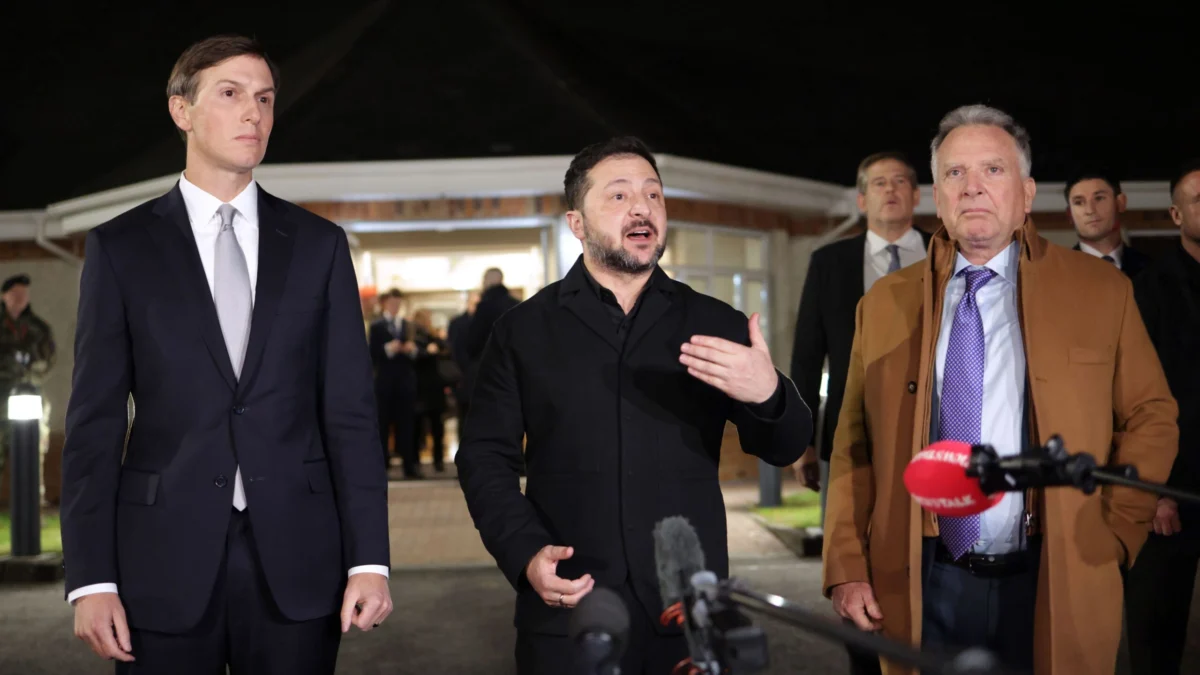
Kyiv, Ukraine – In a potentially significant development in the ongoing conflict and international diplomacy surrounding Ukraine, President Volodymyr Zelenskyy has revealed that US intermediaries have proposed a withdrawal from the Donbas region in exchange for NATO membership for Ukraine. The assertion, made during recent peace talks with Russia in Abu Dhabi, marks the first time, according to Zelenskyy, that the issue of NATO accession has been directly linked to territorial concessions in the context of these negotiations.
The Ukrainian President shared these remarks with journalists, with his office releasing the statements on Saturday. This revelation injects a complex new layer into the already intricate geopolitical landscape, raising questions about the United States’ official stance, the implications for Ukrainian sovereignty, and the broader strategic objectives of key international players.

A Stated US Proposal: Donbas Concessions for NATO Membership
According to President Zelenskyy’s account, the proposal emerged during the latest round of peace discussions involving Russia. He directly quoted the US intermediaries as posing a question that tied Ukraine’s potential NATO membership to its willingness to withdraw forces from the Donbas. "The Americans raised the question: ‘What if Ukraine joins NATO? Would Ukraine withdraw from Donbas?’" Zelenskyy reportedly stated.
This alleged proposal, if accurately reported, represents a dramatic shift in the narrative and potential pathways toward de-escalation. For months, Ukraine has maintained a firm stance against any territorial concessions, viewing them as a betrayal of national sovereignty and a reward for Russian aggression. The Donbas region, partially occupied by Russian-backed separatists since 2014 and a primary theater of conflict since the full-scale invasion in February 2022, is considered by Kyiv to be an integral part of Ukraine.
Ukraine’s Unwavering Stance on Territorial Integrity
President Zelenskyy reaffirmed his government’s unequivocal position that Ukraine will not cede any of its territories. This principle has been a cornerstone of Ukraine’s defense and diplomatic strategy, resonating with international law and the concept of national self-determination. The idea of trading territory for security guarantees, even from a powerful alliance like NATO, runs counter to this deeply held national conviction.
However, Zelenskyy also presented a conditional scenario under which he would be willing to put the question of territorial concessions to a national referendum. This condition is tied to Ukraine receiving a comprehensive security package. This package, as outlined by the President, would need to include robust security guarantees, the right to maintain a strong and well-funded military, and substantial financial aid for reconstruction efforts. The specifics of such a package would undoubtedly be subject to intense negotiation and scrutiny.
Russia’s Long-Standing Opposition to NATO Expansion
The alleged US proposal comes against the backdrop of Russia’s long-standing and vocal opposition to NATO’s eastward expansion. Russian President Vladimir Putin has repeatedly identified Ukraine’s potential NATO membership as a critical "red line" and a primary justification for the full-scale invasion launched in February 2022. Moscow views NATO’s growth as a direct threat to its security interests and sphere of influence.
From Russia’s perspective, any move towards Ukraine’s NATO membership would be seen as an unacceptable escalation, potentially leading to increased military presence and infrastructure close to its borders. This historical context is crucial for understanding the geopolitical sensitivities involved in any discussion about Ukraine’s alliance status.
Background: The Road to the Donbas Conflict and NATO Aspirations
The conflict in Ukraine has its roots in the 2014 Maidan Revolution, which saw the ousting of pro-Russian President Viktor Yanukovych. This was followed by Russia’s annexation of Crimea and the subsequent eruption of armed conflict in the eastern Donbas region, where Russian-backed separatists fought against Ukrainian forces. The Minsk agreements, brokered in 2014 and 2015, aimed to resolve the conflict but ultimately failed to achieve lasting peace, with both sides accusing the other of violations.
Ukraine’s aspirations to join NATO have been a consistent feature of its foreign policy since gaining independence in 1991. The alliance’s "open door" policy has allowed for new members, but the path to accession for Ukraine has been fraught with political and security challenges, particularly due to Russia’s objections. Following the 2022 invasion, Ukraine formally applied for accelerated NATO membership, a move that has been met with cautious responses from some member states concerned about provoking Russia further.
Data and Statistics: The Human and Economic Cost
The war in Ukraine has resulted in a devastating human toll and immense economic damage. According to United Nations estimates, tens of thousands of civilians have been killed or injured since the start of the full-scale invasion. Millions have been displaced, creating a significant refugee crisis across Europe.

Economically, Ukraine’s GDP has experienced a sharp decline. The World Bank has projected significant losses due to the destruction of infrastructure, disruption of supply chains, and the overall impact of ongoing hostilities. The rebuilding effort is expected to require hundreds of billions of dollars in international aid.
The Donbas region itself has been a focal point of the conflict, with significant infrastructure damage and a high concentration of displaced persons. The strategic importance of this region, both for Ukraine’s territorial integrity and for Russia’s geopolitical ambitions, cannot be overstated.
Analyzing the Implications: A Tightrope Walk for Diplomacy
The alleged US proposal, if indeed communicated as described by President Zelenskyy, presents a complex diplomatic tightrope walk.

- For the United States: The US, as a leading NATO member, would be navigating a delicate balance between supporting Ukraine’s security and territorial integrity, while also seeking avenues for de-escalation and avoiding direct confrontation with Russia. The proposal could be interpreted as an attempt to find a pragmatic, albeit controversial, solution that addresses both Russian security concerns and Ukraine’s desire for security guarantees. However, it risks alienating Ukraine if perceived as pressuring Kyiv to compromise on its sovereignty.
- For Ukraine: Kyiv is faced with an agonizing choice. Accepting such a proposal would mean abandoning territory that is considered sacrosanct by many Ukrainians and could be seen as a capitulation. Rejecting it outright might close off a potential pathway to NATO membership, a long-held strategic goal. The conditionality of a referendum on a comprehensive security package suggests Zelenskyy is seeking to ensure that any decision is made with the full backing of the Ukrainian people and with concrete, verifiable security assurances.
- For Russia: While Russia has consistently opposed NATO expansion, the prospect of Ukraine relinquishing claims to the Donbas could be seen as a partial victory. However, any NATO membership for Ukraine, even without the Donbas, might still be viewed with suspicion. The proposal could be part of a broader negotiation strategy to achieve specific Russian objectives.
- For NATO: The alliance itself would be grappling with the implications of admitting a country engaged in an active conflict, especially if that conflict involved territorial disputes. The conditions for membership, including democratic reforms, military readiness, and adherence to alliance values, would be under intense scrutiny.
Official Responses and International Reactions (Inferred)
While specific official statements from the US State Department or the White House regarding this alleged proposal have not been immediately available in the provided text, their response would be critical. Such a statement would likely aim to clarify the US position, emphasizing its commitment to Ukraine’s sovereignty while also acknowledging the complexities of the peace process. It might seek to frame any discussions as exploratory rather than definitive policy proposals.
NATO headquarters would also likely issue a statement, reiterating its open-door policy but also emphasizing the consensus-based nature of any membership decisions and the rigorous accession process.
Reactions from other NATO member states would vary, reflecting differing strategic priorities and levels of risk tolerance regarding Russia. Some might welcome any initiative that could lead to de-escalation, while others might express concern about the potential implications for the alliance’s security and its relationship with Russia.

The Path Forward: A Complex Negotiation Landscape
The revelation of this alleged US proposal underscores the extraordinarily complex and sensitive nature of the ongoing peace negotiations. President Zelenskyy’s willingness to consider a referendum, contingent on robust security guarantees, suggests a pragmatic approach to finding a resolution, even if it involves difficult compromises.
However, the core issue of territorial integrity remains a deeply emotional and politically charged matter for Ukraine. The international community will be closely watching how this alleged proposal is addressed by all parties involved, as it could significantly shape the future of Ukraine, the security architecture of Europe, and the broader global geopolitical order. The coming days and weeks are likely to see intense diplomatic activity as stakeholders grapple with the implications of this reported proposition.
