

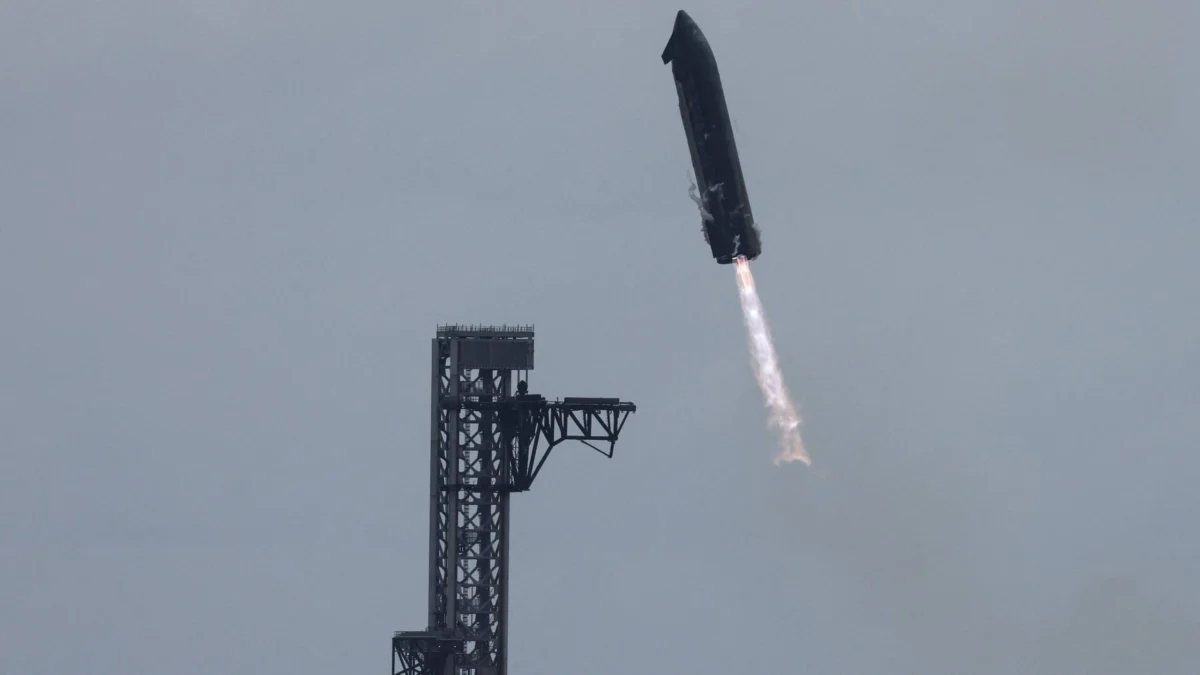
New York – In a significant stride towards reusable rocket technology, SpaceX successfully recovered the upper stage of its colossal Starship system for the first time following an orbital test flight. This historic event, marking the 15th flight test for the Starship program, saw the spacecraft return to SpaceX’s Starbase launch site in Texas approximately 20 hours after liftoff, where it was caught by mechanical arms attached to the launch tower. This marked the inaugural attempt by SpaceX to execute such a mid-air catch for the Starship upper stage.
The ambitious test flight, however, was not without its setbacks. While the Starship upper stage achieved its recovery milestone, the accompanying booster, known as Super Heavy, failed to land successfully. The booster, designed to return to Earth for recovery, was intended to be caught by similar mechanical arms at the launch tower. Unfortunately, this part of the mission did not go as planned. Shortly after its return to Earth, the Super Heavy booster crashed into the ocean and was engulfed in flames, representing a significant loss for this particular flight test. SpaceX has not yet released specific details regarding the cause of the Super Heavy’s failure.
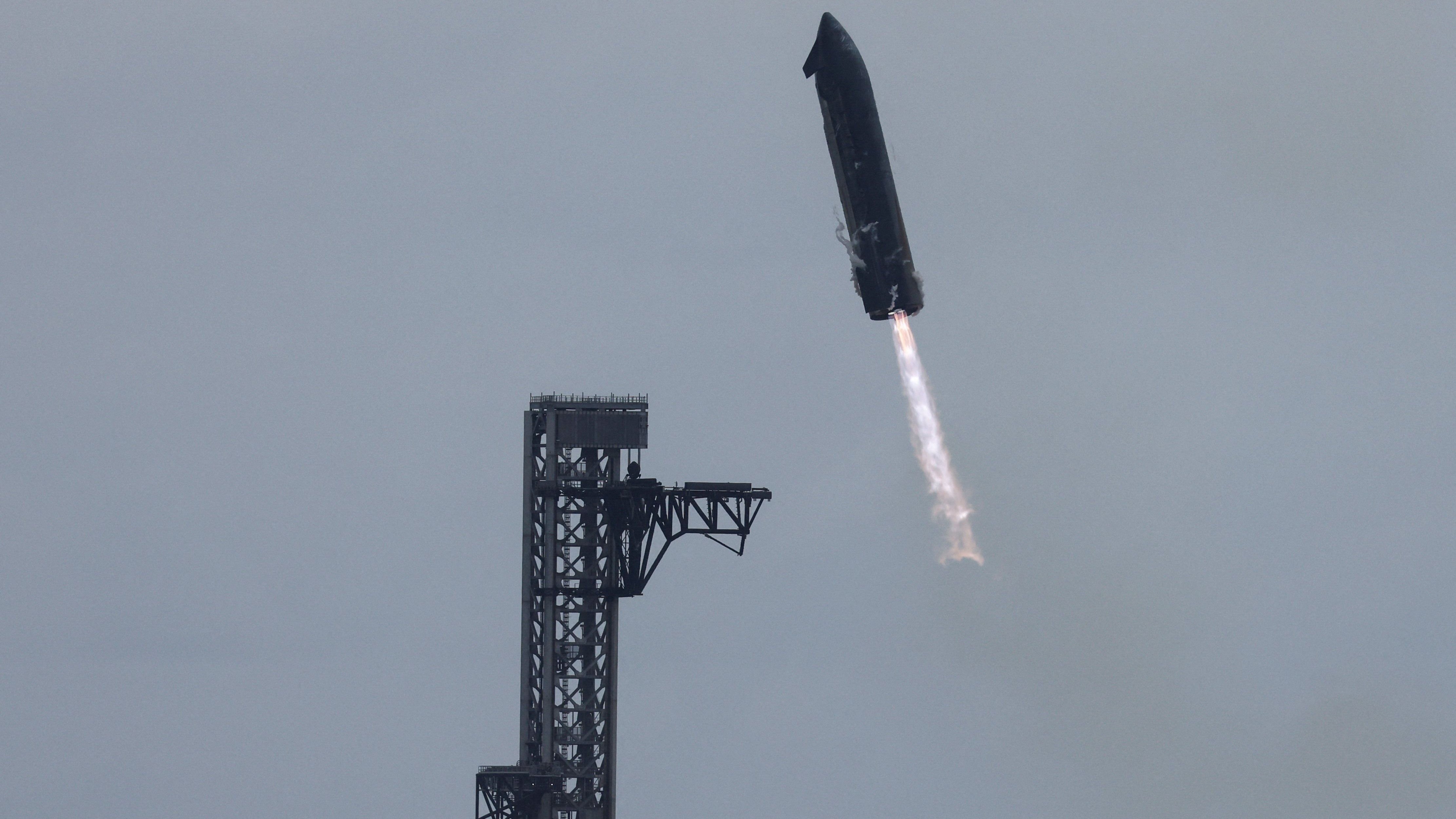
This latest test flight builds upon previous attempts to perfect the recovery of both Starship stages. In three prior test flights, SpaceX had successfully managed to catch the lower rocket stage. The overarching goal of the Starship program, spearheaded by tech billionaire Elon Musk, is to develop a fully reusable launch system capable of transporting humans and cargo to Mars and beyond. The ability to recover and reuse both the Starship upper stage and the Super Heavy booster is critical to achieving this vision and drastically reducing the cost of space exploration.
The Starship Program: Ambition and Evolution
The Starship program represents one of the most ambitious undertakings in the history of spaceflight. Conceived by Elon Musk, founder and CEO of SpaceX, Starship is designed to be the most powerful rocket ever built. Its ultimate aim is to facilitate the colonization of Mars, enabling large-scale transportation of both people and supplies. The system comprises two main components: the Super Heavy booster, which serves as the first stage, and the Starship spacecraft, which functions as the second stage. Together, they form a vehicle capable of lifting over 100 metric tons into orbit.
Development of Starship has been characterized by rapid iteration and testing. SpaceX has adopted an agile approach, building and testing numerous prototypes at its Starbase facility in Boca Chica, Texas. This methodology allows for quick identification and correction of design flaws, accelerating the learning process. The company has faced numerous challenges and setbacks in its testing phases, with many early prototypes failing during ascent or landing. However, each failure has provided invaluable data that has informed subsequent designs and operational procedures.

The flight test that concluded recently was the 15th in the Starship program’s history, signifying a sustained effort to refine the system’s capabilities. Previous tests have focused on various aspects, including ascent, stage separation, orbital insertion, and atmospheric re-entry. The ability to recover the Starship upper stage after it has achieved orbit and deployed payloads marks a crucial step towards full reusability.
Chronology of the 15th Flight Test
The latest Starship test flight commenced with a launch from Starbase, Texas. The Super Heavy booster, equipped with its array of Raptor engines, provided the immense thrust needed to lift the combined Starship vehicle off the launchpad. The ascent proceeded as planned, with the vehicle reaching significant altitudes.
A critical phase of the mission was the hot staging maneuver, where the Starship upper stage ignites its engines while still attached to the Super Heavy booster. This technique, developed by SpaceX, allows for a more efficient transfer of momentum. Following successful hot staging, the Starship upper stage continued its journey towards orbit.
While the Starship upper stage successfully entered a suborbital trajectory and performed its planned maneuvers, including the deployment of satellites for SpaceX’s Starlink internet constellation, the fate of the Super Heavy booster diverged. After separating from the Starship, the booster initiated its boostback burn to begin its return trajectory. However, instead of executing a controlled landing for recovery, the booster experienced a failure. Reports indicate that the booster returned to Earth, but instead of being caught by the launch tower’s arms, it impacted the ocean and subsequently caught fire.
Meanwhile, the Starship upper stage continued its mission, orbiting the Earth for approximately 20 hours. This extended duration in orbit allowed for further testing of its systems and capabilities. The spacecraft then began its descent, re-entering Earth’s atmosphere. The crucial moment arrived as Starship approached the Starbase launch site. Using its distinctive grid fins for aerodynamic control, the spacecraft maneuvered towards the landing zone. As it neared the ground, the massive catch arms of the launch tower extended, poised to secure the vehicle. In a remarkable feat of engineering and precision, the arms successfully grasped the Starship upper stage, bringing it to a controlled stop.
Supporting Data and Technological Advancements
The Starship system is a testament to cutting-edge aerospace engineering. The Super Heavy booster is designed to be approximately 71 meters (233 feet) tall and 10 meters (33 feet) in diameter, powered by up to 33 Raptor engines. The Starship upper stage, also 10 meters in diameter, stands at approximately 50 meters (165 feet) tall. When fully stacked, the entire vehicle reaches a staggering height of around 121 meters (397 feet).

The Raptor engines are a key innovation, utilizing full-flow staged combustion, which allows for higher efficiency and performance compared to traditional rocket engines. These engines are capable of running on supercooled liquid methane and liquid oxygen, a combination chosen for its potential to be produced on Mars through in-situ resource utilization.
The success of the Starship recovery, despite the booster failure, highlights the advancements made in atmospheric re-entry and controlled landing systems. The grid fins, a prominent feature of the Starship, are large, articulated fins that provide precise aerodynamic control during atmospheric descent. These fins allow the spacecraft to maneuver and orient itself for a controlled landing or, in this case, a mid-air catch.
The mid-air catch mechanism itself is a complex system. Two large robotic arms, integrated into the launch tower structure, are designed to intercept the descending Starship. These arms are equipped with specialized grippers capable of securely holding the immense weight and forces exerted by the returning spacecraft. The precision required for this operation is extraordinary, demanding synchronized movements and real-time adjustments based on the vehicle’s trajectory and velocity.

Reactions and Broader Implications
While the successful recovery of the Starship upper stage is a significant achievement, the loss of the Super Heavy booster serves as a stark reminder of the inherent challenges in developing such complex systems. Elon Musk, known for his candid communication about SpaceX’s progress, acknowledged the mixed results. In a post on X (formerly Twitter), Musk stated, "Starship upper atmosphere was too hot, causing loss of comms and loss of control. Super heavy booster failed to reignite engines for landing burn. Thus, both vehicles were lost. Congratulations to the SpaceX team for achieving so many milestones on Starship’s 15th flight! We have much to be proud of. This was a test flight, and the data we gathered will help us make Starship even better."
The successful recovery of the Starship upper stage is a critical step towards SpaceX’s goal of achieving rapid reusability. The ability to catch and reuse both stages of the rocket is paramount to making space travel significantly more affordable and sustainable. This could unlock new possibilities for space exploration, including more frequent and cost-effective missions to the Moon, Mars, and beyond.
The implications of fully reusable rockets extend beyond scientific exploration. They could revolutionize satellite deployment, enabling companies to launch larger constellations of satellites for communication, Earth observation, and scientific research at a lower cost. Furthermore, the development of Starship is seen by many as a crucial element in humanity’s long-term survival strategy, providing a means to establish off-world settlements and reduce the risks associated with remaining solely on Earth.

The Road Ahead
The Starship program is still in its developmental phase, and further test flights are expected to continue. SpaceX will undoubtedly analyze the data from this latest mission to understand the root causes of the Super Heavy booster’s failure and refine its recovery procedures. The focus will remain on achieving consistent and successful recovery of both the upper stage and the booster, paving the way for operational flights.
The ultimate success of Starship hinges on its ability to be reliably reused. While this recent test flight presented a partial success with the recovery of the Starship, the loss of the Super Heavy booster underscores the ongoing challenges. Nevertheless, the progress demonstrated by SpaceX in pushing the boundaries of rocket technology is undeniable. The company’s relentless pursuit of innovation and its willingness to embrace iterative testing, even with its inherent risks, positions Starship as a transformative force in the future of space exploration. The vision of a reusable, Mars-capable rocket is one step closer to reality, fueled by the lessons learned from each ambitious test.
