


The US Bureau of Labor Statistics (BLS) is set to release the highly anticipated September Consumer Price Index (CPI) data on Wednesday, a pivotal moment for financial markets globally. This report is widely expected to indicate a further acceleration in headline inflation, accompanied by a marginal increase in annual core inflation. Any significant deviation from these carefully calibrated analyst estimates has the potential to profoundly influence the Federal Reserve’s (Fed) future monetary policy outlook and trigger substantial shifts in the valuation of the US Dollar (USD) against its major counterparts.
Understanding the Consumer Price Index: A Vital Economic Barometer
The Consumer Price Index serves as the primary gauge of inflation, measuring the average change over time in the prices paid by urban consumers for a market basket of consumer goods and services. It is a critical economic indicator for central banks, governments, and businesses, providing insights into purchasing power and the overall health of the economy. The BLS compiles this data monthly, offering both month-over-month (MoM) and year-over-year (YoY) percentage changes.
A key distinction is made between "headline CPI" and "core CPI." Headline CPI reflects the total inflation in the economy, encompassing all goods and services. Core CPI, however, excludes the more volatile components of food and energy prices. These exclusions are crucial because food and energy prices are often subject to sharp, unpredictable swings due to geopolitical events, weather patterns, and supply chain disruptions, which may not reflect underlying, persistent inflationary pressures. Central banks, particularly the Federal Reserve, tend to focus more on core inflation when formulating monetary policy, as it provides a clearer picture of long-term price trends and demand-driven inflation. The Fed’s dual mandate, enshrined by Congress, is to foster maximum employment and maintain price stability, typically defined as a 2% annual inflation rate. Therefore, the CPI report is directly tied to the Fed’s ability to meet its price stability objective, and deviations from this target often necessitate policy adjustments.
September’s Inflationary Landscape: Forecasts and Underlying Drivers
Economists broadly anticipate that the monthly CPI for September will register a 0.6% increase, a notable acceleration from the 0.4% rise observed in August. On an annual basis, the headline reading is projected to edge higher to 3.6%, up from 3.4%. For core CPI, which strips out the more erratic food and energy segments, expectations are for a 0.2% monthly increase and a 2.5% rise year-over-year. These forecasts suggest that while underlying inflation might be moderating, the headline figure is still grappling with persistent price pressures, particularly from the energy sector.

Analyzing the Drivers: Energy’s Persistent Influence
The energy market has played a significant role in shaping recent inflation dynamics. Crude Oil prices, as measured by West Texas Intermediate (WTI), experienced a sharp ascent during the first half of September. Although a subsequent correction in the latter half of the month somewhat tempered these gains, WTI still recorded an approximate 5% increase for the entire month. This upward trajectory in crude oil prices inevitably translates into higher costs for refined petroleum products, including gasoline and diesel.
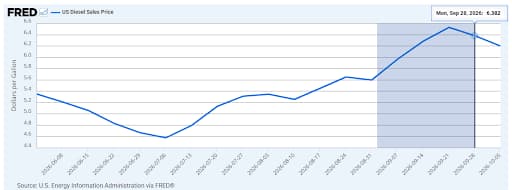
The impact on diesel prices, in particular, has been pronounced. In the United States, diesel prices per gallon surged from $5.6 to $6.38 within this period, marking an approximate 14% increase. This specific rise in diesel costs holds significant implications for the broader economy, as highlighted by analysts at Societe Generale. They underscore diesel’s outsized and often underappreciated role in shaping US inflation dynamics, noting its deep integration across various critical sectors.
Societe Generale’s analysis points out that "few fuels are as deeply embedded in the US economy as diesel, with its importance spanning freight, agriculture, construction, and industry." This pervasive presence creates a "clear transmission channel from diesel prices into broader inflation." The bank further stresses the robust empirical relationship, stating that "the empirical relationship is striking — diesel price changes explain roughly 70% of the variation in US inflation surprises." Quantifying this impact, Societe Generale calculates that "a 1% YoY increase in diesel prices is associated with a 0.06 percentage point rise in the inflation surprise." This detailed insight underscores how movements in a single, fundamental fuel can materially influence headline inflation outcomes, extending far beyond the gas pump to affect everything from transportation costs for consumer goods to the operational expenses of agricultural and industrial enterprises. Beyond energy, other components like housing, services, and the lingering effects of supply chain adjustments continue to contribute to the overall inflationary picture, albeit with varying degrees of intensity.
The Federal Reserve’s Tightrope Walk: Recent Signals and Market Expectations
The Federal Reserve has been on an aggressive monetary tightening path since early 2022, initiating a series of rapid interest rate hikes to combat inflation that had soared to multi-decade highs following the pandemic. This period saw the federal funds rate climb from near-zero levels to its current range of 5.25%-5.50%. Each CPI report throughout this cycle has been met with intense scrutiny, directly influencing the pace and magnitude of subsequent rate adjustments.
However, recent weeks have seen a discernible shift in the rhetoric from some Fed policymakers, suggesting a more cautious approach to further tightening. Fed Vice Chair for Supervision Michelle Bowman, for instance, remarked that there is "no urgent need for more rate moves this year," signaling a potential pause or a slower pace. Similarly, Minneapolis Fed President Neel Kashkari told Bloomberg that continued rate increases would "put different pressure on different parts of the economy," acknowledging the cumulative impact of past hikes. Fed Governor Christopher Waller, while still advocating for further rate increases, emphasized the need for flexibility regarding the pace of tightening. These nuanced comments collectively point towards a data-dependent strategy, where the Fed is prepared to observe the impact of its previous actions before committing to additional steps.
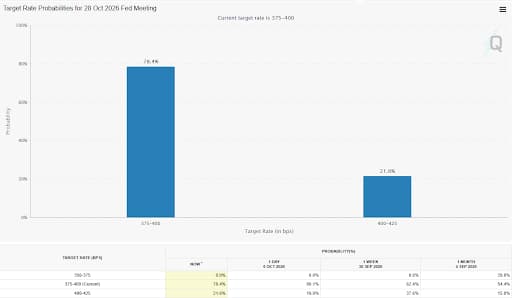
Further bolstering the case for a potential pause was the disappointing September labor market report. The Bureau of Labor Statistics reported that Nonfarm Payrolls rose by a mere 29,000 in September, significantly missing market expectations of a 90,000 increase. Concurrently, the Unemployment Rate edged higher to 4.2% from 4.1% in August. A weakening labor market typically suggests a cooling economy, which can alleviate inflationary pressures and reduce the urgency for further rate hikes. This confluence of cautious Fed commentary and softer labor market data has prompted investors to scale back their bets for an immediate interest rate hike. According to the CME FedWatch Tool, markets are currently pricing in an approximately 80% probability of a policy hold at the upcoming Federal Open Market Committee (FOMC) meeting in October. Despite this, the probability of the federal funds rate being higher than its current level by December remains robust at around 85%, indicating that markets anticipate at least one more hike by year-end, even if not in October.
Navigating the CPI Scenarios: Impact on Monetary Policy and the US Dollar
The upcoming CPI report presents several distinct scenarios, each with significant implications for monetary policy and currency markets.
Scenario 1: Significant Upside Surprise (Monthly CPI 0.7% or higher)
Should the monthly CPI print come in significantly hotter than expected, perhaps at 0.7% or higher, it would likely reignite expectations for an October rate hike. Such an outcome would suggest that inflationary pressures, particularly from elevated energy prices, are spilling over more broadly into the wider economy and consumer inflation. This would be a significant concern for the Fed, potentially forcing their hand to maintain an aggressive stance. In this scenario, the US Dollar (USD) would almost certainly gather immediate strength as markets price in a higher probability of tighter monetary policy. This, in turn, would cause the EUR/USD pair to come under renewed and intense selling pressure, pushing it lower.
Scenario 2: Soft Inflation Print (Monthly CPI 0.4% or lower)
Conversely, a soft monthly inflation print of 0.4% or lower would largely reaffirm expectations for a policy hold in October. Such a reading would offer relief that inflationary pressures are indeed moderating, potentially allowing the Fed more room to pause and assess the cumulative impact of its past rate hikes. While this scenario would likely weigh on the USD and help the EUR/USD stabilize in the near term, it might not be sufficient to trigger a steady or robust recovery for the Euro. This is due to prevailing market concerns regarding the European Central Bank’s (ECB) ability to continue tightening monetary policy amidst growing uncertainty surrounding France’s fiscal outlook and the widening spread between German and French government bonds, also known as Obligations Assimilables du Trésor (OATs).
Scenario 3: Consensus Match or Slight Deviation
Finally, a monthly CPI print that closely matches the market consensus of 0.6%, or comes in just 0.1 percentage points below it, would likely fail to materially alter the market pricing of the Fed’s rate outlook. In this case, the impact on the USD’s performance would be limited, as markets would have already largely factored in such an outcome. Attention would then quickly shift to subsequent economic data releases and future commentary from Fed officials for clearer guidance on the path of monetary policy.
The Euro’s Predicament: European Central Bank and French Fiscal Uncertainty
While the US CPI report dominates the immediate focus, the European side of the EUR/USD equation faces its own set of formidable challenges, contributing to the Euro’s fragility. There is waning market confidence in the European Central Bank’s (ECB) ability to maintain an aggressive monetary tightening stance, especially when compared to the Fed’s potential flexibility. The Eurozone economy grapples with varied national fiscal situations, making a unified monetary policy difficult.
A significant source of this concern stems from France’s fiscal outlook. The widening spread between French and German government bonds (OATs), a key indicator of perceived sovereign risk, underscores growing investor apprehension. This spread reflects the additional premium investors demand to hold French debt over historically safer German debt. Analysts at MUFG/BTMU have weighed in on this, arguing that the fiscal plans proposed by Marine Le Pen, the leader of France’s main opposition party, are unlikely to materially alter the outlook for French government bonds before voters head to the polls. They state, "this alternative budget is unlikely to make much difference to the risks associated with OATs ahead of the election next year — especially given a plausible scenario of a presidential election run-off in the second round between Le Pen and the hard-left candidate Jean-Luc Mélenchon, who is now usually polling second on around 20% versus Le Pen on around 30%." This political uncertainty, coupled with the Eurozone’s sensitivity to global interest rate movements, leads MUFG/BTMU to conclude that "EUR/USD downside risks are set to prevail." The implications of this instability extend beyond currency markets, potentially impacting borrowing costs for France and broader Eurozone financial stability.
Technical Outlook for EUR/USD: Charting the Path Ahead
From a technical perspective, the EUR/USD pair finds itself in a precarious position, as observed by Valeria Bednarik, Chief Analyst at FXStreet. She notes, "The EUR/USD pair remains depressed near its lowest level since May 2023 in the 1.1150 price zone, and aims to extend its decline from a technical point of view." The daily chart clearly illustrates the pair trading consistently below all its bearish moving averages, with the 20-day Simple Moving Average (SMA) gathering strong downward momentum at 1.1325, reinforcing the prevailing bearish sentiment. While technical indicators are observed to be turning marginally higher after reaching oversold readings, Bednarik interprets this as reflecting a near-term bounce rather than suggesting the pair has found an interim bottom, indicating that any upward movement is likely corrective within a larger downtrend.
Looking ahead, key support levels for EUR/USD are identified. "Once the October low near 1.1150 gives up," Bednarik explains, "EUR/USD can extend its slide initially towards the 1.1100 area, and then towards 1.1060." The next significant support level is the psychological threshold of 1.1000, although she cautions that "it seems unlikely that the pair will reach such a level just with the CPI release," suggesting that such a move would require more sustained bearish drivers. Conversely, any extension of the ongoing recovery would encounter initial resistance at around 1.1260. Should the pair manage to clear this area convincingly, the rally could potentially continue towards the 1.1320 price zone, where the 20-day SMA currently resides, likely acting as a strong dynamic resistance. The overall technical picture suggests that the path of least resistance for EUR/USD remains to the downside, with any bullish reversal requiring a substantial shift in fundamental drivers.
Conclusion: A Data-Dependent Future
The forthcoming September Consumer Price Index report is far more than just another economic data point; it is a critical juncture that will shape the narrative around inflation, monetary policy, and currency valuations in the weeks and months to come. With market expectations finely balanced and central banks adopting an increasingly data-dependent stance, any divergence from consensus forecasts could trigger significant market reactions. The interplay between persistent inflationary pressures, particularly from energy, the Federal Reserve’s evolving policy stance, and the complex fiscal and political landscape in Europe creates a highly dynamic environment for global financial markets. Investors and policymakers alike will be scrutinizing every detail of the CPI report, as it offers vital clues to the trajectory of interest rates and the broader economic outlook. The stakes are high, and the market awaits with bated breath.
