

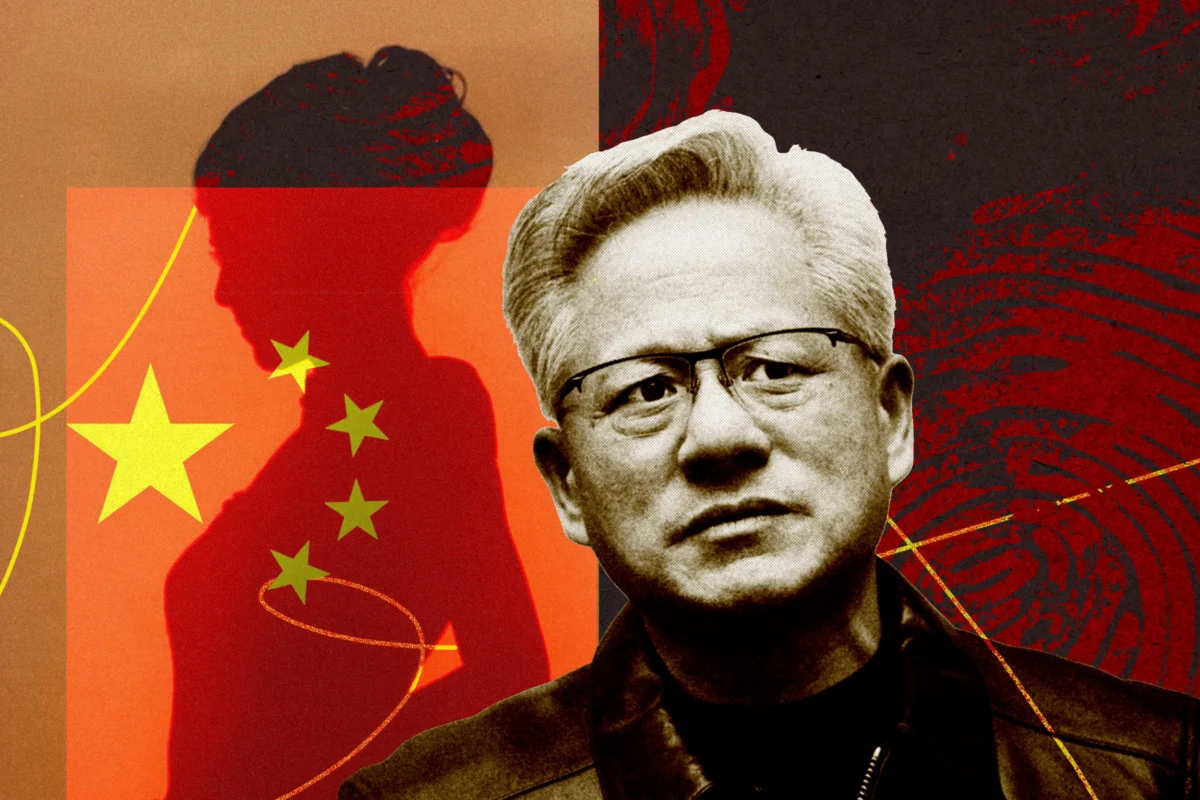
A well-worn adage within government, military, and intelligence circles serves as a stark reminder of a persistent threat: "If she’s a 10 and you’re a 5, she’s a spy!" This principle, often reinforced during counterintelligence briefings, highlights the vulnerability of individuals in positions of power to sophisticated intelligence operations. The U.S. Army’s Counterintelligence Command, for instance, articulated this concept on Valentine’s Day with the potent message: "It doesn’t take a mathematician to figure out ’10 + 5 = honeytrap.’" The underlying caution is clear: an unusually attractive individual showing keen interest in someone with a seemingly ordinary life may indeed harbor ulterior motives, often involving a "honeytrap" designed to exploit personal relationships for intelligence gain.
Jensen Huang, the centibillionaire CEO of Nvidia, a company at the epicenter of the 21st century’s technological and geopolitical landscape, would seemingly be acutely aware of such possibilities. As the leader of one of the world’s most consequential and strategically vital corporations, Huang is undoubtedly a high-priority target for foreign intelligence agencies. The very nature of Nvidia’s business – the design and production of advanced semiconductors that power artificial intelligence and high-performance computing – makes it a critical asset in the global technological arms race. Therefore, recent news involving Huang in a complex spy scandal, weaving together themes of infidelity, international espionage, and the volatile political climate of the Trump administration, has sent shockwaves through both the tech and intelligence communities.
The intricate web of allegations began to surface shortly before Halloween, with a multi-part investigative report in The New York Times detailing a purported Chinese intelligence plot targeting Jensen Huang. According to the reporting, which began to emerge between late 2024 and early 2025, Huang allegedly engaged in an affair with Alice Huang (no relation), a former executive at Megaspeed, a Singapore-based cloud computing provider. U.S. intelligence agencies reportedly alerted high-ranking U.S. officials to their belief that Alice Huang was an operative for Chinese intelligence. While Nvidia’s board has launched its own internal investigation, stating it has "no reason to believe that either national security or Nvidia secrets were compromised," the revelations have nonetheless raised significant concerns, extending far beyond potential data breaches.
China has vehemently denied any involvement in such a plot. A spokesperson for the Chinese Ministry of Foreign Affairs, in a statement on a recent Monday, dismissed the accusations as "entirely based on groundless speculation" and characterized them as "nothing more than slander and smearing."
However, further reporting by The New York Times and the Financial Times suggests that U.S. intelligence officials maintain that Alice Huang, also known by the name Huang Le, was reporting to China’s Ministry of State Security (MSS), a primary intelligence agency. Megaspeed itself issued a statement on LinkedIn, asserting that U.S. authorities had found "no evidence of any violations concerning the illicit transfer of chips or any illegal activities." It is important to note that Alice Huang is not believed to be a direct employee or "officer" of Chinese intelligence but rather an "asset" – an individual who aids an intelligence agency, often through personal connections or specialized knowledge, sometimes compensated and sometimes not. Her background as a former Chinese state journalist may have provided her with access and insights relevant to intelligence gathering.
China’s strategic emphasis on economic espionage is well-documented. The nation has been accused of systematically stealing intellectual property across various sectors, ranging from advanced military technology like U.S. fighter jet designs to more mundane yet commercially vital innovations such as solar panel manufacturing techniques and even commercial paint recipes. The "honeytrap" or "honeypot" strategy, which involves using an attractive operative to seduce or develop a personal relationship with a target to extract information or exert influence, is a long-standing and infamous tactic in the intelligence playbook. French officials, for instance, have been warning about Chinese honeypots since at least 2011, when intelligence reports detailed a case involving a pharmaceutical researcher who was reportedly seduced and subsequently blackmailed by a Chinese spy operation.
Silicon Valley: A Persistent Target of Foreign Intelligence
Over the past quarter-century, as Silicon Valley has ascended to become a global hub of technological innovation, economic power, and political influence, it has inevitably become a focal point for foreign intelligence operations. One notable instance involved a Chinese national named Fang Fang, who reportedly spent years attempting to cultivate relationships with politicians in the Bay Area, including then-U.S. Representative Eric Swalwell. While intelligence officials at the time were reportedly convinced of Fang’s operative status, law enforcement authorities did not bring charges against her.
The pervasive nature of such threats has led U.S. business executives traveling to China to adopt stringent security protocols. It has become common practice to leave personal phones and computers behind and utilize "burner" devices to prevent the installation of spyware or malware. This author, during a reporting trip to China in 2019 for WIRED, followed similar precautions to investigate Huawei. The level of concern was starkly illustrated in 2012 when Leon Panetta, then Secretary of Defense, and his team were advised to take precautions such as bathing and showering in darkness during his first trip to China, in anticipation of potential hotel room surveillance. Last year, the persistent threat of honeypots prompted the U.S. government to issue explicit guidance banning personnel working in China and Hong Kong from engaging in romantic or sexual relationships with Chinese citizens. More recently, U.S. officials, in conjunction with allies, have issued warnings about China’s increasingly sophisticated "LinkedIn espionage" – the use of the business-oriented social networking platform to recruit and build relationships with unsuspecting executives.
The Interplay of Business, Politics, and Espionage
Alice Huang’s company, Megaspeed, plays a significant role in the Asia-Pacific cloud services market, focusing on the very advanced computer chips that form the core of Nvidia’s business. This connection is particularly sensitive given the Biden administration’s efforts to restrict the export of cutting-edge chips to China to slow its AI development. Jensen Huang, however, had previously lobbied the Trump administration to relax such export controls, a move that now faces heightened scrutiny in light of these allegations.
During a press conference on a recent Monday, former President Donald Trump addressed the allegations, denying any prior knowledge of Alice Huang’s potential espionage activities. "I didn’t hear about it then, but a lot of people have heard about it, and Jensen totally denies that," Trump stated. He added, "I asked him that question: ‘Did you have any idea that she was a spy?’ He said, ‘I had no idea that she was a spy.’" However, The New York Times reported on Tuesday that Marco Rubio had briefed Trump in May, prior to Jensen Huang accompanying the former President on Air Force One for a trip to China. The veracity of these claims and the timeline of briefings will undoubtedly be a subject of intense investigation, echoing the famous Watergate maxim: "What did the president know and when did he know it?"
Nvidia’s CEO has reportedly been linked to the Megaspeed executive since at least 2024, and Alice Huang’s husband, Kang Weigh, has reportedly known Jensen Huang since the 2010s. Lauren Goode of WIRED reported on a Monday that Jensen Huang, beginning in 2025, retained the crisis communications firm of Risa Heller, which has extensive experience in managing public sex scandals. This spring, Secretary of State Marco Rubio was reportedly instrumental in drafting a classified memo within the administration that warned officials about Jensen Huang’s potentially compromising relationship.
The Stakes for Nvidia and National Security
Jensen Huang, a prominent figure and ardent champion of artificial intelligence, now finds himself in an exceptionally precarious position. The central questions revolve around his awareness and judgment: Was he an unwitting victim, unaware that his associate might be a foreign intelligence asset? Was he merely reckless with his personal reputation, his fiduciary responsibility to Nvidia shareholders, and the technological security of the United States? Or could he be implicated as a knowing accomplice in actions that undermine U.S. national security?
Regardless of the ultimate truth, Nvidia appears to be on the losing end. Shareholders have experienced a tumultuous period, with the company’s stock surging approximately 600 percent over the past five years, catapulting it to become the world’s second-most valuable company. However, in the past month alone, the stock has seen a significant decline of roughly 25 percent. The potential for further fallout for Nvidia seems substantial, with the looming specter of lawsuits, including those from its own shareholders, adding to the company’s woes.
Similarly, the Trump administration is likely to face rigorous questioning from the newly Democratic-controlled Congress. Key inquiries will undoubtedly focus on when the former President and other senior officials were briefed about this intelligence threat, what communications, if any, were made to Nvidia and by whom, and whether U.S. intelligence agencies could or should have done more to prevent Alice Huang from accessing Nvidia and its CEO.
The fact that Megaspeed is a significant customer of Nvidia introduces an additional layer of complexity. Reports have circulated for at least a year suggesting U.S. concerns that Megaspeed might be diverting Nvidia chips to Chinese intelligence agencies. Such a development could have profound implications for the global AI race. Bloomberg reported this week that Megaspeed subsidiaries have purchased billions of dollars worth of Nvidia chips, and an audit requested by the U.S. government last year revealed that Megaspeed could not initially account for approximately 50,000 purchased chips.
A Pattern of Close Ties and Political Influence
The professional relationship between Jensen Huang and former President Trump developed notably closely. Huang engaged in multiple meetings to advocate for the loosening of Biden-era export controls, controls that Trump had repeatedly relaxed during his presidency. Huang also contributed $25 million to a Trump project. During a trip to Beijing earlier this year, which included other tech leaders like Elon Musk and Tim Cook, Air Force One made a special stop in Alaska to pick up Huang. He also attended a White House state dinner for Chinese President Xi Jinping and Trump, who, in turn, awarded Huang a National Medal of Science earlier that fall.
The implication that Trump may have been aware of the intelligence threat for a year and taken no significant action would represent one of the most significant counterintelligence failures of the past decade. The consequences could be far-reaching. Historically, numerous individuals have faced imprisonment for involvement in honeypot scandals. Just last year, a former adviser was arrested in a similar plot; while acquitted of economic espionage charges, he was convicted for making false statements to investigators.
Even under ordinary circumstances, corporate America’s tolerance for CEO misconduct has diminished significantly in recent years. CEOs at a range of companies, including Nestlé, Kohl’s, BP, NBCUniversal, and Norfolk Southern, have either resigned or been forced out following inappropriate relationships that violated company standards.
Were Nvidia any other company and Jensen Huang any other CEO, the known facts of this scandal would likely be sufficient to trigger significant personnel changes. However, with former President Trump still a prominent political figure and the ongoing political climate, the full ramifications of this developing story remain to be seen. While this scandal may not yet be the most prominent news of the month, its implications for national security, corporate governance, and geopolitical stability are profound and warrant continued scrutiny.
We welcome your thoughts on this article. Please submit letters to the editor to [email protected].
