

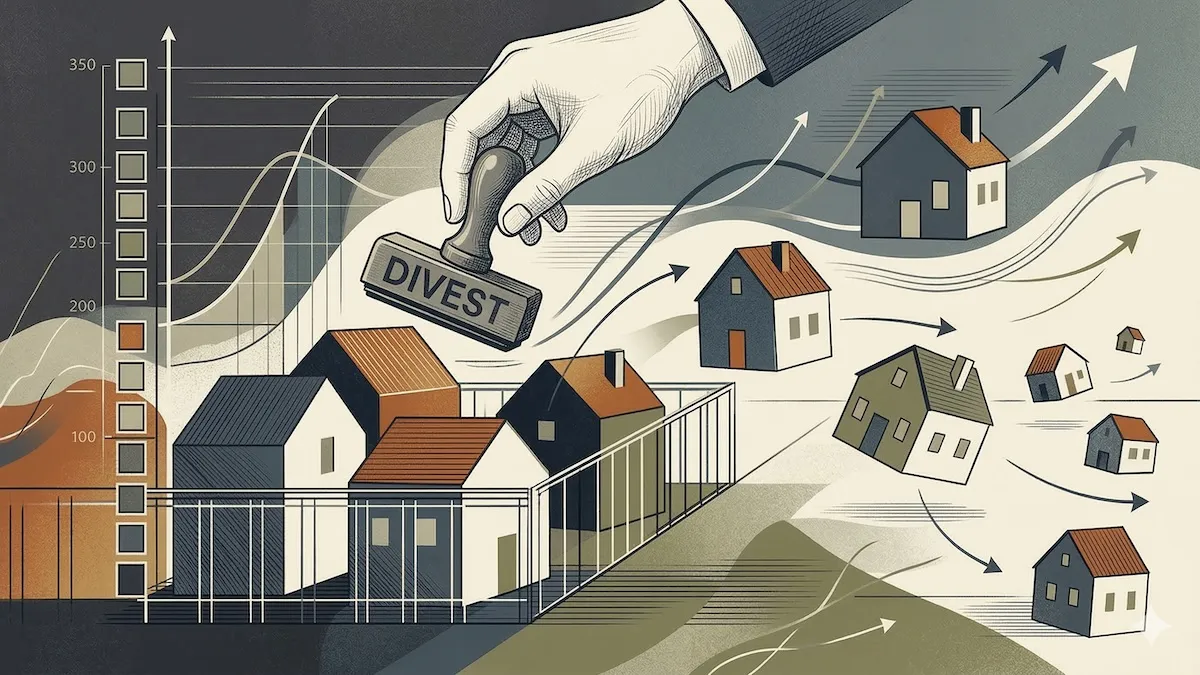
The United States Senate on Thursday overwhelmingly approved the 21st Century ROAD to Housing Act, a sweeping piece of legislation aimed at addressing the nation’s ongoing housing affordability crisis. Central to the bill is a contentious provision titled “Homes Are for People, Not Corporations,” which seeks to fundamentally alter the landscape of the single-family rental market by imposing strict acquisition limits on institutional investors. Specifically, the provision targets entities owning 350 or more single-family homes, prohibiting them from purchasing additional properties once they cross this threshold. While proponents of the bill argue that the measure will unlock inventory for aspiring homeowners and curb price appreciation, a growing body of economic data suggests the impact may be more symbolic than transformative for the broader market.
The legislation comes at a time of heightened political scrutiny over the role of Wall Street in the residential sector. For years, housing advocates and local officials have pointed to the rise of "mega-landlords" as a primary driver of rising rents and the disappearance of entry-level starter homes. However, recent reports from major real estate data providers, including Realtor.com and Cotality, indicate that institutional investors represent a significantly smaller portion of the market than public perception often suggests. As the bill moves to the House of Representatives for consideration, the debate has shifted from whether the government should intervene to whether this specific intervention targets the correct segment of the market.
A Statistical Reality Check on Institutional Ownership
In a comprehensive report released on Friday, Realtor.com economists Jake Krimmel and Hannah Jones analyzed a decade of transaction data spanning from 2015 to 2025. Their findings reveal a stark contrast between the political narrative and the statistical reality of the housing market. According to the report, institutional investors—defined as entities that have made more than 350 single-family purchases since 2015—accounted for only about 12% of all investor purchases over the last ten years. When viewed against the entirety of the single-family housing market, these large-scale entities were responsible for just 1% of all purchases nationwide during that period.
The data further suggests that the "institutional wave" may have already crested. In 2015, institutional players represented 12.2% of all investor activity. While that share surged to a peak of 16.3% in 2021 during the height of the pandemic-era housing boom, it has since retreated significantly. By early 2025, the institutional share of investor purchases had fallen to 7.5%. Jake Krimmel noted in an interview with HousingWire that the proposed ban is "attacking a trend that is already decreasing as opposed to one that is becoming increasingly part of the market." Because these large firms are highly sensitive to interest rates and financing conditions, the current high-rate environment has naturally curtailed their acquisition appetite, making the legislative cap less impactful than it might have been three years ago.
The Dominance of the Small-Scale Investor
While the "Homes Are for People, Not Corporations" provision focuses on the largest players, the data indicates that the true drivers of investor activity are small-scale landlords. The Realtor.com report found that "small investors"—defined as those owning fewer than 10 properties—accounted for roughly 53% of all gross investor purchase activity over the past decade. This was followed by "medium investors" (10 to 99 homes) at 27% and "large investors" (100 to 349 homes) at 8%.
In total, investors of all sizes purchased approximately 5.5 million single-family homes over the last ten years. However, this figure is eclipsed by the 58 million single-family homes purchased by non-investors—primarily traditional owner-occupants—during the same window. This suggests that while investor activity is a factor in market dynamics, the overwhelming majority of transactions remain driven by individual households.
Data from Cotality, published in mid-February, corroborates these trends. Cotality’s Q4 2025 report found that small investors held the largest share of investor purchases at 13.9% as of December 2025. In contrast, "mega investors" (those owning over 1,000 homes) represented just 2.8% of the market. Cotality also noted a general cooling in investor interest, with the total investor share of the market dropping from 31.9% in January 2025 to 30.3% by the end of the year.
Geographic Concentration and Localized Impact
One reason the presence of institutional investors feels so pervasive is their tendency to cluster in specific metropolitan areas and neighborhoods. The Realtor.com report highlights that institutional activity is highly concentrated; the top 10 metropolitan areas for institutional activity account for more than 50% of all such purchases nationwide. The top 25 metros account for 75%.
In certain markets, the footprint of large-scale investors is far more visible than the national average. The Memphis, TN-MS-AR metro area reported the highest institutional share at 4.4% of all purchases, followed closely by Colorado Springs (4.3%) and Charlotte (4.2%). Other high-concentration areas include:
- Atlanta-Sandy Springs-Roswell, GA: 3.8%
- Birmingham, AL: 3.8%
- Dallas-Fort Worth-Arlington, TX: 3.6%
- Raleigh-Cary, NC: 3.5%
- Indianapolis, IN: 3.5%
The Dallas-Fort Worth metro area led the nation in sheer volume, with investors purchasing 65,579 homes between 2015 and 2025. Houston, Phoenix, and Charlotte also saw tens of thousands of investor acquisitions. In Houston, the concentration was particularly acute at the ZIP code level. Over the last 11 years, institutional purchases in Houston were clustered in just 10 ZIP codes, where they captured up to 73% of the local investor market. Krimmel explained that this hyper-concentration is why the issue elicits such a "visceral reaction" from residents. Even if the national impact is negligible, the impact on a specific street or neighborhood can feel overwhelming to local homebuyers.
Chronology of Institutional Entry into Housing
The rise of the institutional single-family rental (SFR) asset class is a relatively recent phenomenon, born out of two distinct historical anomalies:
- The Post-2008 Financial Crisis (2010–2013): Following the collapse of the housing bubble, millions of homes entered foreclosure. At the time, the housing market was in an "unhealthy position," as Krimmel described it, with a massive glut of distressed inventory and no buyers. Institutional investors stepped in to provide liquidity, purchasing homes in bulk at steep discounts and converting them into rentals.
- The COVID-19 Pandemic (2020–2022): A decade later, the pandemic created a second surge. Record-low interest rates and a shift toward remote work drove a massive increase in demand for suburban space. Institutional investors, flush with cheap capital, competed aggressively for properties, often outbidding traditional buyers with all-cash offers.
- The Current Correction (2024–2025): As the Federal Reserve raised interest rates to combat inflation, the cost of capital for institutional firms increased. This, combined with high home prices, has led many large firms to pivot from buying existing homes to "build-to-rent" strategies, where they fund the construction of entire new communities specifically for rental purposes.
Policy Implications and Alternative Solutions
Economists argue that the ROAD to Housing Act may fail to deliver the "rapid inventory relief" that politicians have promised. The Realtor.com report suggests that a ban on large-scale acquisitions provides only a modest, one-time injection of inventory into a handful of neighborhoods. It does not address the fundamental structural issue: a chronic lack of housing supply.
According to many analysts, the risk of an institutional ban is that it adds another barrier to the housing market without incentivizing new supply. Institutional investors often provide the capital necessary for large-scale developments that might otherwise not be built. If they are barred from the market, there is a concern that overall construction levels could fall, further exacerbating the inventory shortage in the long run.
Instead of targeting ownership thresholds, the report recommends focusing on:
- Zoning Reform: Eliminating restrictive single-family zoning to allow for higher-density housing like duplexes and townhomes.
- Incentivizing Construction: Reducing the regulatory costs and "not-in-my-backyard" (NIMBY) hurdles that prevent new homes from being built.
- Streamlining Permitting: Shortening the time it takes for developers to bring new units to market.
The Path to Law
The 21st Century ROAD to Housing Act now moves to the House of Representatives. Its passage in the Senate with overwhelming support suggests a bipartisan appetite for housing reform, but the specific provision regarding institutional investors remains a point of contention for trade groups. Organizations representing the rental housing industry have raised concerns that the bill could inadvertently hurt renters by reducing the supply of professionally managed rental homes, which often offer better maintenance and amenities than "mom-and-pop" rentals.
Furthermore, the bill must eventually be signed into law by President Donald Trump. While the President has historically voiced support for policies that protect "the American Dream" of homeownership, his administration’s stance on market-interventionist policies like investor caps remains to be seen. If signed, the law would represent one of the most significant federal interventions in the residential real estate market in decades.
As the debate continues, the data suggests that while the "Homes Are for People, Not Corporations" provision may be a popular political slogan, the solution to America’s housing affordability crisis likely lies in building more homes, rather than simply changing who is allowed to buy the existing ones. For now, the market remains characterized by a cooling of institutional interest and a continued dominance by small-scale investors, leaving the ultimate impact of the ROAD to Housing Act an open question for the years to come.
