

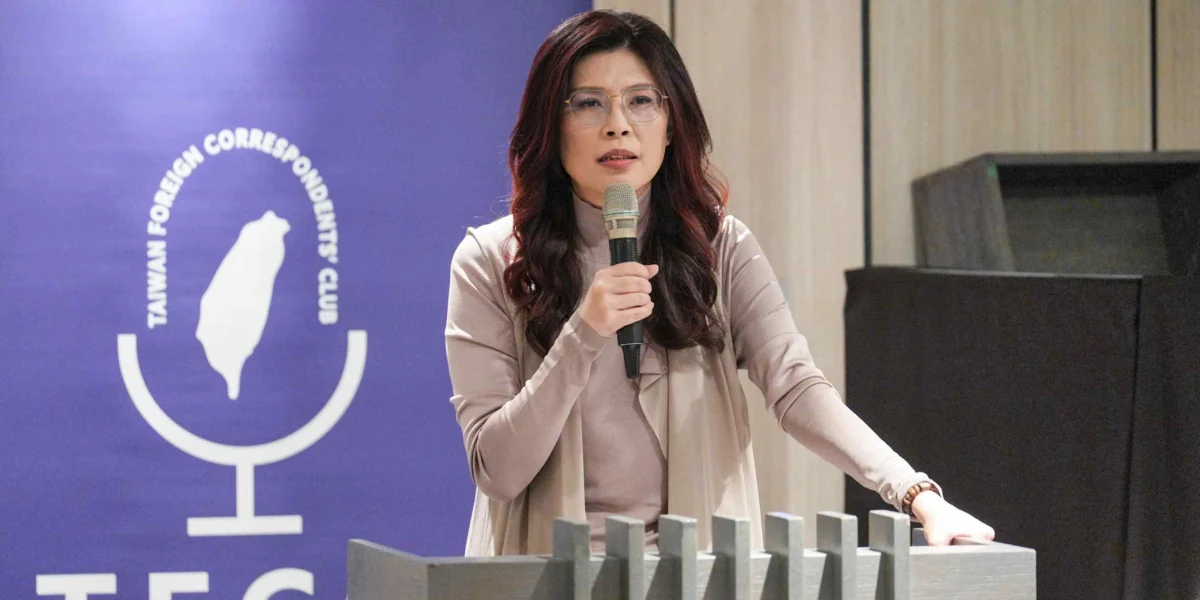
TAIPEI — Cheng Li-wun, chairwoman of Taiwan’s main opposition Kuomintang (KMT), articulated a resolute commitment on Monday to initiate dialogue with Chinese President Xi Jinping, though she refrained from providing a specific timeframe for such engagement. Concurrently, Cheng leveled criticism against President Lai Ching-te’s signature defense initiatives, a stance that underscores a deepening political schism within Taipei. The KMT leader’s remarks, delivered at a briefing hosted by the Taiwan Foreign Correspondents’ Club, signal a strategic push by the opposition party to reassert its influence on cross-strait relations and domestic policy as Taiwan navigates an increasingly complex geopolitical landscape.
KMT’s Strategic Vision: Dialogue with Beijing
Cheng’s assertion of a desire to engage directly with President Xi Jinping represents a significant departure from the current administration’s approach, which has prioritized strengthening Taiwan’s self-defense capabilities and fostering international partnerships in the face of persistent pressure from Beijing. The KMT, historically a proponent of closer ties with mainland China, views dialogue as a crucial avenue for de-escalating tensions and safeguarding Taiwan’s economic and security interests. While Cheng’s statement lacked concrete details on the timing or agenda of any potential meeting, her unambiguous declaration of intent signals the KMT’s unwavering focus on cross-strait engagement as a cornerstone of its political platform.
This ambition to engage with Beijing is deeply rooted in the KMT’s historical legacy. Founded in 1912, the party played a pivotal role in the establishment of the Republic of China. Following the Chinese Civil War, the KMT retreated to Taiwan in 1949, where it governed as a one-party state for decades. Throughout this period, its stance on cross-strait relations oscillated between advocating for eventual reunification and maintaining a firm anti-communist front. In recent decades, the party has navigated a complex internal debate on how to best manage relations with the People’s Republic of China, with a significant faction advocating for pragmatic engagement and economic cooperation. Cheng’s current position appears to align with this more outward-looking, dialogue-oriented approach, seeking to position the KMT as a bridge builder in a period of heightened regional uncertainty.
Criticisms of President Lai’s Defense Strategy
Parallel to her overtures towards Beijing, Cheng launched a pointed critique of President Lai Ching-te’s defense modernization plans. The specifics of Lai’s flagship proposal, which aims to bolster Taiwan’s asymmetric warfare capabilities and enhance its resilience against potential Chinese aggression, have become a focal point of domestic political debate. While details of Cheng’s precise criticisms were not fully elaborated in the initial report, it is understood that the KMT leader may be questioning the efficacy, cost, or strategic direction of these initiatives.
President Lai Ching-te, who assumed office in May 2024, has made strengthening Taiwan’s defense a central pillar of his administration. His government has prioritized investment in indigenous defense manufacturing, the acquisition of advanced weaponry from international partners, and the implementation of strategies designed to make Taiwan a more difficult target for invasion. This includes a focus on developing capabilities such as unmanned aerial systems, advanced missile defense, and robust cyber warfare defenses. The rationale behind this strategy is to deter any potential military action by Beijing by significantly increasing the cost and risk of an invasion, thereby preserving Taiwan’s de facto independence.
The KMT’s opposition to certain aspects of this defense strategy could stem from various considerations. Historically, the party has been perceived as more accommodating towards Beijing, and a robust defense buildup might be viewed by some within the KMT as unnecessarily provocative or economically burdensome. Alternatively, the KMT might advocate for a different mix of defense spending, perhaps emphasizing traditional military assets or seeking alternative security assurances. The lack of specific details regarding Cheng’s criticisms leaves room for interpretation, but it is clear that the KMT is seeking to differentiate itself from the ruling Democratic Progressive Party (DPP) on a critical national security issue.
Broader Political Landscape and KMT’s Position
Cheng’s remarks arrive at a critical juncture for Taiwan’s political landscape. The island has been grappling with a series of domestic challenges, including economic headwinds, social divisions, and the persistent threat from mainland China. The KMT, as the largest opposition party, holds significant sway in shaping public discourse and influencing policy decisions. Cheng’s assertive stance on cross-strait relations and defense policy indicates a strategic effort to galvanize its base and attract a broader electorate concerned about Taiwan’s future security and economic stability.
The KMT’s current political standing reflects its long history as one of Taiwan’s two major political forces. While it has experienced periods of electoral success, including winning the presidency in 2008 and 2012, the party has faced challenges in recent years in recapturing the presidency, losing in 2016 and 2020. The party’s platform often emphasizes economic development and pragmatic engagement with mainland China, contrasting with the DPP’s more emphasis on Taiwanese identity and sovereignty. Cheng’s leadership represents an attempt to revitalize the KMT and present a compelling alternative to the ruling party.
Analysis of Implications
Cheng Li-wun’s dual pronouncements carry significant implications for Taiwan’s domestic politics and its relationship with mainland China.
For Cross-Strait Relations: The KMT’s explicit desire for dialogue with Xi Jinping, even without a timeline, signals a continued willingness from a major Taiwanese political force to engage directly with Beijing. This could create a parallel track of communication separate from official government channels, potentially influencing public opinion and creating domestic pressure on President Lai’s administration. Beijing has consistently stated its preference for dialogue with parties that acknowledge the "one China principle," a stance the KMT has historically interpreted in ways that differ from the DPP. The KMT’s approach could be seen by Beijing as a more amenable partner, though any concrete engagement would likely be scrutinized for its adherence to Beijing’s fundamental conditions.
For Domestic Politics: The KMT’s criticism of President Lai’s defense proposal aims to carve out a distinct policy position and appeal to voters who may be concerned about the economic implications or the potential for increased tensions arising from a robust defense buildup. This creates a clear point of contention between the ruling and opposition parties, fueling political debate and potentially impacting future electoral outcomes. The effectiveness of this strategy will depend on the KMT’s ability to articulate a credible alternative defense and security vision that resonates with the Taiwanese public.
Geopolitical Context: Taiwan’s strategic location and its complex relationship with China make its internal political dynamics a matter of international concern. The United States, a key security partner for Taiwan, will be closely watching any developments in cross-strait dialogue and the KMT’s stance on defense. The KMT’s emphasis on dialogue could be seen by some as a de-escalation strategy, while its criticism of defense spending might raise concerns about Taiwan’s preparedness. The international community will likely be assessing whether Cheng’s approach ultimately contributes to regional stability or introduces new uncertainties.
Historical Precedents and Future Trajectories
The KMT’s pursuit of dialogue with Beijing is not unprecedented. During the Ma Ying-jeou presidency (2008-2016), significant strides were made in cross-strait relations, including the historic meeting between Ma and Xi Jinping in Singapore in 2015, the first between leaders of the mainland and Taiwan since the end of the Chinese Civil War. This period saw a marked increase in economic cooperation and a reduction in overt political tensions. However, the subsequent rise of the DPP and a growing sense of Taiwanese identity have shifted the political landscape, leading to a more cautious approach from Taipei towards Beijing.
Cheng Li-wun’s current stance suggests a potential re-emphasis on the KMT’s traditional approach, seeking to leverage economic ties and direct engagement to manage cross-strait relations. The success of this strategy will depend on several factors, including Beijing’s willingness to engage constructively, the KMT’s ability to present a united front, and the prevailing sentiment among the Taiwanese populace. The coming months will likely see further elaboration on the KMT’s policy proposals and a clearer indication of the direction of Taiwan’s political discourse on its relationship with mainland China and its own security. The interplay between the KMT’s overtures, President Lai’s defense initiatives, and Beijing’s responses will undoubtedly shape the future of cross-strait dynamics and Taiwan’s place in the Indo-Pacific region.
