

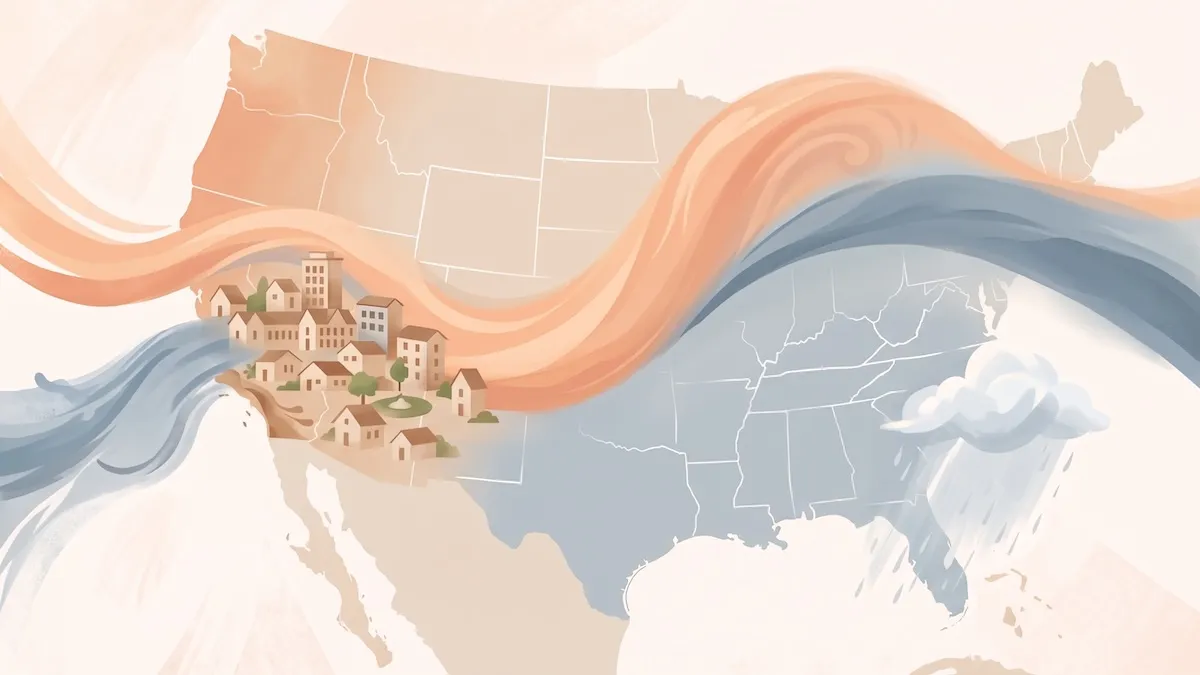
A powerful El Niño weather pattern brewing in the Pacific Ocean is poised to significantly disrupt the United States housing market this winter, exposing deep-seated structural vulnerabilities in homes and testing the financial resilience of the broader real estate ecosystem. From the mudslide-prone canyons of Southern California to the storm-lashed Gulf Coast, the atmospheric shift is expected to challenge real estate agents, insurers, appraisers, and prospective buyers, forcing a nationwide reckoning with how climate risk is priced into property values.
Meteorologists and climate scientists are increasingly concerned that the current El Niño event—characterized by unusually warm sea surface temperatures in the central and eastern tropical Pacific—is evolving into a "super" event. Howard Botts, chief scientist at Cotality, suggests that the primary danger of the coming season is not necessarily the creation of new risks, but the revelation of existing ones. For many homeowners, the record-breaking temperatures in the Pacific serve as a precursor to a winter that will test the physical and economic durability of their assets.
The Mechanics of a Super El Niño and the Shift in Jet Streams
El Niño Southern Oscillation (ENSO) events typically occur every two to seven years, but the 2023-2024 cycle is being amplified by record-high global sea temperatures. Historically, these patterns shift the Pacific jet stream southward. For the United States, this repositioning means the jet stream flows directly over the southern tier of the country.
In the West, this configuration leads to a significant increase in atmospheric rivers—long, narrow regions in the atmosphere that transport water vapor outside of the tropics. When these "rivers in the sky" make landfall, they release staggering amounts of precipitation. For California, which has spent the last decade oscillating between extreme drought and record-breaking rainfall, the arrival of another super El Niño raises the specter of catastrophic flooding and debris flows.
The vulnerability is particularly acute in areas recently affected by wildfires. Howard Botts, who resides in the Pacific Palisades near a major wildfire burn scar, notes that storm preparation has become a routine necessity for residents. In these "burn-scar" zones, the lack of vegetation means that even moderate rainfall can trigger massive mudflows. Last year, nearby canyons saw walls of mud reaching five feet in height, inundating homes and businesses. As the current El Niño gains strength, the risk of such "pluvial" or flash-flooding events increases, often occurring in areas that are not designated as high-risk flood zones.
Regional Outlook: A Map of Nationwide Impacts
The impact of El Niño is rarely uniform, creating a patchwork of winners and losers across the American landscape. While the Southern U.S. prepares for a deluge, other regions may face entirely different environmental stressors.
- The West Coast and California: The primary concern remains atmospheric rivers, landslides, and coastal erosion. With sea levels currently elevated by as much as six inches due to thermal expansion—where warmer water occupies more volume—the combination of storm waves, king tides, and full moons creates a recipe for severe coastal flooding. Orange County and Los Angeles County have already seen accelerated erosion due to recent Pacific hurricane activity, leaving multi-million dollar coastal properties on increasingly precarious footing.
- The Southeast and Gulf Coast: Historically, El Niño suppresses hurricane activity in the Atlantic during the summer, which provided a temporary reprieve for Florida and the Gulf Coast this year. However, as the season shifts into late fall and winter, the southern jet stream will bring cooler, wetter conditions. This shift is frequently associated with more severe convective storms and a heightened risk of tornado activity across the "Dixie Alley" region.
- The Pacific Northwest: In a stark contrast to the south, the Pacific Northwest is expected to experience a drier-than-average winter. While this may sound beneficial for residents tired of the rain, it carries long-term risks. Drier winters lead to lower snowpacks, which can escalate wildfire risks by late spring and summer and create significant water-management challenges for the region’s agricultural sector.
- The Northeast and Midwest: The northern tier of the country may see more frequent coastal storms, often referred to as Nor’easters, while the Midwest could face a winter characterized by mixed precipitation and "ice-jam" flooding in the Great Lakes region.
Insurance as the Economic Early Warning System
In the real estate world, the insurance market often acts as the "canary in the coal mine." According to Botts, the difficulty of obtaining insurance or the rapid escalation of premiums serves as a leading indicator of how the risk market views specific locations.
Data from Cotality shows a rising trend in transaction cancellations. These are often triggered when a home fails a specialized inspection or when a buyer discovers that the cost of hazard insurance is prohibitively expensive, effectively breaking their debt-to-income ratio for a mortgage.
A significant point of confusion for many homeowners is the distinction between "fluvial" (river) flooding and "pluvial" (surface/flash) flooding. Many residents believe that if they are outside a mandatory 100-year flood zone—a Special Flood Hazard Area (SFHA)—they do not need flood insurance. However, El Niño-driven events are frequently pluvial, caused by intense rainfall that overwhelms local drainage systems. Because these events are not tied to rising river levels, homeowners without specific flood endorsements often find themselves with no coverage for mudflow or water damage, leading to total financial loss.
The Valuation Squeeze: Appraisals and Marketability
The impact of El Niño extends beyond physical damage; it actively reshapes the perceived value of real estate. Michael Romano, vice president of staff appraisers for valuation at ServiceLink, emphasizes that a property does not need to be damaged to lose value.
Appraisal methodology is fundamentally rooted in market reaction. If a neighborhood becomes known for flooding or accessibility issues during storm seasons, marketing times for homes in that area will likely extend. When homes sit on the market longer, sellers are often forced to drop asking prices or offer significant incentives, such as repair credits or interest rate buy-downs. These market actions provide the data points that appraisers use to justify lower valuations.
Romano notes that as buyers become more climate-literate, they are increasingly hesitant to purchase in areas with high environmental risk. This reduction in demand leads to an increase in supply, exerting downward pressure on prices. Furthermore, the rising "carrying cost" of a home—driven by higher insurance premiums, increased property taxes for infrastructure repair, and rising community maintenance fees—directly diminishes a property’s value in the eyes of a professional appraiser.
While appraisers do not typically compare one home’s insurance premium directly against another’s, the collective reaction of the market to these costs is what ultimately determines the "fair market value." Over time, the aggregated data from climate-impacted regions shows a clear trend: as environmental risks become more visible, the premium previously paid for coastal or canyon-side living begins to erode.
The Florida Perspective: Resilience vs. Migration
While the West Coast braces for impact, the real estate market in South Florida remains surprisingly buoyant. Alfredo Pujol, chairman of Miami Realtors + RWorld, reports that El Niño has yet to become a major talking point in local transactions. Instead, the Miami market remains dominated by cash buyers and concerns over high interest rates.
Florida has taken a different approach to climate risk, focusing heavily on hardening infrastructure and legislative reform. The "My Safe Florida Home" program, for instance, provides grants to homeowners to install impact-resistant windows and reinforce roofs. These improvements not only protect the physical structure but also help stabilize insurance rates by reducing the risk of total loss during a storm.
Pujol argues that if El Niño-driven disasters become a recurring theme in California, Florida may actually see an uptick in migration. "If El Niño affects California, those residents are going to be moving to Florida," Pujol said, noting that Florida’s updated building codes—overhauled after the devastation of Hurricane Andrew in 1992—provide a sense of security that older West Coast developments may lack.
However, even Florida is not immune to the broader insurance crisis. While state regulators have reported a slight decline in rates recently, the long-term sustainability of the market depends on the continued success of these mitigation efforts. For agents dealing with out-of-state buyers, the focus has shifted from "selling the view" to "selling the code," ensuring clients understand the specific construction standards and insurance programs available to them.
Chronology of a Developing Crisis
To understand the current urgency, one must look at the timeline of the 2023-2024 El Niño development:
- Early 2023: NOAA and international climate agencies began tracking a rapid warming of the central Pacific.
- Summer 2023: Sea surface temperatures reached record highs, leading to the "Super El Niño" designation.
- Fall 2023: The jet stream began its southward migration, resulting in an unusually quiet Atlantic hurricane season but increased storm activity in the Pacific.
- Winter 2023-2024 (Projected): The peak of the El Niño impact is expected, with the highest frequency of atmospheric rivers and southern-tier storms.
- Spring 2024: Potential for rapid transition to La Niña, which could bring a sudden return of drought to the South and a hyper-active Atlantic hurricane season.
Conclusion: A New Standard for Real Estate Due Diligence
As the U.S. housing market navigates this winter, the overarching lesson for the industry is the necessity of individual property assessment. Broad regional projections are no longer sufficient for buyers, agents, or lenders.
Howard Botts’ core message remains a warning for the future: El Niño is a catalyst for transparency. It forces a "negative grading" of the market, where the ground must literally and figuratively slope away from the foundation to ensure stability. For the real estate professional, the use of comprehensive property risk reports is becoming as essential as a standard home inspection.
In a market where climate risk and insurance costs are becoming inextricably linked to property value, the "Super El Niño" of 2024 may be remembered as the event that permanently changed the way America buys and sells homes. Whether through the lens of an appraiser measuring market demand or a homeowner preparing for a mudflow, the focus has shifted from the aesthetic to the structural, and from the immediate sale to long-term viability.
