

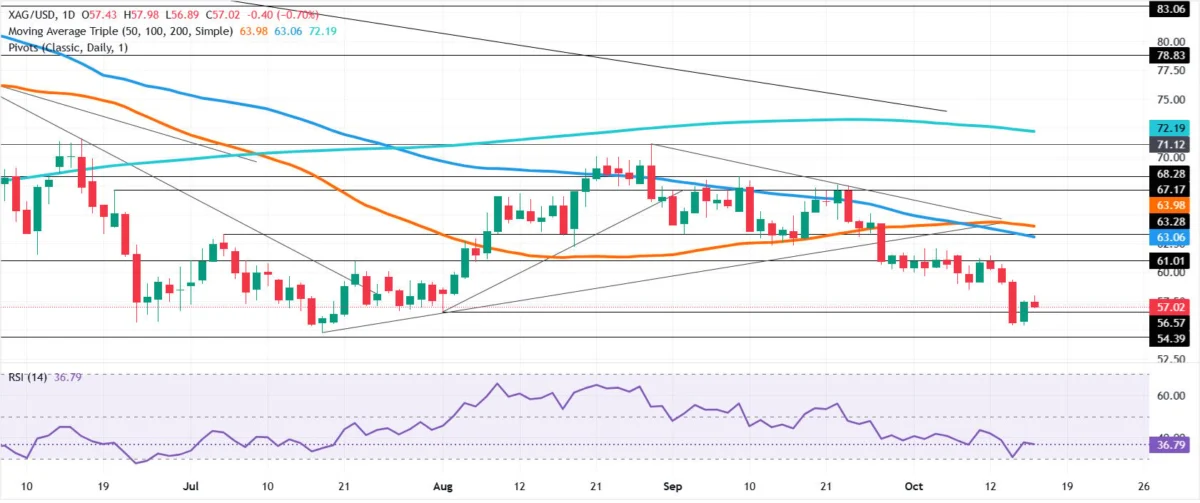
Silver (XAG/USD) is poised to conclude the current trading week with substantial losses, having decisively fallen below the critical $60.00 support level. This breach exacerbated a sell-off that drove the white metal to a weekly low of $55.38. As of the latest market observations, Silver is exchanging hands near the $57.00 mark, reflecting a notable decline of 0.83% in intraday trading and significantly more over the past five sessions. This downturn signifies a challenging period for precious metal investors, with bearish momentum firmly taking hold of the market.
A Deeper Dive into Silver’s Recent Trajectory
The recent price action for XAG/USD illustrates a clear reversal of fortunes for the metal, which had shown periods of resilience earlier in the year. The breach of the psychological $60.00 threshold is not merely a technical event; it reflects a confluence of macroeconomic factors and shifting market sentiment. For weeks leading up to this decline, silver had been attempting to consolidate gains, often finding support around the $60.00-$62.00 range. However, persistent headwinds, including a strengthening US Dollar and evolving expectations around global interest rates, have ultimately pressured the commodity lower. The descent towards $55.38 represents a significant retracement, placing it perilously close to its year-to-date (YTD) lows, signaling a potential re-evaluation of its immediate future by market participants.
Technical Outlook: A Bearish Dominance
The technical indicators paint a predominantly bearish picture for Silver. The Relative Strength Index (RSI), a key momentum oscillator, continues its downward trajectory, nearing oversold territory. While an oversold RSI can sometimes signal a potential bounce, its current extended decline implies that sellers remain firmly in control, exerting sustained pressure on prices. This suggests that any short-term rallies might be met with renewed selling interest, reinforcing the current bearish trend.
From a structural perspective, the immediate challenge for XAG/USD is to prevent further losses below the $55.00 milestone. Should this level fail to hold, the next critical support would be the year-to-date (YTD) low of $54.77. A break below the YTD low would be a significant technical event, potentially triggering further liquidation. Beyond this, market analysts are eyeing the November 13, 2025, high-turned-support at $54.39 as the next line of defense. A failure to maintain these levels could open the path for a more substantial decline, with the psychological $50.00 mark becoming a plausible target, a level not seen in a considerable period.
Conversely, for a bullish reversal to materialize, Silver would first need to reclaim the October 14 high at $59.37, which now acts as a significant supply zone. Surpassing this level would pave the way for a retest of the crucial $60.00 mark, transforming it from resistance back into support. Further upside targets include the 100-day Simple Moving Average (SMA) at $63.06, followed by the 50-day SMA at $63.98. A sustained move above the 50-day SMA would be a strong bullish signal, potentially opening the path to challenge the $65.00 level and indicate a more robust recovery. However, given the current momentum, such a reversal would require significant catalysts or a fundamental shift in market dynamics.
Macroeconomic Headwinds and Influencing Factors
Silver prices are highly sensitive to a complex interplay of macroeconomic variables, making its recent decline a reflection of broader global economic currents.
- The Dollar’s Dominance: As a dollar-denominated asset, the strength of the US Dollar (USD) exerts considerable influence over XAG/USD. A stronger Dollar makes silver more expensive for holders of other currencies, thereby dampening demand. Recent weeks have seen a robust performance by the Dollar, largely driven by expectations of higher-for-longer interest rates from the Federal Reserve, making US assets more attractive. This dynamic has acted as a significant headwind for silver, contributing directly to its downward pressure.
- Interest Rate Expectations and Monetary Policy: Central bank policies, particularly those of the U.S. Federal Reserve, are paramount. Silver, being a yieldless asset, tends to perform better in environments of lower interest rates, as the opportunity cost of holding a non-yielding asset decreases. The current hawkish stance by many central banks globally, aimed at combating inflation, has led to higher real interest rates. This environment generally favors interest-bearing assets over precious metals, diminishing silver’s appeal.
- Industrial Demand Under Scrutiny: Unlike gold, which is primarily a monetary asset and store of value, silver also has significant industrial applications. It boasts the highest electrical conductivity of all metals, making it indispensable in sectors such as electronics, solar energy, and medical devices. A significant portion of global silver demand comes from these industrial uses. Concerns about a potential global economic slowdown or recession can dampen industrial activity, thereby reducing demand for silver and putting downward pressure on its price. Major economies like the US, China, and India play crucial roles here; China’s vast industrial sector and India’s strong consumer demand for jewelry are key determinants of overall silver demand. Any slowdown in these regions can have a ripple effect on silver prices.
- Safe-Haven Appeal vs. Industrial Utility: Silver holds a dual identity as both a safe-haven asset and an industrial commodity. In times of geopolitical instability or deep recession fears, it can attract investment seeking safety, albeit to a lesser extent than gold. However, when industrial demand wanes due to economic contraction, its role as a safe haven might not be sufficient to offset the decline, especially if other factors like a strong dollar or high interest rates are also at play. The current environment seems to be weighing more heavily on its industrial side, coupled with a strong dollar.
The Gold-Silver Ratio: A Relative Value Indicator

The relationship between gold and silver prices is often analyzed through the Gold/Silver ratio, which indicates how many ounces of silver are needed to purchase one ounce of gold. This ratio serves as a vital tool for investors to assess the relative valuation of the two precious metals. When the ratio is high, it can suggest that silver is undervalued compared to gold, or conversely, that gold is overvalued relative to silver. Conversely, a low ratio might imply that gold is undervalued in relation to silver.
Historically, silver prices tend to follow gold’s moves, given their similar status as safe-haven assets. However, silver’s higher volatility and industrial demand component mean its price swings can be more pronounced. The current market conditions, with both metals facing headwinds from a strong dollar and high interest rates, make monitoring this ratio particularly important. If gold maintains its value better than silver during a downturn, the ratio would increase, potentially signaling silver’s relative weakness or presenting a future buying opportunity for those who believe in a reversion to the mean.
Analyst Perspectives and Market Sentiment
Market analysts are closely watching the $55.00 mark, recognizing its significance as a potential breaking point for silver’s short-term trajectory. Many point to the current macroeconomic landscape—specifically, persistent inflation, aggressive central bank tightening, and growing recessionary fears—as the primary drivers behind silver’s underperformance. Some experts suggest that while silver’s industrial demand component offers long-term growth potential, particularly with the global push towards renewable energy and electronics, the immediate future is dictated by monetary policy and currency strength.
Institutional investors and commodity traders appear to be taking a cautious stance, with net long positions potentially being reduced as the metal breaches key support levels. This shift in sentiment often leads to further selling pressure, creating a self-reinforcing cycle. However, some long-term investors may view the current dip as an opportunity to accumulate silver at lower prices, anticipating a future rebound once the macroeconomic environment stabilizes or shifts more favorably towards precious metals.
Implications for Investors
The recent decline has significant implications for various types of silver investors:
- Physical Silver Holders: Individuals holding physical silver (coins, bars) might see a depreciation in the nominal value of their assets in the short term. However, many physical holders adopt a long-term perspective, viewing silver as a hedge against inflation and currency debasement, and may be less concerned by short-term fluctuations.
- Exchange Traded Funds (ETFs) and Derivatives: Investors in silver-backed ETFs or those trading silver derivatives are more directly exposed to daily price movements. The current bearish trend could lead to losses for those with long positions, while offering opportunities for those employing short-selling strategies.
- Industrial Users: Industries reliant on silver for manufacturing might welcome lower prices, as it reduces their input costs, potentially boosting profit margins or allowing for more competitive product pricing.
Looking Ahead: Key Levels and Potential Reversal Triggers
The immediate focus for XAG/USD remains on the $55.00 support level. A breach could lead to an accelerated decline towards $54.77 (YTD low), $54.39, and potentially $50.00. On the upside, reclaiming $59.37 and subsequently $60.00 are crucial steps for any meaningful bullish reversal. Beyond technical levels, a fundamental shift would be required to trigger a sustained rebound.
Potential catalysts for a bullish reversal could include:
- A weaker US Dollar: Any indication of a pivot in the Federal Reserve’s hawkish stance or a general weakening of the dollar against other major currencies would provide significant relief for silver.
- Easing Inflationary Pressures: If inflation shows clear signs of moderation, central banks might become less aggressive with interest rate hikes, making yieldless assets more attractive.
- Renewed Industrial Demand: Stronger-than-expected global economic data, particularly from major industrial economies, could boost demand for silver’s industrial applications.
- Increased Geopolitical Uncertainty: A significant escalation in global tensions could rekindle silver’s safe-haven appeal, driving investment demand.
In conclusion, silver’s recent plunge below $60.00 marks a challenging week for the white metal, underscoring the dominance of bearish sentiment driven by a strong dollar and hawkish monetary policies. While its industrial utility and long-term safe-haven properties offer underlying value, the immediate outlook remains cautious, with market participants keenly watching key technical levels and broader macroeconomic developments for signs of a potential turnaround.
