

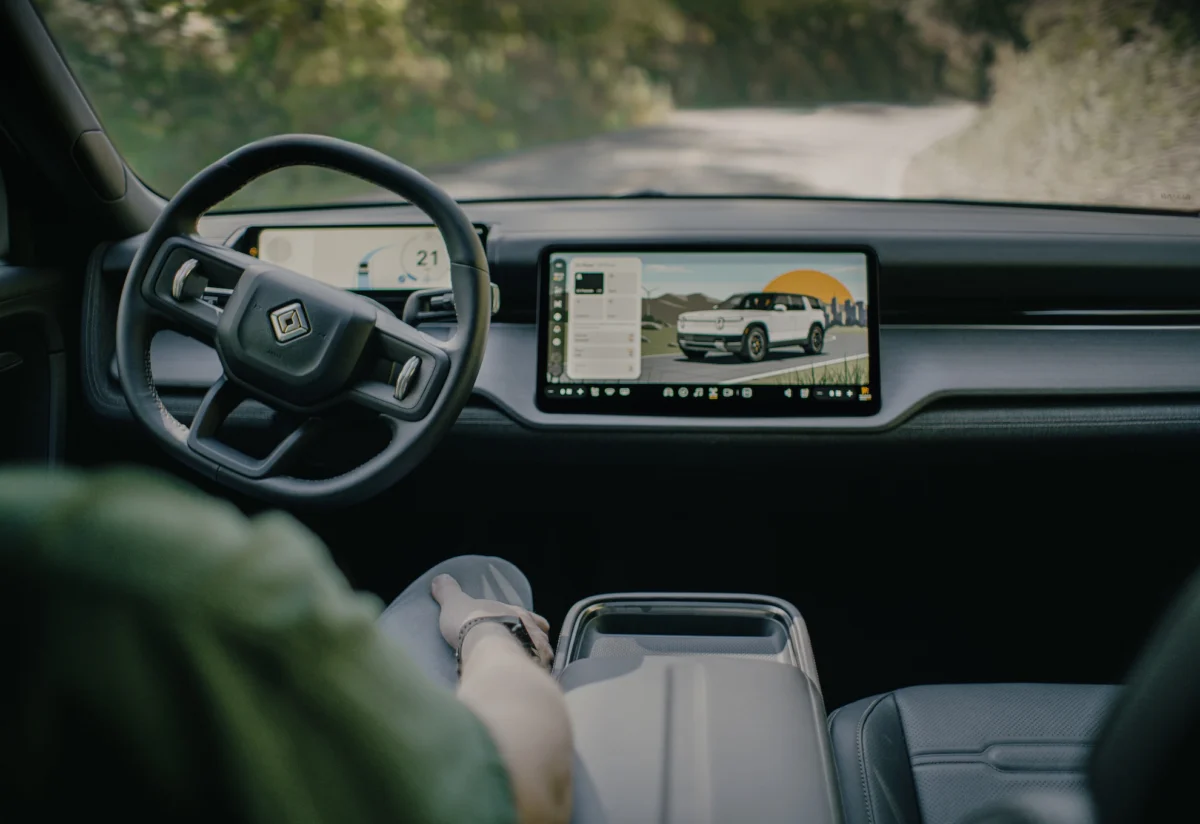
Rivian, the Irvine, California-based electric vehicle manufacturer, announced on Thursday a landmark partnership with ride-sharing giant Uber, aimed at developing and deploying thousands of fully autonomous robotaxis based on Rivian’s highly anticipated R2 SUV platform. This strategic alliance, potentially worth up to $1.25 billion for Rivian, signals a significant acceleration in the race towards widespread autonomous mobility and offers a critical financial and strategic lifeline to the nascent EV maker.
The collaboration will commence with an initial $300 million investment from Uber into Rivian, underscoring Uber’s confidence in Rivian’s technological capabilities and manufacturing prowess. As part of the agreement, Uber is committed to purchasing 10,000 fully autonomous R2 robotaxis, with a planned commercial rollout beginning in San Francisco and Miami in 2028. This initial order is a substantial endorsement for Rivian’s yet-to-be-produced R2 platform, which is designed to be a more accessible and higher-volume offering than its existing R1T pickup and R1S SUV. Beyond the initial commitment, Uber retains the option to acquire up to 40,000 additional autonomous R2 SUVs from Rivian starting in 2030, which would propel the total value of the deal to the projected $1.25 billion. The ambitious long-term vision for this partnership includes launching these robotaxis in 25 cities across the U.S., Canada, and Europe by the end of 2031, with the entire fleet operating exclusively on Uber’s extensive network.
Rivian’s Strategic Pivot and the Ambitious Autonomy Journey
For Rivian, this partnership represents a pivotal moment, validating its significant investment in autonomous driving technology and providing a crucial revenue stream as it navigates the capital-intensive landscape of EV manufacturing. Founded in 2009 by RJ Scaringe, Rivian initially gained prominence for its "adventure lifestyle" electric vehicles, the R1T pickup and R1S SUV, alongside a major contract to supply electric delivery vans to Amazon. While celebrated for its innovative design and performance, Rivian has faced substantial financial challenges, including slower-than-expected production ramp-ups, high manufacturing costs, and a constant need for capital infusion to scale operations and develop new models. The R2, unveiled earlier this year, is central to Rivian’s strategy to achieve profitability by expanding into a more competitive, mid-market segment.
The pursuit of automated driving technology has long been a top priority for Rivian and its founder, RJ Scaringe. His vision for the company extends beyond simply building electric vehicles; it encompasses transforming the entire driving experience through advanced autonomy. This commitment was prominently highlighted during Rivian’s inaugural "Autonomy & AI Day" in December, where Scaringe hinted at the company’s intention to explore opportunities in the ride-share sector, a clear precursor to the Uber announcement.
Scaringe’s strategic foresight led to a significant overhaul of Rivian’s approach to driver assistance in 2021. The company abandoned its previous rules-based framework in favor of an AI-first strategy. This modern approach leverages large language models (LLMs) to train the autonomous system, enabling it to perceive and navigate the world with greater sophistication and adaptability. This automated driving system is meticulously designed to learn continuously from real-world fleet data, progressively enhancing its capabilities and increasing its autonomy over time.
The culmination of this development effort is the Rivian Autonomy Platform, which made its debut in 2024 with the automaker’s second-generation R1 vehicles. This platform serves as the foundational technology for Rivian’s multi-stage plan to escalate autonomous capabilities. Initially, it offers hands-free driving on designated highways. The company anticipates introducing a point-to-point navigation feature later this year, which aims to automate driving controls throughout entire journeys, marking a significant step towards full autonomy.
Rivian’s ultimate goal is to offer a hands-off, eyes-off system through a hardware upgrade. This upgrade, expected to launch in a version of the R2 SUV in late 2026, will include the addition of a lidar sensor and a high-performance "autonomy computer" capable of processing an astounding 5 billion pixels per second. While these features are highly advanced, they are not yet classified as fully autonomous driving systems, which necessitate no driver intervention or responsibility.
The startup is, however, deeply committed to achieving that ultimate level of automated driving. At its autonomy day, Rivian articulated plans for what it terms "personal L4," referencing Level 4 autonomy as defined by the Society of Automotive Engineers (SAE). SAE Level 4 signifies a high degree of automation where the vehicle can operate autonomously within a specific operational design domain (ODD) without any human intervention required. Scaringe reiterated this commitment at SXSW 2026, stating, "Our path to get to hands-off, eyes-off in 2027 is something we’re spending more money on than anything else." He expressed profound optimism regarding the pace of progress in autonomous technology: "If you were to look at the progress in autonomy in the last five years and try to use it as a rough metric or gauge to predict the next five years, you would be wildly wrong. The rate of progress is so much different than looking forward five years than looking backwards five years. The past, in this case, is not a good predictor of the future."
Navigating Formidable Hurdles and Risks for Rivian
Despite the immense potential, this agreement with Uber is fraught with considerable risks and challenges for Rivian. The most immediate obstacle is the R2 SUV itself. While unveiled to much fanfare, the R2 has not yet entered production, with manufacturing expected to commence by June. Crucially, Rivian has not yet tested and deployed a self-driving system specifically designed and validated for robotaxi operations, which requires a much higher safety and reliability threshold than consumer-facing ADAS (Advanced Driver-Assistance Systems).
Adding another layer of complexity, the R2 robotaxis are slated to be built at Rivian’s Georgia factory, a massive undertaking that is still under construction. The completion of this facility, its successful commissioning, and the ramp-up of R2 production to meet the demands of both consumer sales and the Uber partnership, all by 2028, represent an enormous logistical and financial challenge. Delays in factory construction or production could severely impact the partnership’s timeline and Rivian’s financial stability. The capital expenditure required for the Georgia plant and the continued R&D in autonomy will continue to be a significant drain on Rivian’s resources, even with Uber’s initial investment.
Moreover, the competitive landscape for autonomous vehicles is intensely challenging. Companies like Waymo (Alphabet), Cruise (GM, currently facing significant operational hurdles), Nuro, Motional (Hyundai/Aptiv), and Mobileye (Intel) have spent billions of dollars and many years developing and deploying autonomous systems. Tesla, while pursuing a different strategy with its "Full Self-Driving" (FSD) software, also represents a major player in the broader autonomy race. Rivian’s success will depend on its ability to rapidly mature its technology, ensure its safety, and efficiently scale production amidst these established players.
Uber’s Strategic Play in the Autonomous Ride-Hailing Market
For Uber, this partnership with Rivian is a calculated and significant step in its long-term strategy to dominate the future of ride-hailing. Having famously sold its own autonomous vehicle division (Advanced Technologies Group, or ATG) to Aurora in 2020 after years of massive investment and limited success, Uber has pivoted to an asset-light partnership model. This strategy allows Uber to leverage the specialized expertise and significant capital investments of AV developers and automakers, mitigating its own risk and R&D costs, while focusing on its core strength: managing a vast, global ride-hailing platform.
Uber’s approach is characterized by a diversified fleet strategy, partnering with multiple dedicated robotaxi and autonomous vehicle companies worldwide. This redundancy ensures that Uber is not beholden to a single technology provider and can deploy different solutions based on regional needs, technological maturity, and competitive dynamics. Its most prominent partnership to date is with Waymo, whose robotaxis are already operating on Uber’s app in key markets like Austin and Atlanta. Uber also has deals with Motional (operating in Las Vegas), China’s Baidu, and is a major investor in the U.K. startup Wayve, with plans to launch a robotaxi service in Tokyo this year with Wayve and Nissan. Last year, Uber also announced a partnership with Lucid Motors and Nuro to build robotaxis based on Lucid’s Gravity SUV, with commercial deployment expected by the end of this year in San Francisco.
The economic imperative for Uber to integrate robotaxis is clear. The rising costs associated with human drivers, including wages, benefits, and incentives, alongside persistent driver shortages in many markets, pose significant challenges to Uber’s profitability and scalability. Autonomous vehicles promise a future of dramatically reduced operational costs, increased service availability, and potentially lower fares for consumers, which could significantly boost demand and market share. By removing the human driver, Uber aims to improve its unit economics and create a more predictable and scalable service.
Broader Industry Implications and Future Outlook
The Rivian-Uber deal carries significant implications for both the electric vehicle and autonomous driving industries. For Rivian, it represents a substantial validation of its technological direction and an injection of capital that could be crucial for its long-term viability. It also signifies a strategic diversification beyond consumer and commercial fleet sales, positioning Rivian as a key player in the burgeoning mobility-as-a-service (MaaS) sector.
For the broader autonomous vehicle industry, this partnership underscores the accelerating trend of collaboration between ride-hailing platforms and AV developers/OEMs. It signals growing confidence in the eventual widespread deployment of Level 4 autonomous vehicles, even as significant technical, regulatory, and public acceptance hurdles remain. The 2028 target for initial deployment, followed by a rapid expansion to 25 cities by 2031, if achieved, would represent one of the most aggressive robotaxi rollouts to date.
The convergence of electric vehicle platforms and autonomous driving technology is also a critical theme highlighted by this deal. EV architectures are inherently well-suited for autonomous systems due to their simpler drivetrain, easier integration of sensors and computing power, and often, their "software-defined" nature. This partnership further solidifies the notion that the future of mobility will be both electric and autonomous.
However, regulatory environments remain a patchwork across different regions and even within countries. Navigating the legal and safety frameworks for L4 operations in the U.S., Canada, and Europe will require significant effort and coordination. Public perception and trust, often shaken by high-profile incidents involving autonomous vehicles, will also be crucial for successful widespread adoption.
Analyst perspectives on the autonomous vehicle market remain a blend of cautious optimism and realism. While the technological progress has been immense, the path to truly scalable and profitable L4 operations has proven longer and more complex than initially anticipated by many. This Rivian-Uber deal, however, serves as a powerful testament to the ongoing belief in the transformative potential of robotaxis and the willingness of major players to commit substantial resources to make this future a reality. It could very well be a bellwether for more such OEM-ride-hailer collaborations in the years to come, reshaping urban transportation and the very concept of car ownership.
