

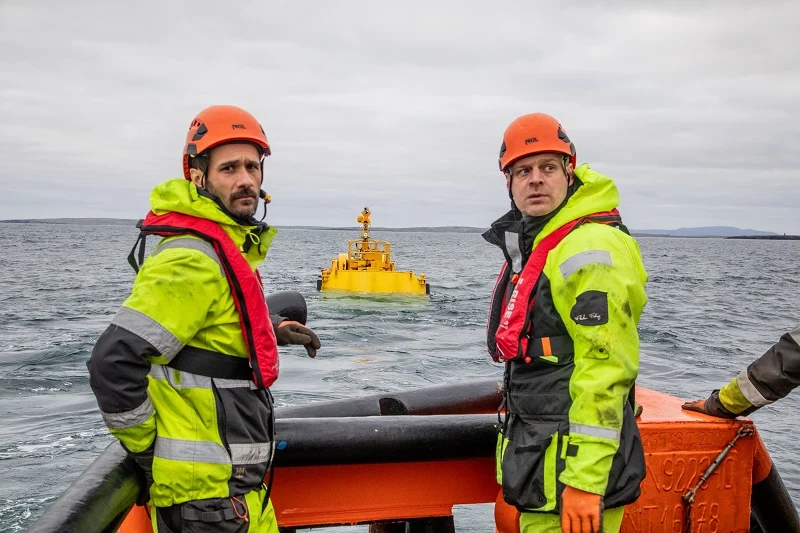
The global surge in artificial intelligence is driving an unprecedented demand for electricity, pushing traditional power grids to their limits and forcing technology giants to seek alternative energy solutions. In this climate of escalating power needs, the Scottish company Mocean Energy has unveiled a strategic pivot that could redefine the relationship between renewable energy and digital infrastructure. By integrating wave energy converters with modular offshore data centers, the company aims to solve the dual challenges of power availability and cooling requirements that currently plague the onshore data center industry. This concept, known as Blue Core, represents a significant evolution in the application of marine energy, positioning it not just as a competitor to wind and solar, but as a specialized solution for the high-intensity computing demands of the 21st century.
The Convergence of Marine Engineering and Hyperscale Computing
As AI models become more complex, the hardware required to train and run them—primarily Graphics Processing Units (GPUs)—demands vast amounts of electricity and generates significant heat. Mocean Energy’s Blue Core is designed as a modular offshore data center powered by a combination of wave energy and offshore solar, supported by integrated energy storage and high-performance computing capacity. According to Mocean Energy’s managing director, Cameron McNatt, the project is a response to a clear market gap. While traditional utility-scale energy markets often prioritize the lowest levelized cost of energy (LCOE), new technologies like wave power often struggle to compete with established onshore wind and solar on price alone. However, by targeting a niche, high-value application like offshore computing, wave energy can leverage its unique advantages: reliable power generation, proximity to natural ocean cooling, and the ability to bypass congested land-based power grids.
The core of the technology lies in Mocean’s proprietary wave energy converter. Unlike traditional designs that attempt to resist the ocean’s force, Mocean’s device features a distinctive nose-down hull geometry. This design allows the machine to respond dynamically to wave motion, capturing energy more efficiently in moderate seas while naturally "diving" through larger, potentially damaging waves. This "survivability by design" is a critical feature for any infrastructure intended to house millions of dollars worth of sensitive computing equipment in the harsh environments of the North Sea or the Pacific Ocean.
Addressing the Data Center Energy Crisis
The urgency of the Blue Core initiative is underscored by the current state of the global data center market. According to the International Energy Agency (IEA), data centers, artificial intelligence, and the cryptocurrency sector accounted for nearly 2% of global electricity demand in 2022, a figure that could double by 2026. In major hubs like Ireland, data centers already consume roughly 20% of the nation’s total electricity. This rapid growth has led to a "gridlock" in several jurisdictions, where new data center applications are being denied or delayed due to a lack of available power capacity.
"The sort of power required for data centers has jumped by a factor of 10 in the past five years," McNatt noted, highlighting that the bottleneck is often not the generation of power itself, but the time and capital required to build the necessary grid connections. Furthermore, onshore data centers face increasing social and environmental scrutiny. Large facilities are often criticized for their noise, their consumption of local water supplies for cooling, and their visual impact on the landscape. By moving these facilities offshore, Mocean Energy proposes a "blue" alternative that utilizes the ocean’s thermal mass for cooling, thereby eliminating the need for vast quantities of fresh water and reducing the noise and land-use conflicts associated with terrestrial sites.
Technical Evolution: From Blue Star to Blue Core
The development of Blue Core is not a leap into the unknown but a calculated progression from Mocean’s existing "Blue Star" technology. The Blue Star system was originally designed to provide reliable, low-carbon power to subsea equipment in the offshore oil and gas sector. In that industry, providing small amounts of power to remote equipment—such as valves or sensors—often requires kilometers of expensive cabling. Mocean’s wave converters proved they could provide a cost-effective, localized power solution for these "off-grid" marine applications.
Blue Core scales this concept for the digital age. The system is designed around modular units rated between 500kW and 1MW. To put this in perspective, a single 1MW unit is capable of powering several racks of high-density GPUs. The long-term vision involves "data center farms" consisting of hundreds of these units daisy-chained together via fiber-optic cables. These farms would not be tethered to a specific geographic location by physical grid constraints. Instead, they could be deployed anywhere with a viable wave resource—from the rugged coasts of Scotland to Western Australia or the U.S. West Coast. Connectivity would be maintained through low Earth orbit (LEO) satellite constellations, such as SpaceX’s Starlink or Amazon’s Project Kuiper, allowing these offshore farms to function as a "virtual" global hyperscale facility.
Strategic Timeline and Operational Hurdles
Mocean Energy is currently in the data collection and modeling phase, with plans to deploy a test unit as early as next year. This pilot program will be crucial in addressing the primary concerns of the technology industry: reliability and maintenance. Operating sophisticated electronics in a saltwater environment presents significant engineering challenges, primarily regarding corrosion and mechanical vibration.
To mitigate these risks, the computing hardware in the Blue Core units will be housed in a sealed, nitrogen-filled environment to exclude moisture and oxygen, effectively neutralizing the threat of corrosion. Furthermore, the motion of the wave energy converter is characterized by long-period, sinusoidal oscillations rather than high-frequency vibrations. This smooth motion is intended to protect the physical integrity of the GPU racks.
Maintenance, however, remains a logistical hurdle. Unlike an onshore facility where a technician can replace a failed server in minutes, an offshore unit requires a vessel and favorable weather for access. Mocean’s strategy involves "graceful degradation," a design philosophy where the system is built with enough redundancy that individual GPU failures do not compromise the entire facility. When a certain threshold of maintenance is required, the modular unit can be disconnected and towed back to shore. Mocean is also exploring the use of autonomous propulsion, which would allow the units to return to port for servicing without the need for human-crewed support vessels, significantly reducing operational costs.
Economic Implications and Business Models
The commercialization of Blue Core represents a shift from selling hardware to selling services. Mocean Energy is exploring a "GPU-as-a-Service" (GPUaaS) model, which McNatt identifies as having the highest risk-reward ratio. In this scenario, Mocean would not just provide the power and the housing; it would own the computing infrastructure and rent out processing power to AI developers and researchers. This model aligns with the growing "on-demand" market for AI training and inference, where companies seek to scale their computing needs without investing in their own physical infrastructure.
Industry analysts suggest that this approach could be particularly attractive to "sovereign AI" initiatives—nations looking to build their own independent computing capacity without straining their domestic energy grids. By utilizing international waters or exclusive economic zones (EEZs), countries could deploy offshore data centers that operate independently of land-based resource constraints.
Broader Impact on the Renewable Energy Sector
The success of the Blue Core project could have far-reaching implications for the wider wave energy industry. Historically, wave energy has struggled to reach the commercial maturity of wind and solar due to the harshness of the marine environment and the high costs of early-stage development. By identifying the data center market as a high-value "anchor tenant," Mocean Energy may provide the financial bridge necessary for wave energy to reach economies of scale.
Furthermore, the project highlights a growing trend of "co-location" in the blue economy. Just as offshore wind farms are being explored as sites for green hydrogen production, Mocean’s vision suggests that the ocean could become a multi-purpose industrial zone where energy generation, storage, and data processing happen in a localized, circular system.
As the world moves toward a future where digital and physical infrastructure are inextricably linked, the Blue Core concept serves as a blueprint for sustainable growth. "Engaging with AI and data centers is like being a part of this humongous revolution," McNatt concluded. "It’s going to be one of the most significant things that happens in our lifetime." For Mocean Energy, the challenge now lies in proving that the ocean—long a source of mystery and power—can also become the backbone of the global digital economy. The upcoming trials will be watched closely by both the energy and technology sectors as they seek to navigate the complexities of the AI-driven energy transition.
