

Following a pivotal discussion with Russian President Vladimir Putin, President Donald Trump declared on Friday that Russia would immediately commence the supply of over 300,000 tons of diesel to the United States and global energy markets. This initial shipment is slated to be followed by subsequent deliveries of 500,000 tons in November, with a further commitment of 1 million tons thereafter. The first tranche of 300,000 tons translates to approximately 2.2 million barrels, a volume that represents slightly more than half a day’s demand for distillate fuels, primarily diesel, in the United States. This significant announcement comes amidst ongoing global energy market volatility and heightened concerns over fuel supplies and pricing.
A Strategic Policy Shift: OFAC General License 135
Crucially, on the same day as President Trump’s announcement, the U.S. Treasury Department’s Office of Foreign Assets Control (OFAC) issued General License 135. This license explicitly authorizes the sale and import of Russian diesel, including its entry into the U.S. market, with an effective period extending until April 7, 2027. The issuance of General License 135 marks a notable adjustment in U.S. energy policy, particularly given the backdrop of existing sanctions against Russia stemming from geopolitical events. Historically, the U.S. had moved to curb imports of Russian energy products as part of broader economic pressure. This new license signals a strategic prioritization of energy supply and price stability, allowing for specific exceptions to established sanctions regimes.
The general license delineates the permissible scope of transactions, providing legal clarity and certainty for entities involved in the trade and transport of Russian diesel. It effectively removes the legal barriers that previously prevented U.S. companies from engaging in such commerce, opening a channel for a significant volume of fuel to enter the market. The long-term validity of the license, spanning several years, suggests a more enduring policy decision rather than a short-term emergency measure, indicating a calculated effort to diversify supply sources and exert downward pressure on diesel prices over an extended period.
A Pattern of Intervention: Stabilizing Diesel Markets
This latest initiative represents the second significant move by President Trump within a week aimed at stabilizing global diesel supplies and prices. Just days prior, on October 2, European Union countries, acting at President Trump’s request, agreed to a French proposal to release diesel stockpiles. That coordinated action was intended to provide immediate relief to tight European markets, which had been grappling with elevated prices and supply chain disruptions. The back-to-back interventions underscore the administration’s proactive stance on energy security and its determination to address inflationary pressures driven by high fuel costs.
The global diesel market has been under considerable strain due to a confluence of factors, including robust post-pandemic industrial demand, geopolitical tensions disrupting traditional trade routes, and refinery capacity constraints. Diesel is a critical fuel for a wide array of economic activities, powering transportation (trucking, rail, shipping), agriculture, construction, and industrial machinery. Shortages or significant price spikes in diesel can have cascading effects across the economy, leading to increased costs for goods and services, and ultimately contributing to broader inflation. By securing additional supplies and facilitating their entry into the market, the administration aims to mitigate these economic risks.
Market Repercussions: Diesel Futures and Crude Oil Dynamics
The announcement had immediate and discernible effects on global energy markets. New York diesel futures, which had been trading near elevated levels, experienced a notable decline following the news. Prices dropped to approximately $4.67 per gallon, giving back most of the gains observed in the preceding trading session. This price point translates to roughly $196 per barrel, a significant premium when compared to West Texas Intermediate (WTI) crude oil, which was trading near $90.50 per barrel at the time.
This differential, known as the "crack spread," represents the profit margin that refiners earn from converting crude oil into refined products like diesel. A margin exceeding $100 per barrel, as seen previously, indicates highly profitable conditions for refiners. The introduction of Russian cargoes directly into the market, however, increases competition for domestically produced diesel. A smaller crack spread, resulting from increased supply, diminishes the incentive for refiners to pay up for WTI crude, thereby potentially exerting downward pressure on crude oil prices as well.
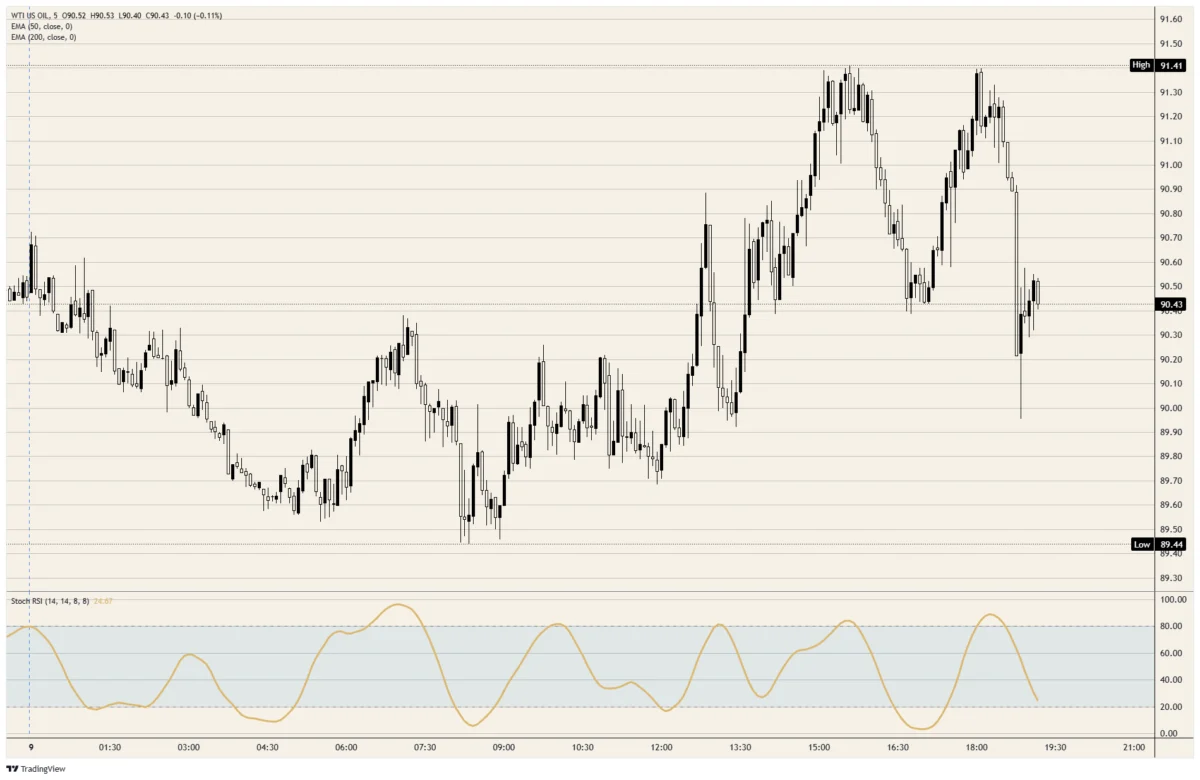
Indeed, the impact was also felt in the crude oil market. Spot WTI prices, which had been hovering near $91.00 per barrel, fell to just under $90.00 in the immediate aftermath of the announcement. This decline occurred swiftly within two five-minute trading bars, erasing approximately three-quarters of the climb from the session’s low of just under $89.50. The drop came after WTI had twice approached, but failed to decisively break above, the $91.50 resistance level, suggesting that market participants quickly priced in the potential for increased diesel supply to cool broader energy prices.
On the charts, WTI has since recovered marginally to trade near $90.50, positioning itself in the middle of the session’s range between $89.50 and $91.50. Intraday momentum indicators, which had previously signaled overbought conditions, rapidly shifted towards oversold territory during the drop and continued to trend downwards, reflecting the abrupt change in market sentiment.
The Geopolitical and Economic Context of US-Russia Energy Relations
The decision to permit the import of Russian diesel represents a complex interplay of economic necessity and geopolitical realities. For several years, particularly following events in Eastern Europe, the United States and its allies imposed various sanctions on Russia, targeting its financial sector, key individuals, and its lucrative energy industry. These measures were designed to isolate Russia economically and limit its ability to fund certain activities. The U.S. had, for a period, banned imports of Russian crude oil and refined products, contributing to a significant reshuffling of global energy trade flows.

However, the global energy landscape has evolved dramatically. Post-pandemic economic recovery led to surging demand, while supply struggled to keep pace due to underinvestment, production cuts, and ongoing disruptions. The resulting energy crunch, characterized by elevated gasoline, diesel, and natural gas prices, became a major inflationary driver globally. For the United States, which relies heavily on diesel for its vast logistics and agricultural sectors, high prices posed a direct threat to economic stability and consumer purchasing power.
U.S. diesel inventories, in particular, have been a point of concern. For much of the past year, distillate fuel stocks in the U.S. Northeast, a key consumption hub, have lingered at historically low levels, at times dipping to multi-decade lows. This scarcity, exacerbated by limited refining capacity expansions and strong export demand for U.S. refined products, created a vulnerable market susceptible to price spikes. In this context, the administration’s move to tap into Russian supplies, even with the associated geopolitical complexities, underscores the perceived urgency of addressing domestic energy security and cost pressures.
Domestic Energy Landscape: Demand, Inventories, and Refining Capacity
The United States is one of the world’s largest consumers of diesel fuel. Its trucking industry, responsible for moving the vast majority of goods across the country, is entirely dependent on diesel. Farmers rely on diesel for tractors and harvesting equipment, while construction sites and industrial facilities utilize it for heavy machinery and power generation. A stable and affordable supply of diesel is therefore paramount to the functioning of the American economy.
According to data from the Energy Information Administration (EIA), U.S. demand for distillate fuels, which includes diesel and heating oil, typically averages around 4 million to 4.5 million barrels per day. The initial 2.2 million barrels from Russia, while substantial, provides a snapshot of the scale of domestic consumption. The subsequent larger shipments of 500,000 tons (approximately 3.7 million barrels) and 1 million tons (approximately 7.3 million barrels) would represent more significant injections into the market, equivalent to roughly one day’s and nearly two days’ worth of U.S. demand, respectively, assuming they are primarily directed to the U.S.
The U.S. refining industry, while robust, has faced challenges. Capacity has seen modest declines over the past decade, and maintenance outages can temporarily reduce output. Moreover, refiners are often incentivized by export markets, especially in Latin America and Europe, where demand for U.S. refined products can be very strong. This competitive environment sometimes means that domestic supplies face pressure, even when crude oil is abundant. The direct import of Russian diesel, therefore, serves as an external supply shock designed to bypass some of these domestic market dynamics and directly boost available inventory.
Reactions and Analysis: A Calculated Risk?
The decision is likely to elicit a range of reactions. From an economic perspective, businesses and consumers struggling with high fuel costs will likely welcome any measure that promises price relief. Industry analysts generally view increased supply as a positive for market stability and inflation control. The U.S. Treasury’s involvement through OFAC indicates a carefully considered policy decision, balancing geopolitical considerations with domestic economic imperatives.
However, the move is also likely to spark debate. Critics might argue that it undermines the broader sanctions regime against Russia, potentially sending mixed signals to international allies who have maintained stricter embargoes. Environmental groups might also raise concerns about increased reliance on fossil fuels, especially from a source traditionally viewed as geopolitically challenging.
From a strategic standpoint, this action suggests a pragmatic approach to energy policy. It acknowledges that in certain critical sectors, market stability and affordability may, at times, necessitate temporary or specific deviations from broader geopolitical postures. It also highlights the intricate global interconnectedness of energy markets, where actions by one major producer or consumer can ripple across continents.
Looking Ahead: Economic and Strategic Implications
The inflow of Russian diesel, facilitated by OFAC General License 135, has several key implications. Economically, it aims to alleviate inflationary pressures by increasing supply in a tight market. If successful, this could translate into lower pump prices for consumers and reduced operating costs for businesses, potentially bolstering economic growth.
Strategically, it underscores the U.S. administration’s willingness to leverage all available options to ensure energy security, even if it means navigating complex geopolitical waters. The duration of the license suggests a long-term strategy to incorporate diverse supply sources, rather than a reactive, short-term fix. This could lead to a more diversified global energy market, but also potentially complicates international diplomatic efforts if not carefully managed.
The market will closely monitor the actual delivery of these volumes and their impact on U.S. diesel inventories and prices. While the initial market reaction has been positive for consumers, the broader geopolitical ramifications and the long-term sustainability of such a policy will be subject to ongoing scrutiny and debate. The coming months will reveal the full extent of this strategic pivot and its effectiveness in balancing the imperatives of energy security, economic stability, and international relations.
