


The New Zealand Dollar (NZD) concluded the trading week on an upward trajectory against its American counterpart, the US Dollar (USD), registering a gain of 0.55% to close at 0.5652. This movement was primarily driven by a palpable weakening of the Greenback, as market participants expressed increasing skepticism regarding the likelihood of a Federal Reserve (Fed) interest rate hike in October. This sentiment persisted despite recent US economic indicators pointing towards stubbornly high inflation, shifting investor focus towards upcoming critical inflation data from New Zealand.
The Fed’s Conundrum: Inflation vs. Patience
Friday’s slate of US economic data, while largely robust, failed to sway market expectations towards a more aggressive stance from the Federal Reserve. The central bank’s report indicated a significant acceleration in Industrial Production for September, growing 0.7% month-over-month, surpassing both analysts’ estimates and August’s revised 0.1% expansion. This data underscored underlying strength in the manufacturing sector.
However, the primary focus remained firmly on inflation metrics. The release of the US Consumer Price Index (CPI) revealed an annual inflation rate of 3.7% year-over-year, exceeding the consensus forecast of 3.6%. Simultaneously, the Producer Price Index (PPI) surged to 6.3% year-over-year, a full percentage point above expectations of 5.3%. These figures, typically strong catalysts for hawkish monetary policy speculation, surprisingly did not translate into increased odds for an October Fed rate increase. According to Prime Terminal data, the probability of a Fed hike in the current month remained remarkably low at just 16%.
This apparent disconnect between strong inflation data and muted rate hike expectations highlights a deeper dilemma within the Federal Reserve. For months, the Fed has navigated a delicate balance, aiming to cool an overheated economy without triggering a severe recession. After an aggressive hiking cycle that saw the federal funds rate climb from near-zero to its current range of 5.25%-5.50% over 18 months, policymakers appear to be favoring a wait-and-see approach. The prevailing narrative among many Fed officials suggests a preference for patience, allowing the cumulative effect of past rate increases to fully materialize within the economy.
Several prominent Fed officials have articulated this stance. While some projections from the September Federal Open Market Committee (FOMC) meeting indicated the possibility of two further rate hikes by 2026, with the first of those already implemented, the near-term rhetoric emphasizes prudence. For instance, comments from various governors have implied that a December rate hike is more plausible than one in October, granting the committee additional time to assess incoming data. Conversely, some members, like Cleveland Fed President Beth Hammack, have voiced concerns over the persistence of inflation, noting its stubbornness above the Fed’s 2% target for an extended period, now five and a half years. This division underscores the ongoing internal debate about the appropriate pace and duration of monetary tightening.
Adding to the uncertainty, Fed Chair Kevin Warsh (note: the original article mistakenly refers to a "Fed Chair Kevin Warsh"; Jerome Powell is the current Fed Chair) delivered a speech at the IMF forum on Friday but conspicuously refrained from offering explicit forward guidance on future interest rates. While acknowledging the underlying resilience and strength of the US economy, his silence on monetary policy specifics further contributed to the market’s skepticism about an immediate rate adjustment. This lack of definitive direction from the central bank’s leadership often leads to increased volatility and a more cautious stance from investors.

New Zealand’s Economic Docket: Awaiting Critical Inflation Data
In contrast to the data-heavy week in the US, New Zealand’s economic calendar remained relatively light. However, market attention is rapidly shifting towards a series of crucial data releases scheduled for the upcoming week, which could significantly influence the Reserve Bank of New Zealand’s (RBNZ) monetary policy outlook.
On October 18, the Trade Balance report is expected, offering insights into New Zealand’s export and import dynamics. While important, the highlight of the week will undoubtedly be the release of the Consumer Price Index (CPI) for the third quarter, due shortly thereafter. This data, reported on both a quarterly and yearly basis, is paramount for the RBNZ, as it directly informs their mandate of maintaining price stability. The RBNZ’s inflation target is set at 1-3% over the medium term, with a focus on keeping it near the 2% mid-point.
Should next week’s New Zealand CPI data come in hotter than anticipated, it could serve as a powerful catalyst, prompting investors to fully price in an RBNZ rate hike at its upcoming October 28 meeting. Currently, market odds, as reflected in various financial instruments, stand at approximately 85% for the RBNZ to hold rates steady, with a further 40 basis points of tightening priced in towards the end of the year. However, a significant upside surprise in inflation could quickly shift these probabilities, potentially leading to an earlier and more aggressive tightening cycle.
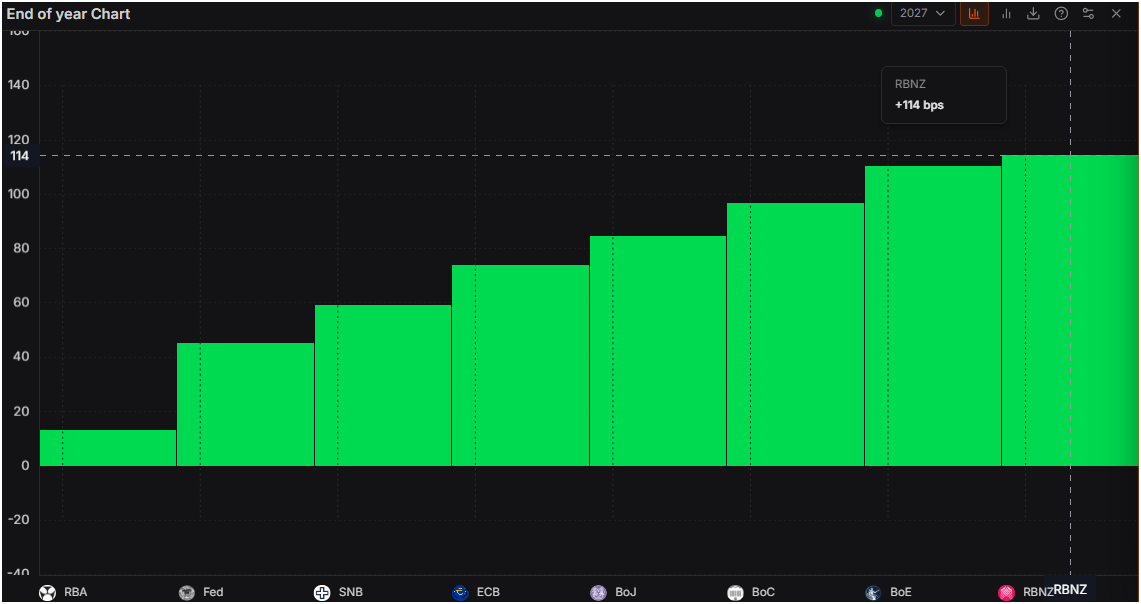
It is noteworthy that money markets, looking further out to 2027, had already priced in a substantial 114 basis points of tightening by the end of that year. This reflects a broader perception of the RBNZ as one of the more hawkish central banks among major currencies, often demonstrating a proactive approach to combating inflationary pressures. The RBNZ has a history of aggressive rate hikes, having been one of the first central banks to begin tightening in the post-pandemic era, illustrating its commitment to its inflation mandate.
Rate Differentials and Global Context: The Backdrop for NZD/USD
Despite the recent uptick in the NZD/USD pair, a significant interest rate differential continues to favor the US Dollar. Currently, US interest rates are 125 basis points higher than those in New Zealand. This substantial gap inherently exerts downward pressure on the NZD/USD, as higher yields in the US attract capital flows, making USD-denominated assets more appealing to investors seeking better returns. For the NZD to sustain a significant rally, this differential would need to narrow, either through aggressive RBNZ hikes or substantial Fed cuts, or a combination of both.
The broader global economic landscape also plays a crucial role in the NZD’s performance. The New Zealand Dollar, often referred to as the "Kiwi," is considered a commodity currency. Its value is intrinsically linked to global commodity prices, particularly dairy, as New Zealand is a major exporter of dairy products. Furthermore, the health of the Chinese economy significantly impacts the Kiwi, given China’s status as New Zealand’s largest trading partner. Any signs of robust growth in China or rising global commodity prices tend to bolster the NZD, while slowdowns or price drops can exert downward pressure.
Moreover, the NZD tends to strengthen during "risk-on" periods, when global investor sentiment is optimistic, and appetite for riskier assets increases. Conversely, during times of heightened market turbulence or economic uncertainty, investors often seek the safety of traditional safe-haven currencies like the US Dollar, leading to a weakening of the Kiwi. The current environment, characterized by uncertainty surrounding global inflation, central bank policies, and geopolitical tensions, creates a complex backdrop for currency movements. The recent skepticism around a Fed hike, coupled with the potential for hawkish signals from the RBNZ, temporarily shifted the risk perception in favor of the NZD.
Technical Outlook: Signs of a Potential Reversal
From a technical perspective, the NZD/USD pair has recently demonstrated signs of stabilization and a potential reversal from its recent lows. The price action indicates that the pair found a strong bottom within the 0.5580-0.5600 range, which subsequently triggered a rally towards an 11-day high of 0.5674 before settling at its current levels. This rebound suggests that selling pressure around these lower thresholds may be dissipating.
Despite the daily Simple Moving Averages (SMAs) still signaling a prevailing bearish bias, a closer examination of momentum indicators offers a glimmer of hope for the bulls. The Relative Strength Index (RSI), a key oscillator that measures the speed and change of price movements, suggests that momentum is shifting bullishly. While the overarching downtrend remains intact, this bullish divergence in the RSI could be an early indication of a nascent reversal in the price trend.
For the NZD/USD to confirm a more sustained bullish trajectory, it would need to reclaim the significant resistance level of 0.5750. A successful breach above this mark could pave the way for a further ascent towards the confluence of the 50-day and 100-day SMAs, which currently reside in the 0.5775-0.5781 range. Overcoming this combined resistance zone would be a strong bullish signal, potentially opening the door for the pair to challenge the 200-day SMA, situated above the 0.5800 psychological milestone at 0.5838. A move to these higher levels would indicate a more significant shift in market sentiment and technical momentum.
Conversely, for the bearish trend to resume its dominance, the NZD/USD must decisively drop below its October 14 swing low of 0.5564. A breach of this support level would likely trigger further downside momentum, with the 0.5500 psychological mark serving as the next critical target for sellers. Sustained trading below this level would reinforce the bearish outlook and could lead to a retesting of multi-year lows.
In conclusion, the New Zealand Dollar’s recent strength against the US Dollar is a nuanced development, primarily fueled by a dovish shift in market perceptions regarding the Fed’s immediate actions, even in the face of persistent US inflation. This has redirected investor attention towards New Zealand’s upcoming inflation data, which holds the potential to significantly alter the RBNZ’s policy path. While technical indicators hint at a possible reversal, the broader fundamental landscape, particularly the substantial interest rate differential, will continue to play a pivotal role in shaping the NZD/USD’s trajectory in the weeks and months ahead. The interplay between global risk sentiment, commodity prices, and the diverging policy paths of the Fed and RBNZ will be critical determinants for the Kiwi’s future performance.
