

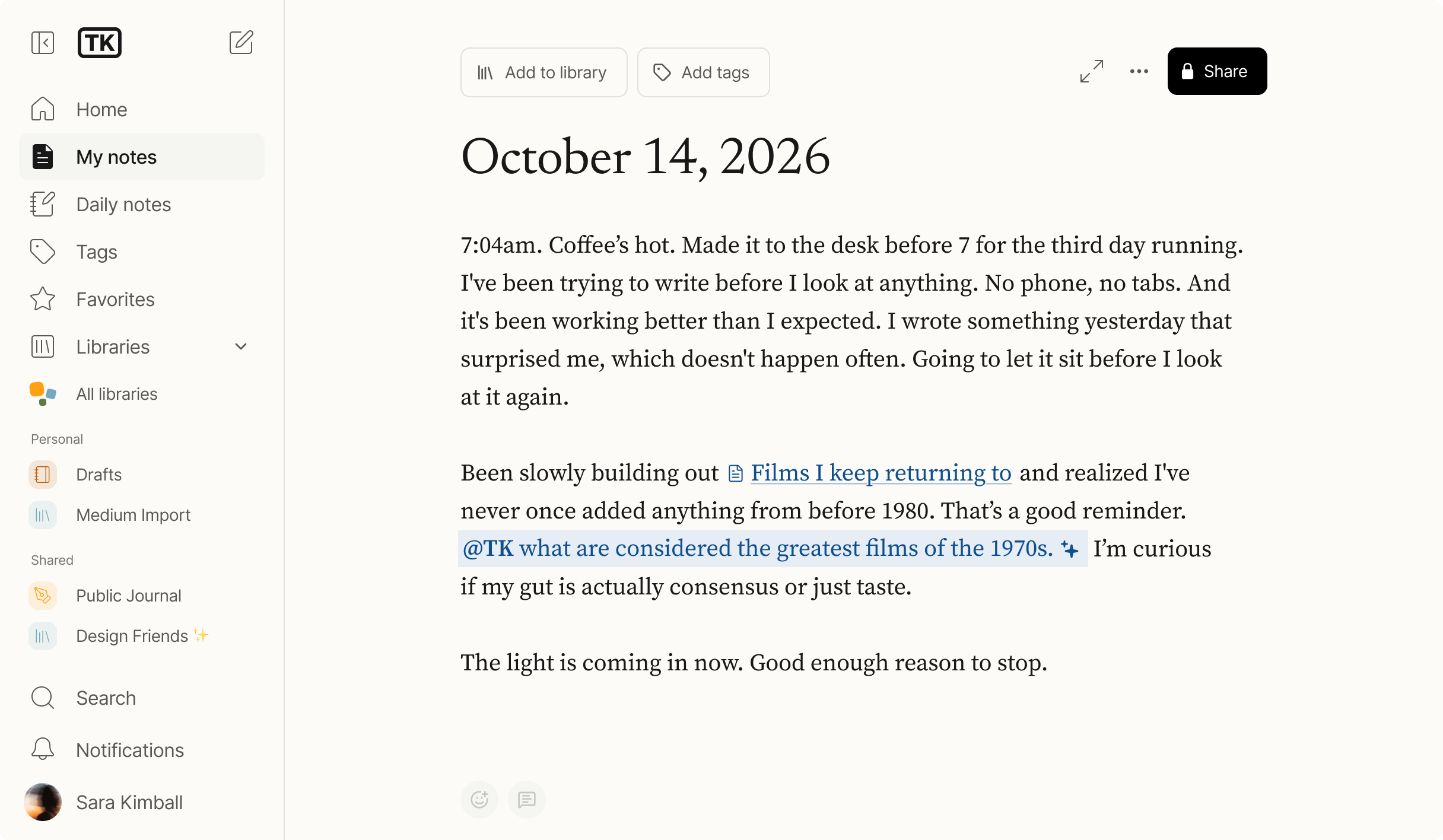
Online publishing giant Medium on Monday launched a groundbreaking new application named TK, designed to embed artificial intelligence directly into the core of the writing process. This strategic move aims to streamline the journey from nascent ideas to polished prose by integrating an AI assistant within the editor itself. Users can summon this intelligent co-pilot by simply typing "@TK" followed by their query or prompt, signaling a significant shift in how writers might interact with their tools.
Bridging Ideas to Execution: How TK Works
The name "TK" itself carries a profound historical resonance within the fields of publishing and journalism. It is a venerable placeholder, standing for "to come," used by editors and reporters to mark sections where missing information or additional details are required before publication. The deliberate use of ‘K’ instead of ‘C’ for "to come" ensures its distinctiveness, as the "tk" letter combination is rare in English, making it highly visible to proofreaders and ensuring no critical information is overlooked. In Medium’s new application, TK cleverly repurposes this traditional journalistic marker, transforming it from a symbol of absence into an active agent designed to help users fill in those blanks.
At its core, TK functions as an intelligent assistant capable of a range of tasks intended to reduce friction in the writing workflow. It can rapidly answer factual questions that would typically necessitate switching to an external browser tab, such as confirming the number of days in a specific month. More impressively, the app is engineered to recall and integrate snippets of writing previously saved within the platform, allowing users to draw upon their evolving ideas and research as they flesh out their drafts. This capability promises to transform the app into a dynamic "private notebook" where thoughts can not only be recorded but actively nurtured and expanded with AI guidance.
Beyond simple factual retrieval and memory assistance, Medium emphasizes TK’s sophisticated editorial capabilities. The app is set to ship with specialized "skills" for providing editorial feedback, suggesting compelling headlines, and even adapting a draft to conform to the specific style guides of various Medium publications. This level of integrated, context-aware assistance positions TK not merely as a grammar checker but as a comprehensive editorial partner, aiming to elevate the quality and consistency of user-generated content across the platform.
Amplifying Human Intelligence: Medium’s AI Philosophy
Medium’s bold embrace of AI at the nascent stages of writing positions it firmly in the ongoing, often contentious, global debate surrounding artificial intelligence in creative industries. The company articulates a clear philosophical stance, asserting that "artificial intelligence makes writing more important, not less." This perspective frames AI not as a replacement for human creativity but as a powerful amplifier of human intelligence, with the written word serving as its fundamental bedrock.
This proactive stance from a major publishing platform reflects a growing conviction among certain tech leaders that AI’s true potential lies in augmenting human capabilities rather than supplanting them. Medium envisions TK as a tool that can liberate writers from repetitive tasks, overcome writer’s block, and refine their ideas more efficiently, thereby allowing them to focus on the deeper, more nuanced aspects of their craft. This aligns with broader trends in AI development, where the focus is increasingly on human-AI collaboration rather than full automation, particularly in creative domains. The company’s belief is that by providing intelligent assistance, TK can foster a more prolific, articulate, and diverse ecosystem of content creation.
Navigating the AI Frontier: Industry Reactions and Concerns
Medium’s move, while innovative, inevitably steps into a highly charged environment where the publishing and literary worlds are grappling intensely with the ethical and practical implications of AI-generated content. The past few years have seen a rapid acceleration in AI’s capabilities, particularly with the advent of sophisticated large language models (LLMs) like those powering tools such as ChatGPT, Jasper, and Copy.ai. This technological leap has sparked a profound reckoning within creative sectors, raising fundamental questions about authorship, intellectual property, and the very nature of human creativity.
Numerous high-profile incidents underscore the industry’s anxieties. Several authors have reportedly lost lucrative book deals due to suspicions, sometimes substantiated, that they employed AI technology to assist in their writing process. Literary awards have also faced intense scrutiny, with past winners and nominees coming under fire for allegedly using AI assistance, leading to debates over the legitimacy and criteria of such accolades. These controversies highlight a palpable fear within the literary community: that the distinct human voice, the unique perspective, and the arduous craft of writing could be diluted or even overshadowed by machine-generated prose.
A primary concern revolves around the blurring lines between AI assistance and AI generation. While writers have long utilized automated tools for basic proofreading and grammatical corrections—tools like Grammarly have become ubiquitous—there is a growing apprehension that an AI assistant’s "suggestions" can subtly or overtly transform into the writing itself, rather than merely reflecting or refining the writer’s original thoughts. This raises critical questions about attribution and authenticity, particularly when AI models are trained on vast corpora of human-written text, leading to concerns about potential plagiarism or homogenization of style.
Furthermore, the efficacy and reliability of AI detection tools themselves are under significant debate. Since AI models learn from human writing, accurately distinguishing between content written with AI assistance, content generated by AI, and purely human-created text remains a complex challenge. This ambiguity complicates efforts by publishers and institutions to enforce policies against AI use, creating a "grey area" that tools like TK are now entering with explicit intent.

Cultivating Trust: TK’s Stance on Transparency
Medium acknowledges these legitimate concerns head-on, conceding that AI does indeed raise the specter of low-quality content and the blurring of human-AI distinctions. However, instead of shying away from this debate, TK leans into it, taking the proactive stance that these nuances, while critical now, may ultimately evolve in their significance. Medium champions what AI can bring to the writing world, but critically, it also seeks to establish new norms for transparency and accountability in the AI era.
To address the profound ethical questions surrounding provenance, TK incorporates a novel feature: authors will have the ability to publish "notes" that transparently explain how AI was utilized in the creation of their writing. This mechanism is designed to provide clarity to readers and critics alike, detailing the extent and nature of AI involvement. In a blog post announcing the launch, Medium articulated its vision: "This is a start of what we believe is required to publish in the AI era, which is to make the provenance of writing clear, transparent, and inspectable, right down to the prompting and source material."
This commitment to transparent disclosure represents a significant step towards building trust in an evolving content landscape. By offering tools for writers to explicitly state their use of AI, Medium aims to foster an environment where AI assistance is not necessarily hidden but openly declared, allowing readers to engage with content with full awareness of its origins. This approach could set a precedent for other platforms and publishers, encouraging a new standard of ethical disclosure in the age of generative AI.
A Comprehensive Ecosystem for Creators: Features and Future
Beyond its core AI assistance, TK is designed to be a holistic environment for writers. The app aims to help users remember, organize, and retrieve their previously written content, acting as a dynamic knowledge base tailored to individual projects. It also offers intelligent writing prompts, helping to overcome creative blocks and spark new ideas. A particularly advanced feature is the option to connect TK to a user’s own AI agent via TK’s MCP server or a Claude skill. This integration allows the app to gain a deeper understanding of a user’s ongoing projects, established positions, and other stored ideas, thereby offering more personalized and contextually relevant assistance.
Medium is also integrating a crucial human element into TK through a "social layer" designed for collaboration and feedback. Writers can easily share early drafts of their work with trusted peers or editors within the app, soliciting and receiving human feedback directly. This blend of AI augmentation and human collaboration underscores Medium’s belief that while AI can assist, the ultimate refinement and validation of creative work often benefits from human interaction and perspective.
At its initial launch, TK is accessible as a web-based application, with a dedicated desktop application already on the roadmap, indicating Medium’s commitment to expanding its accessibility and functionality. The app supports the import and export of Markdown files, a popular lightweight markup language for writers, though Medium clarifies that TK itself is not exclusively a Markdown editor. While the writing within TK is not encrypted by default—a design choice made to facilitate collaboration—users will have the ability to set granular access control permissions on their work, ensuring privacy and control over shared documents.
Accessibility and Strategic Positioning
Medium, a profitable online publishing platform, has strategically positioned TK as a free tool for all users with a Medium account. This decision is significant, as it democratizes access to advanced AI writing assistance, potentially attracting a broader base of creators and solidifying Medium’s position as a leading platform for writers. By offering such a powerful tool without an additional subscription fee, Medium aims to lower the barrier to entry for high-quality content creation and foster a more vibrant and diverse ecosystem of voices.
This move by Medium can be seen as a strategic response to the rapidly evolving landscape of content creation. As AI tools become more prevalent and sophisticated, platforms that fail to integrate them risk being left behind. By offering TK for free, Medium not only enhances its value proposition for existing users but also positions itself as an innovator at the forefront of AI integration in publishing, potentially attracting new users seeking cutting-edge writing tools.
The Evolving Landscape of Authorship and Publishing
The launch of TK by Medium is more than just a new app; it represents a significant marker in the ongoing evolution of authorship and publishing in the digital age. It forces a re-evaluation of what constitutes "writing" and "authorship" when artificial intelligence plays an intimate role in the creative process. Will the concept of a sole author diminish, giving way to a more collaborative model between human and machine? How will intellectual property laws adapt to creations where AI has contributed significantly? These are complex questions with no easy answers, and TK serves as a practical experiment in navigating this uncharted territory.
Ultimately, Medium’s TK is a testament to the platform’s vision for a future where technology empowers human expression, rather than diminishing it. By actively engaging with the ethical debates surrounding AI and offering tools for transparency, Medium aims to guide its community through the complexities of the AI era. As writers, readers, and publishers continue to grapple with the implications of artificial intelligence, TK stands as a powerful new entrant, poised to reshape the dynamics of content creation and consumption for years to come.
