

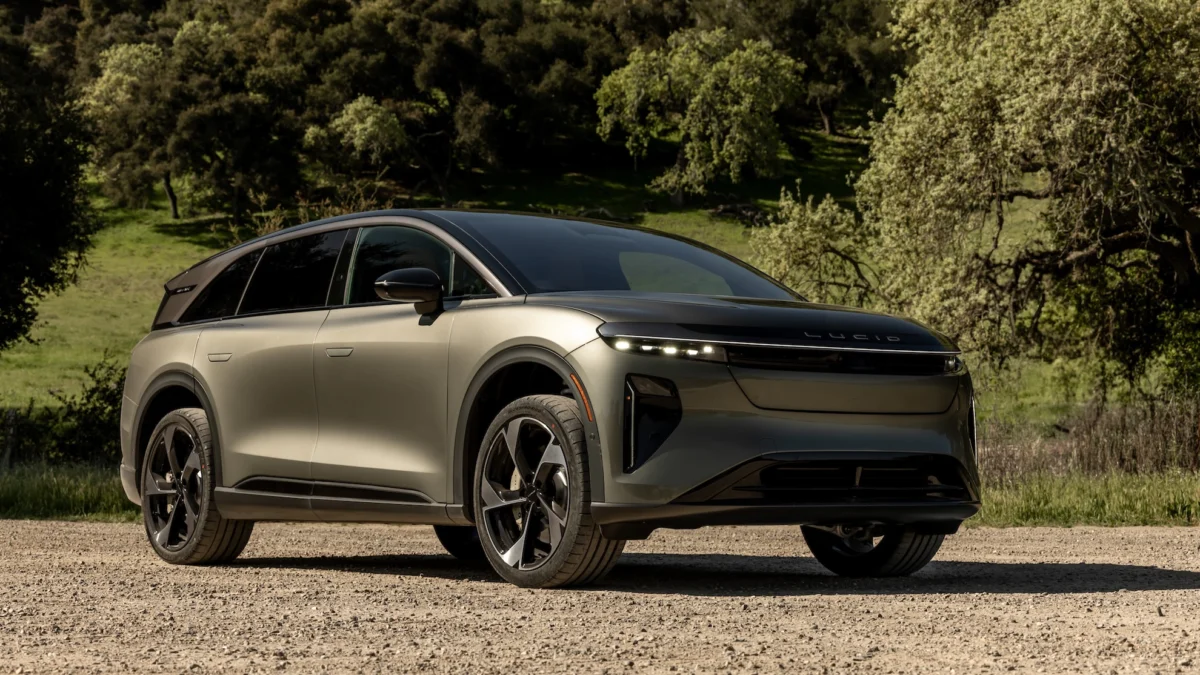
Lucid Motors, the California-based electric vehicle (EV) manufacturer, reported a substantial decline in production for the third quarter of this year, building 2,954 vehicles. This figure represents a sharp 54% decrease compared to the same period a year ago, a deliberate curtailment by the company aimed at better aligning output with actual market demand for its luxury electric vehicles. The pronounced reduction marks the third consecutive quarter of declining production for Lucid and constitutes its lowest quarterly output since the first quarter of 2025, which coincided with the nascent production phase of its second EV model, the Gravity SUV.
While production figures saw a steep decline, deliveries in the third quarter stood at 3,806 EVs. This number remained relatively flat when compared to the second quarter of the current year but indicated a decrease of approximately 200 vehicles from the third quarter of 2025. The persistent disparity between production and delivery figures underscores a fundamental challenge for Lucid: a struggle to attract a sufficiently broad customer base for its premium-priced EV offerings. Over the past six quarters, the company has consistently built more vehicles than it has successfully delivered to customers in five of those periods, signaling an inventory buildup and a fundamental disconnect with market absorption rates.
A Chronology of Challenges and Strategic Shifts
Lucid Motors, initially founded in 2007 as Atieva, rebranded in 2016 with an ambitious vision to redefine luxury electric mobility. After years of development, the company went public in 2021 through a merger with a special purpose acquisition company (SPAC), a transaction that injected approximately $4 billion into its coffers. During this highly optimistic period, Lucid made bold projections, estimating it would ship as many as 90,000 EVs in 2024 alone. These initial forecasts were largely predicated on the anticipated success of its flagship Lucid Air sedan, renowned for its industry-leading range and performance, and the subsequent introduction of the Gravity SUV.
However, the reality has diverged significantly from these early aspirations. The company’s journey since its public debut has been characterized by production ramp-up difficulties, supply chain disruptions, and, critically, slower-than-expected consumer adoption. The first quarter of 2025 marked a significant milestone with the commencement of production for the Lucid Gravity SUV, a vehicle designed to expand the company’s product portfolio beyond the Air sedan. Despite the introduction of a second model, the anticipated surge in demand did not materialize, contributing to the ongoing inventory challenges and underperformance against initial targets.
By mid-2026, the severity of these challenges necessitated a significant leadership and strategic overhaul. Silvio Napoli assumed the role of CEO, initiating a comprehensive effort to "simplify the company" and streamline its operations. This multi-faceted initiative has involved difficult decisions, including a workforce reduction of approximately 1,500 employees, representing about 18% of its staff. Concurrently, the company undertook a significant restructuring of its leadership team and made operational adjustments at its Arizona manufacturing facility, notably eliminating a second production shift. These measures were implemented with the explicit goal of achieving substantial cost savings, projected to reach $1.4 billion.
Further illustrating the strategic re-evaluation, Lucid also announced the delay of its third EV model, the Cosmos. This model is intended to be a more accessible offering, with an anticipated starting price of under $50,000, aimed at tapping into a broader market segment. The deferral of the Cosmos, while potentially prudent to ensure product readiness, also postpones Lucid’s entry into the crucial mid-range EV market, a segment increasingly vital for volume growth.
Deep Dive into Production and Delivery Metrics
The third-quarter production figure of 2,954 vehicles represents a stark contrast to the company’s earlier operational peaks. For context, a 54% year-over-year drop implies that Lucid produced approximately 6,420 vehicles in the third quarter of 2025. This sharp contraction reflects not only the deliberate strategic decision to throttle production but also the underlying demand constraints that have plagued the company. The sequential decline across three quarters suggests a sustained effort to manage inventory levels rather than a temporary blip.
Deliveries, at 3,806 units, while slightly higher than production, highlight the ongoing challenge of clearing existing inventory. The roughly flat delivery performance quarter-over-quarter, and the slight dip from the previous year, underscores the difficulty in stimulating demand for both the Air sedan and the Gravity SUV. The persistent trend of building more vehicles than delivering them in five of the last six quarters indicates that Lucid’s manufacturing capacity has consistently outstripped its sales capabilities. This creates a challenging financial environment, tying up capital in unsold inventory and increasing carrying costs, which is particularly detrimental for a company still striving for profitability.
The disconnect between Lucid’s technological prowess and its market performance has become a focal point for analysts and investors. While the Lucid Air has garnered critical acclaim for its range, performance, and luxurious interior, its premium price point, often exceeding $100,000 for many variants, places it in a highly exclusive segment of the automotive market. This niche has proven smaller and more competitive than initially anticipated, especially as established luxury automakers and other EV startups vie for the same affluent clientele.
The Competitive Landscape and Market Dynamics
The announcement of Lucid’s third-quarter figures arrives at a time of significant dynamism and increasing polarization within the broader EV market. Just days prior, rival EV startup Rivian posted its most successful quarter in history. Rivian, known for its electric trucks and SUVs, shipped nearly 20,000 vehicles in the third quarter, a substantial increase from 12,194 units in the second quarter. A key driver of Rivian’s recent surge has been the introduction of its new, more affordable R2 SUV. Although specific delivery figures for the R2 were not disclosed, its impact on Rivian’s overall sales volume is undeniable, signaling a strong market appetite for more competitively priced, yet still desirable, electric SUVs.
Rivian’s success with the R2 offers a compelling counter-narrative to Lucid’s struggles, particularly concerning the critical role of product pricing and market accessibility. While Lucid’s strategy has historically focused on the ultra-luxury segment, Rivian’s expansion into a slightly lower, yet still premium, price bracket appears to be yielding significant dividends in terms of sales volume and market penetration. This contrast highlights a broader trend in the EV market: while early adopters were often willing to pay a premium for novel technology, the market is maturing, and price sensitivity is increasing, even within the premium segments. Consumers are increasingly seeking value propositions that balance innovation, performance, and cost.
Beyond Rivian, the overall EV market is experiencing a period of adjustment. Growth rates have moderated from their earlier exponential trajectories, and competition is intensifying from both legacy automakers introducing their own electric offerings and a myriad of other startups. Price wars, initiated by market leaders like Tesla, have further complicated the landscape, placing additional pressure on profitability and forcing companies to re-evaluate their pricing strategies and cost structures. For Lucid, operating predominantly in the upper echelons of this market, the challenge is amplified by a relatively smaller addressable market and the high expectations associated with its brand.
CEO Napoli’s Assessment and Future Implications
During Lucid’s second-quarter earnings call in August, CEO Silvio Napoli offered a candid assessment of the company’s performance, acknowledging critical missteps. "While there is no question that Lucid brought leading innovations and outstanding products to the market, we have disappointed on several fronts, and for far too long," Napoli stated. He elaborated on the internal failings, citing a lack of consistent execution, missed commitments, premature product launches, underinvestment in service infrastructure, slow responses to quality issues, and an overly complex organizational structure that hampered decision-making. These admissions underscore the systemic challenges that Napoli’s "simplification" strategy aims to address.
The delay of the Cosmos, Lucid’s planned sub-$50,000 EV, directly ties into Napoli’s commitment to rectify past errors. While a more affordable model could theoretically unlock a significantly wider market segment, Napoli cautioned shareholders against rushing its introduction. "We will not repeat the mistakes of the past by bringing a product to market before it is ready," he affirmed. This cautious approach, while potentially delaying much-needed revenue diversification, is intended to safeguard the company’s reputation and ensure a flawless market entry for a product critical to its long-term viability.
The implications of Lucid’s current trajectory are far-reaching. For investors, particularly those who bought into the company’s initial sky-high valuations and ambitious projections, the sustained underperformance and strategic retrenchment present a significant concern. The company’s ability to achieve its stated cost savings of $1.4 billion will be crucial for its financial health and path to profitability. Continued reliance on external funding, notably from Saudi Arabia’s Public Investment Fund (PIF) which holds a majority stake, may be necessary if operational losses persist.
Furthermore, Lucid’s brand identity is at a critical juncture. Can a company that established itself on ultra-luxury and cutting-edge performance successfully pivot to offer a more mass-market product without diluting its premium image? The success of the Cosmos will not only depend on its price point and features but also on Lucid’s ability to expand its sales, service, and charging infrastructure to support a broader customer base.
In conclusion, Lucid Motors’ third-quarter results underscore a period of profound strategic re-evaluation and operational adjustment. The sharp decline in production, coupled with persistent delivery challenges, reflects the company’s struggle to find its footing in a rapidly evolving and increasingly competitive EV market. Under CEO Silvio Napoli, Lucid is attempting a fundamental reset, prioritizing operational efficiency, cost control, and meticulous product development over rapid expansion. The coming quarters will be critical in determining whether these strategic shifts can successfully navigate Lucid through its current turbulence and position it for sustainable growth in the challenging landscape of electric mobility.
