

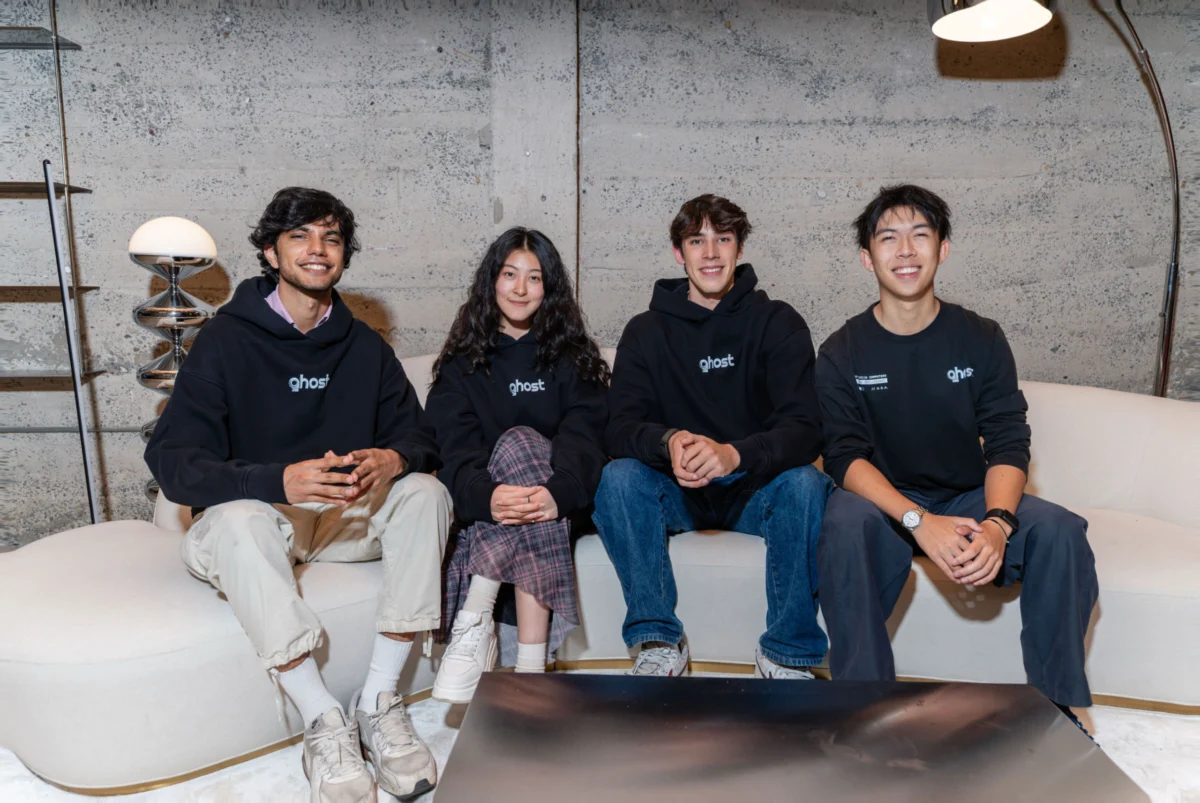
In a significant development for the burgeoning personal artificial intelligence landscape, Ghost, a startup founded by 19-year-old Zain Javaid, has officially emerged from stealth mode, announcing an $11 million seed funding round led by the prominent venture capital firm Andreessen Horowitz (a16z). The company simultaneously unveiled its flagship product, Core, a novel personal computer engineered from the ground up to host and manage AI agents on a user’s behalf. This announcement signals a bold step towards a future where AI assistants are not just cloud-based services but deeply integrated, autonomous entities residing within dedicated personal hardware, promising unprecedented levels of privacy, customization, and continuous operation.
The journey of Ghost began with a profound shift in its founder’s professional aspirations. For much of his formative years, Zain Javaid harbored ambitions of becoming a quantitative analyst, leveraging complex mathematics and data to inform investment strategies. Indeed, he pursued this path for a period, immersing himself in the world of finance. However, a sense of unfulfillment eventually set in. The landscape of his interest dramatically altered in 2022 with the public release of ChatGPT, OpenAI’s groundbreaking conversational AI. "I felt fundamentally excited in a way that I never had been before," Javaid shared with TechCrunch, articulating the catalytic moment that redirected his entrepreneurial drive. This newfound fascination with the potential of artificial intelligence, particularly the concept of "personal AI," became the bedrock upon which Ghost was conceived.
The Genesis of Ghost and Its Vision
The concept of personal AI, as envisioned by Javaid and his team, moves beyond mere chatbot interactions or task automation via cloud services. It posits a future where an AI agent acts as a genuine extension of an individual, deeply understanding their life, preferences, and digital footprint, and proactively taking action to assist them. This vision necessitated a departure from conventional computing paradigms, which Javaid found ill-suited for the continuous, data-intensive demands of truly personal AI. He observed that while existing hardware could run AI models, the user experience was "terrible on many levels," prompting the need for a purpose-built solution.
Ghost’s founding team, a testament to the youthful dynamism often seen in disruptive tech startups, comprises Javaid, CEO of Core, alongside Nicholas Chua, also 19, Yifei Chen, 24, and Gautam Sharda, 23. This lean, agile team spent a year in stealth, meticulously building and refining Core, culminating in Monday’s pivotal announcement. The substantial $11 million seed round, with participation from other notable investors including Abstract, Audacious Ventures, SV Angel, and Nova, underscores the significant confidence the venture capital community places in Ghost’s vision and its potential to carve out a new category in the rapidly evolving AI hardware market. Andreessen Horowitz, known for its early investments in transformative technologies, leading this round, further validates the perceived potential of Ghost’s approach to personal AI.
Core: The Hardware Foundation for Personal AI Agents
At the heart of Ghost’s offering is Core, a compact, screenless personal computer meticulously engineered to serve as the dedicated home for AI agents. The device is designed to centralize a person’s entire digital life—from files on their desktop and applications to data from smart home devices—into a single, secure hardware unit. This centralization enables AI agents running on Core to continuously process information, learn from user interactions, and perform tasks autonomously, acting as a hyper-personalized assistant.
A key differentiator for Core lies in its specialized hardware. Javaid confirmed that Core integrates an Nvidia RTX Pro 4000 SFF Blackwell GPU. While "Blackwell" typically refers to NVIDIA’s next-generation data center architecture, its inclusion in a compact professional-grade GPU for Core signifies a commitment to delivering cutting-edge processing power essential for running complex AI models locally and efficiently. This high-performance GPU is bundled directly into the device’s price, eliminating the need for customers to acquire separate, often expensive, graphics cards.
Beyond its powerful processing unit, Core boasts its own proprietary software layer, a custom browser, and a dedicated filing system. This integrated stack allows the device to operate AI agents continuously and proactively, minimizing the need for constant user prompting. The promise is an AI that doesn’t merely respond to commands but anticipates needs, learns habits, and acts intelligently in the background, making life demonstrably easier for its owner.
Pricing, Availability, and User Interaction
Core is priced at $3,499, positioning it as a premium device for early adopters and tech enthusiasts keen on exploring the frontiers of personal AI. Pre-orders for the inaugural batch opened on Monday, with shipping anticipated for the final week of October.
Interacting with Core, which Javaid aptly describes as a "brain in a box," is primarily facilitated through a companion phone application. While the device itself lacks a screen, users can access its functionalities and interface with their AI agents via the app. A voice mode is also available, requiring users to speak into the Core app rather than directly to the physical unit.
To ensure immediate utility, Core comes preinstalled with three prominent AI models: Qwen-3.8-Next, Qwen-3.8-27B, and Gemma-4-31B. These models represent diverse capabilities and allow users to experience the device’s potential right out of the box. Critically, Core also offers flexibility for advanced users and developers. Owners can install additional models from platforms like Hugging Face, a popular hub for sharing AI models, or even load their own custom-trained models, fostering an open and customizable ecosystem.
Distinguishing Core from General-Purpose Hardware

Javaid was quick to address potential comparisons with existing hardware solutions, particularly Apple’s Mac Mini, which some users configure to run AI tools. He emphasized that Core’s fundamental difference lies in its purpose-built design. "Core’s hardware and software were built specifically for running AI agents, with models already installed," he explained, contrasting it with the Mac Mini, which is a general-purpose computer that can be adapted for AI but lacks the integrated optimization. This distinction is crucial; Core is not merely a powerful computer capable of AI, but a dedicated platform where AI is the primary operational paradigm.
Furthermore, Core leverages a Tesla-like approach to software updates. "As new models or improvements to existing models come out, we can push out over-the-air updates, similar to how Tesla works," Javaid noted. Users will be prompted about new model generations and have the option to switch, or they can enable auto-updates to ensure their agents are always running on the latest available intelligence. This continuous improvement model ensures that Core’s capabilities evolve and adapt with the rapid advancements in AI research.
Commitment to Privacy, Security, and User Autonomy
In an era increasingly concerned with data privacy and digital security, Ghost has placed these principles at the forefront of Core’s design. A cornerstone of the device’s appeal is its commitment to local processing. All models and personal memory operate directly on the device, ensuring that personal information remains encrypted and inaccessible to cloud providers or any third party, including Ghost itself. This architectural choice addresses widespread concerns about data ownership and the potential for surveillance or exploitation of personal information by external entities.
Javaid underscored that users retain ultimate control over their AI agents, including the degree of autonomy they are granted. Crucially, the device is engineered to remain fully functional even if Ghost, the company, were to cease operations. "All of the source code, logic, and model weights live on the device, not the services," Javaid affirmed, highlighting the long-term independence of the hardware. This ensures that the investment in Core is not tied to the perpetual existence of a single company, empowering users with enduring ownership.
To further bolster security, Ghost is developing a sophisticated firewall designed to govern how AI agents utilize credentials, such as login details and passwords. This firewall actively monitors every outgoing network request generated by the computer. If it detects an agent attempting an unsanctioned action or exfiltrating data inappropriately, it will immediately reject the request and flag it for user review. "The user owns all of it," Javaid reiterated, emphasizing that the device, its memory, and all stored data belong exclusively to the owner, processed entirely on the hardware itself.
Market Landscape and Competitive Outlook
The market for AI hardware and personal AI solutions is rapidly expanding, with projections indicating significant growth over the next decade. Industry reports suggest that the global AI hardware market, encompassing everything from specialized chips to dedicated devices, is expected to reach hundreds of billions of dollars, driven by the increasing demand for faster processing, localized AI, and enhanced privacy. Ghost’s entry into this arena positions it at the intersection of several powerful trends: the democratization of AI, the growing preference for edge computing, and escalating privacy concerns.
While Ghost enters a competitive landscape, Javaid expressed confidence in Core’s unique proposition. He acknowledged the formidable resources of established tech giants like Apple, Google, and Microsoft, which are also heavily investing in AI. However, he argued that these incumbents, while possessing the "ingredients" for personal AI, haven’t yet delivered a truly integrated, purpose-built solution. "People sometimes give incumbents credit for having already built the product because they have the ingredients," he observed. While crediting Apple for its hardware prowess and historical disruption, Javaid emphasized that Core’s core innovation lies in its software intelligence: "the model reasons over your life, how it remembers, how it takes action, how it knows when to reach out."
Indeed, the likes of Apple are integrating AI features into their operating systems and hardware (e.g., Apple Intelligence, Neural Engine), and Microsoft is pushing "Copilot+ PCs" designed for on-device AI. However, these are often enhancements to general-purpose devices. Core’s dedicated architecture and philosophy of a "brain in a box" present a distinct alternative, prioritizing the autonomous, continuous operation of AI agents with an emphasis on local data processing and user control. Ghost is betting that this specialized approach will resonate with users seeking a more profound and private integration of AI into their daily lives than what general-purpose devices can offer.
Implications and Future Potential
Core’s potential implications for personal computing are far-reaching. It could catalyze a shift from passive, command-driven interactions with technology to a more symbiotic relationship with intelligent agents that proactively assist and understand. Imagine an AI that, as Javaid illustrated, "proactively sends you a notification that you might be getting sick because it sees your resting heart rate is elevated, sees from computer history that you were up late working on a project, and has seasonal context that it is flu season in San Francisco." This level of contextual awareness and proactive assistance represents a significant leap from current digital assistants.
The success of Core will hinge on several factors, including market adoption, the continuous development of its AI capabilities, and its ability to deliver on the promised seamless user experience. The $3,499 price point might be a barrier for some, but for early adopters and professionals seeking a cutting-edge personal AI solution, the value proposition of privacy, autonomy, and dedicated performance could be compelling. Ghost’s manufacturing strategy, with units currently being built at its San Francisco facility, highlights a hands-on approach to quality control and initial production, crucial for a hardware startup.
Ultimately, Ghost’s ambition, as articulated by Javaid, is to build a product that users genuinely love. "If we can’t do that, Apple isn’t the reason we failed," he stated, underscoring a focus on user experience and core functionality over direct competitive battles. The emergence of Ghost and Core represents a pivotal moment in the evolution of personal AI, offering a glimpse into a future where artificial intelligence is not just a tool but a trusted, autonomous, and deeply personal companion. The backing from Andreessen Horowitz and the innovative approach of its young founders position Ghost as a significant player to watch in the unfolding narrative of AI’s integration into daily life.
