

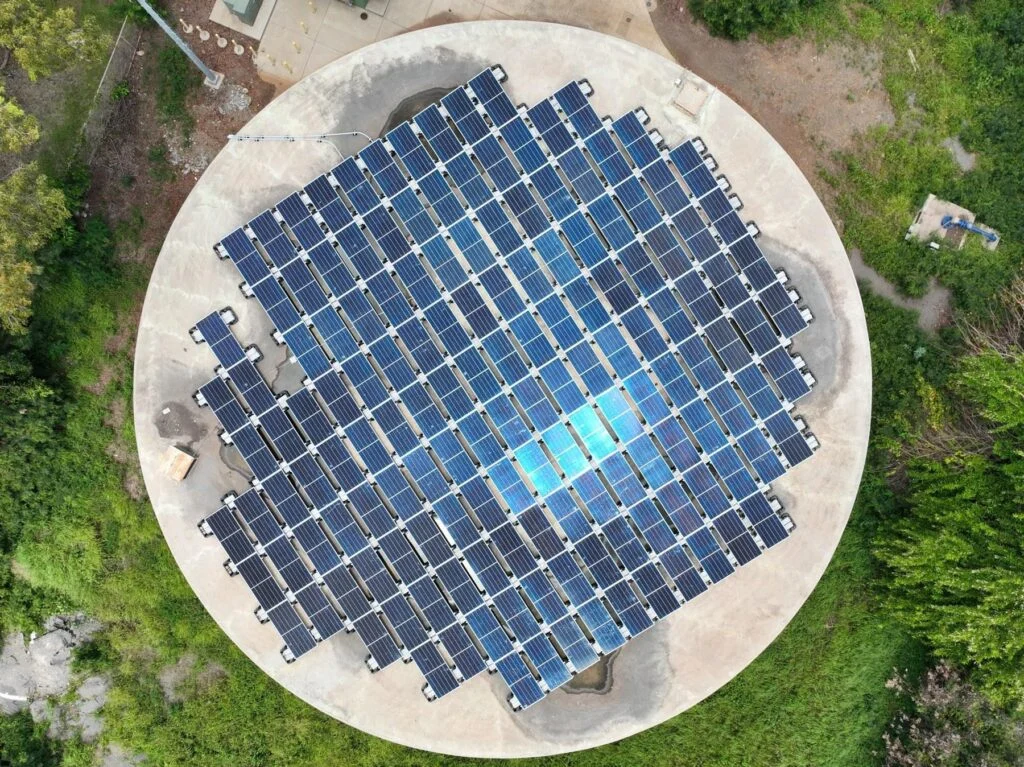
The County of Maui has successfully pioneered a specialized engineering approach to convert its municipal drinking water infrastructure into a source of clean energy, addressing one of the most significant operational expenses in local government. By installing non-penetrating, ballasted photovoltaic (PV) arrays on the circular concrete roofs of its water storage reservoirs, the utility has managed to offset the heavy electrical demands of water pumping and treatment while overcoming the unique structural and geometric constraints of mounting solar panels on containment vessels. This initiative, executed in partnership with program contractor Johnson Controls and engineering firm Pure Power Engineering, represents a significant shift in how municipalities view existing assets in the context of renewable energy goals.
The Economic Imperative of the Water-Energy Nexus
For municipal governments across the United States, the relationship between water and energy—often referred to as the water-energy nexus—is a primary driver of budgetary planning. According to data from the U.S. Environmental Protection Agency (EPA), energy consumption is often the largest controllable operating cost for water utilities, typically accounting for 25% to 30% of total operation and maintenance (O&M) budgets. In many jurisdictions, electricity is the second highest cost for water utilities after labor.
The energy intensity of water services is largely due to the requirements of pumping, processing, and distribution. The EPA notes that roughly 80% of municipal water processing and distribution costs are tied directly to electricity. In island environments like Maui, these challenges are amplified by some of the highest electricity rates in the nation and limited available land for traditional ground-mounted solar arrays. The County of Maui’s decision to utilize the "idle" space on top of its reservoirs directly addresses these economic pressures by placing generation at the site of the load.
Project Overview and Technical Specifications
The Maui portfolio consists of multiple sites featuring low-tilt solar arrays with capacities ranging from approximately 105 to 141 kilowatts (kW)-DC. Unlike traditional rooftop solar installations on commercial or industrial buildings, these projects were mounted on circular concrete reservoirs. These structures are designed primarily for hydrostatic containment rather than as traditional roof decks, necessitating a highly specialized engineering approach.

The project was delivered with a focus on four primary constraints: avoiding roof penetration to maintain the integrity of the water supply, managing the unique circular layout of the reservoirs, balancing wind and seismic ballast requirements, and ensuring that maintenance access for the water utility remained unobstructed. The result is a series of dense, rectangular fields of PV modules that are stepped at the edges to maximize the usable surface area of the circular roofs.
Engineering Chronology: From Assessment to Operation
The development of these tank-mounted systems followed a rigorous chronological progression to ensure safety and longevity.
- Structural Integrity Assessment: Because many of the reservoirs in the portfolio are decades old, the process began with a deep dive into historical records. Structural engineers evaluated original drawings and conducted field evaluations to determine the load-bearing capacity of the concrete. This step was critical because the structural capacity of a water tank is often dictated by its seismic behavior rather than simple gravity loads.
- Geometric Layout and Setbacks: Engineers had to solve the "rectangle-on-a-circle" problem. PV modules are rigid rectangles, while the "site" is a perfect disc. The design team utilized specialized software to model the array, ensuring it stayed within the inner disc of the roof while maintaining specific setbacks from the curved edges.
- Regulatory and Safety Compliance: The layout was designed to comply with the 2018 International Fire Code (IFC), Section 1204.3. This involved maintaining a four-foot clear perimeter pathway and four-foot clearance around all access hatches. By utilizing the Section 1204.3.1 exception for structures where the axis is 250 feet or less, the team was able to reduce the standard six-foot perimeter to four feet, reclaiming valuable space for additional power generation.
- Balance of System (BoS) Installation: To protect the reservoir’s structure, heavy electrical equipment—including inverters, disconnects, and panelboards—was not mounted on the tank itself. Instead, these components were installed on freestanding racks at grade level beside the tanks. Conductors were routed down the tank walls in conduit, using anchors specifically chosen to suit the tank’s construction type without compromising the vessel’s integrity.
The Complex Interplay of Wind and Seismic Forces
One of the most significant technical challenges in tank-mounted solar is the relationship between wind uplift and seismic mass. On high, open ground where reservoirs are typically sited, wind loads are at their peak. In a standard installation, engineers might simply add more ballast (weight) to hold the panels down. However, on a water tank, excess weight is a liability during an earthquake.
The water inside a reservoir reacts dynamically during a seismic event, exerting its own lateral forces against the walls and roof. If a solar array is too heavy, the combined mass of the ballast and the sloshing water could exceed the tank’s structural limits. Therefore, engineers had to treat wind and seismic loads as a single, coupled problem. They utilized an iterative calculation process: sizing ballast to resist wind uplift according to American Society of Civil Engineers (ASCE 7) standards, then immediately checking that mass against seismic limits. The use of low-tilt, low-profile racking was essential here, as it catches less wind and therefore requires less ballast.
Protecting Public Health and Sanitary Integrity
A drinking water reservoir is a critical piece of public health infrastructure. The EPA identifies open access hatches and compromised vent screens as major sanitary risks for "finished-water" storage. If a solar array were to block these features or make them difficult to inspect, the utility could face regulatory penalties or, worse, a contamination event.

The Maui design prioritized "inspection readiness." Maintenance corridors were built into the array layout to allow utility staff to reach vents, hatches, and inspection points without moving panels. Furthermore, the layout accounted for the fact that flat concrete tank roofs often experience "ponding" or water accumulation. Conduit and module supports were routed to avoid these low spots, preventing the trapping of moisture against the concrete, which could lead to long-term degradation or "spalling" of the structure.
Broader Implications for Municipal Energy Strategy
The success of the Maui portfolio offers a blueprint for other water utilities looking to modernize their infrastructure. As municipalities face increasing pressure to meet renewable energy mandates—such as Hawaii’s goal of 100% renewable energy by 2045—the utilization of existing "built" environments becomes paramount.
Land Use Efficiency: This approach eliminates the need for land clearing or the purchase of additional real estate. By using the "fifth facade" of the reservoir, the utility preserves local ecosystems and avoids the "not in my backyard" (NIMBY) opposition that sometimes accompanies large-scale ground-mount solar projects.
Resilience and Distributed Generation: Placing generation at the site of the load increases the resilience of the water system. In the event of a broader grid disturbance, these distributed assets can provide a foundation for microgrid development, ensuring that critical water services remain operational.
Economic Scaling: Treating tank-mounted PV as a repeatable method rather than a bespoke experiment allows utilities to scale their renewable portfolios more efficiently. The discipline applied in Maui—structural assessment first, ballasted non-penetrating arrays, and coupled wind-seismic calculations—can be applied to thousands of similar reservoirs across the country.

Analysis of Future Prospects
The technical success of the Maui projects suggests that the most valuable real estate for municipal solar may not be found in empty fields, but on top of the very infrastructure that consumes the most power. While a reservoir roof is a complex environment with strict sanitary and structural rules, the economic benefits of offsetting pumping loads are too significant to ignore.
As solar technology continues to evolve, we may see the integration of lighter-weight thin-film modules or "bifacial" panels that could further optimize the power density of these circular arrays. For now, the County of Maui has demonstrated that with rigorous engineering and a commitment to protecting the primary function of the asset, the containers that hold a community’s water can also be the engines that power its delivery. This project serves as a clear signal to municipal leaders that the path to a sustainable energy future often runs directly through their existing utility assets.
