

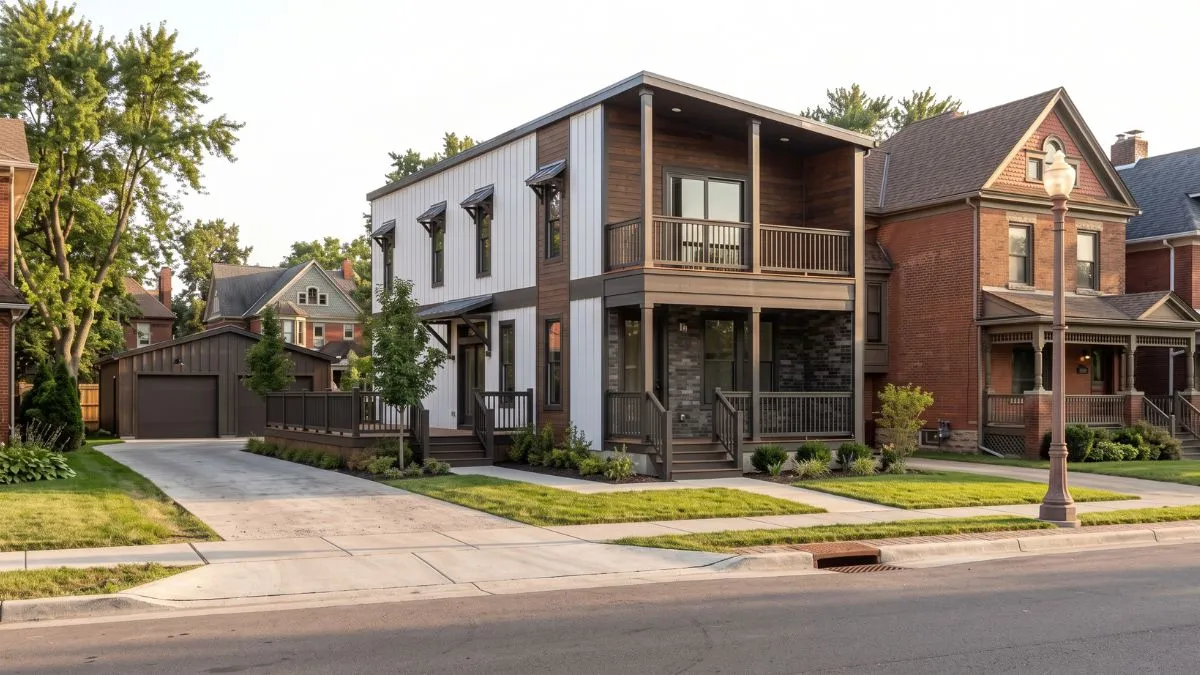
The U.S. Department of Housing and Urban Development (HUD) has officially initiated a transformative era for the American housing market with the release of its "Next Generation Manufactured Housing Action Plan." This strategic roadmap marks the first major step in implementing the 21st Century ROAD to Housing Act, a landmark piece of legislation passed in July that aims to dismantle decades-old regulatory barriers. At the heart of this shift is the removal of the permanent chassis requirement—a move industry experts believe will finally bridge the gap between factory-built efficiency and traditional site-built aesthetics, potentially easing the national housing supply crisis.
For nearly half a century, federal regulations mandated that all manufactured homes be built on a permanent steel chassis. While originally intended to ensure the portability of "mobile homes," the requirement became a significant hurdle for the industry as it evolved toward high-quality, permanent housing. By eliminating this constraint, the new policy allows for the construction of multi-story, high-density, and urban infill developments that were previously impossible under the HUD code. The newly released Action Plan outlines seven specific steps HUD will take to modernize its oversight and integrate these innovations into the broader housing market.
The Seven Pillars of HUD’s Modernization Strategy
The "Next Generation Manufactured Housing Action Plan" is not merely a statement of intent but a structured regulatory overhaul. HUD’s plan details seven critical actions designed to ensure the federal manufactured housing system can support the next generation of factory-built structures while maintaining rigorous safety and quality standards.
-
Modernizing Energy Efficiency Standards:
One of the primary directives of the 21st Century ROAD to Housing Act is the alignment of manufactured housing with modern environmental goals. HUD will conduct formal rulemaking to update the 24 CFR Part 3280 standards. This update is expected to balance the need for lower utility costs for homeowners with the necessity of keeping manufactured housing the most affordable homeownership option in the country. Data from the Department of Energy suggests that modernizing these standards could reduce energy consumption in new manufactured homes by significant margins, providing long-term relief to low-income residents. -
Codifying Chassis-Free Construction:
The most anticipated element of the plan is the revision of Manufactured Home Construction and Safety Standards to accommodate homes built without a permanent steel frame. This involves creating new technical requirements for structural design, lifting, and transportation. Without a chassis, a home must be engineered to withstand the stresses of being moved from a factory to a site using alternative methods, such as cranes or specialized dollies, similar to modular construction. -
Updating Foundations and Installation Protocols:
HUD will revise 24 CFR Part 3285 to address how chassis-free homes are anchored to the ground. The Manufactured Housing Consensus Committee (MHCC) will be tasked with recommending new standards for foundations and structural connections. This is a critical step for local building inspectors and lenders, as it provides a standardized federal framework for homes that will look and function exactly like site-built residences once installed. -
Streamlining Multi-Module Construction:
As the industry moves toward more complex designs, HUD plans to create flexible pathways for homes built in multiple factory sections. This action aims to preserve the "substantial factory completion" benefit of the HUD code while allowing for sophisticated site assembly. This is particularly relevant for the "CrossMod" category of homes, which blend factory-built components with site-built features like garages and porches. -
Developing a Performance-Based Code for Multifamily Structures:
In a significant expansion of its jurisdiction, HUD is developing a performance-based code for residential structures containing five or more units. Current standards are primarily focused on single-family or small-scale multi-unit dwellings (duplexes to quadplexes). The new framework will address the complexities of larger buildings, including shared corridors, fire separation, and accessibility. HUD has already partnered with the National Institute of Building Sciences (NIBS) to support this initiative, signaling a move toward using factory-built technology to solve the "missing middle" housing shortage in urban centers. -
Case Studies and Market Education:
Recognizing that "chassis-free" is a new concept for many stakeholders, HUD will document early pilot projects. These case studies will serve as a resource for zoning boards, appraisers, and lenders. By providing empirical data on how these homes perform in the market, HUD hopes to mitigate the "NIMBY" (Not In My Backyard) opposition that has historically restricted manufactured housing to rural areas. -
The Manufacturer On-Ramp:
To increase the supply of HUD-regulated homes, the agency will develop guidance to help existing modular and off-site manufacturers enter the HUD regulatory system. By reducing barriers to entry, HUD aims to foster a more competitive and diverse manufacturing landscape, encouraging innovation from companies that previously focused only on state-regulated modular builds.
Contextualizing the Regulatory Shift
The transition to a chassis-free environment is the culmination of years of advocacy by groups like the Manufactured Housing Institute (MHI). According to MHI CEO Lesli Gooch, the removal of the chassis requirement is a "blue-sky" moment for the industry. Historically, manufactured homes were stigmatized as "trailers," a perception reinforced by the visible steel hitch and frame. By allowing these homes to be placed on permanent masonry foundations without a chassis, the industry can now produce homes that are indistinguishable from traditional site-built houses.
This shift comes at a time when the United States is facing a housing deficit estimated at between 4 million and 7 million units. Data from the U.S. Census Bureau indicates that the average cost per square foot for a manufactured home is roughly half that of a site-built home—approximately $85 per square foot compared to over $160 for traditional construction. By bringing this cost efficiency to urban and suburban infill markets, HUD believes it can significantly lower the barrier to homeownership for millions of Americans.
Industry Leaders Prepare for a New Market
While the regulatory framework is still being finalized, the industry’s major players are already showcasing what is possible. At the 2024 Innovative Housing Showcase in Washington, D.C., industry giants Champion Homes and Cavco Industries debuted prototypes that challenge the traditional definition of manufactured housing.
Champion Homes unveiled a pair of two-story, chassis-free models designed specifically for narrow urban lots. These homes utilize vertical space, a necessity in high-density markets where land costs are the primary driver of housing prices. Similarly, Cavco Industries introduced the "Grande Arbor," its first model built without a permanent steel frame. These models demonstrate that the industry is ready to move beyond the single-wide and double-wide configurations that have defined it for decades.
However, Cavco CEO William Boor has urged a realistic perspective on the timeline. During a recent earnings call, Boor noted that while the policy change is "directionally helpful," the benefits will manifest over years rather than months. The industry must wait for HUD to complete its formal rulemaking process, which includes public comment periods and technical reviews by the MHCC.
The Long-Term Impact on Financing and Zoning
Beyond the factory floor, the removal of the chassis requirement has profound implications for housing finance and local land-use policy. Historically, many manufactured homes were financed as personal property (chattel) rather than real estate, leading to higher interest rates and shorter loan terms. Chassis-free homes, which are designed to be permanently affixed to real property from day one, are more likely to qualify for conventional 30-year mortgages, including those backed by Fannie Mae and Freddie Freddie Mac.
Furthermore, the "Next Generation" plan addresses the zoning hurdles that have long plagued the industry. Many municipalities have zoning ordinances that explicitly ban "manufactured homes" based on the presence of a chassis. By eliminating this feature, manufacturers can argue that their products should be treated the same as any other permanent structure, potentially opening up thousands of acres of land for affordable development.
A Phased Implementation Timeline
The release of the Action Plan is the first milestone in a multi-year process. Industry analysts expect the following chronology:
- Late 2024 – Early 2025: HUD will initiate the formal rulemaking process for the 24 CFR Part 3280 and 3285 updates.
- Mid-2025: The Manufactured Housing Consensus Committee will deliver technical recommendations for foundation and structural standards.
- Late 2025: Final rules are expected to be published, allowing manufacturers to submit chassis-free designs for approval.
- 2026 and Beyond: The first chassis-free manufactured homes are expected to hit the retail market, and the performance-based code for 5+ unit buildings will begin to influence multifamily development.
Conclusion: A Fundamental Evolution
The HUD "Next Generation Manufactured Housing Action Plan" represents more than a technical update; it is a fundamental evolution of the federal government’s approach to housing production. By embracing factory-built innovation and removing the "mobile" vestiges of the HUD code, the agency is positioning manufactured housing as a central pillar of the national strategy to increase supply and affordability.
While the "blue-sky era" of the industry may still be on the horizon, the roadmap provided by HUD provides the clarity and momentum necessary for manufacturers, lenders, and developers to begin investing in a more efficient, inclusive, and modern housing future. As the industry moves toward implementation, the focus will remain on ensuring that the core strengths of the federal system—affordability, safety, and speed—are preserved in this new, chassis-free landscape.
