

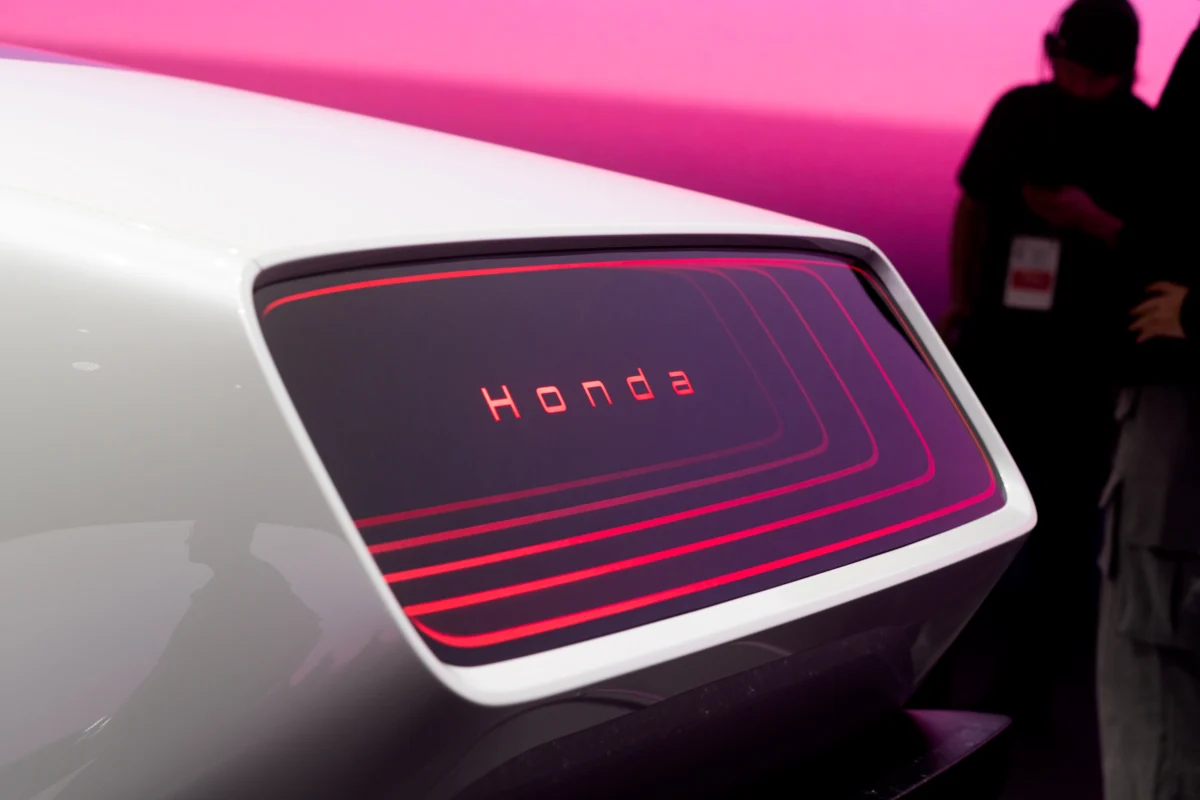
In a move sending ripples through the global automotive industry, Honda Motor Co. has announced a significant curtailment of its electric vehicle (EV) programs, effectively signaling a retreat from ambitious electrification targets. This decision, attributed by the Japanese automaker to challenging market conditions, particularly U.S. tariffs and intense competition from Chinese manufacturers, raises profound questions about Honda’s long-term viability in an industry rapidly transitioning towards electric drivetrains and software-defined vehicles (SDVs). Critics argue that this strategic pivot not only leaves Honda vulnerable but also highlights a fundamental misunderstanding of the transformational shifts occurring within the automotive landscape.
The series of announcements began with the halting of development for several key ground-up EV models. On Thursday, the company confirmed the suspension of plans for the electric Acura RDX, a premium SUV, and two models under the new Honda 0 series – a sedan and an SUV. These vehicles were poised to be Honda’s first internally developed EVs, representing a significant investment in a dedicated electric architecture. The cancellations were particularly notable given the minimal information previously shared with the public about these models, suggesting internal development challenges or a lack of conviction in their market potential. The following day, reports from Automotive News confirmed an even more immediate impact: Honda would cease production of the Prologue, an EV developed in partnership with General Motors, which largely utilized GM’s Ultium platform and design. The Prologue, intended as Honda’s volume EV offering in North America, thus becomes a short-lived chapter in the company’s electrification story.
A History of Hesitation and Partnerships
Honda’s journey into electrification has been marked by caution and, at times, what some analysts perceive as a lack of decisive commitment. While the company has a long history of hybrid vehicle development, notably with the Insight and various Civic and Accord hybrid models, its entry into pure battery electric vehicles has been comparatively slow and fragmented. Early efforts included limited-run models like the Honda Clarity EV, which served primarily as compliance cars in specific markets rather than volume sellers.
The partnership with General Motors was seen as a crucial acceleration of Honda’s EV strategy, providing access to GM’s established EV platform and battery technology. This collaboration was initially ambitious, encompassing not just the Prologue and its Acura ZDX counterpart, but also plans for jointly developed affordable EVs using next-generation Ultium components. The cancellation of the Prologue, therefore, casts a shadow over the broader strategic alliance, though both companies have indicated that other collaborative projects, such as fuel cell technology and autonomous driving, are still ongoing. This reliance on external platforms, while potentially cost-effective in the short term, has also limited Honda’s ability to build internal expertise in core EV development, including battery integration, electric motor design, and power electronics – critical competencies for long-term success.
The Stated Rationale: External Pressures or Internal Missteps?
Honda’s official explanation for the retrenchment points directly to external economic and geopolitical factors. The company cited escalating U.S. tariffs on imported components and vehicles, alongside fierce price competition from rapidly advancing Chinese EV manufacturers, as primary deterrents. In its recent earnings report, Honda acknowledged its struggles in the Chinese market, stating, "Honda was unable to deliver products that offer value for money better than that of newer EV manufacturers, resulting in a decline in competitiveness." This admission followed nearly $16 billion in losses for the company in the previous year, with significant headwinds originating from China, the world’s largest automotive market and a hotbed of EV innovation.
While tariffs and competition are undeniably real challenges for all automakers, particularly those importing from overseas, critics argue that Honda’s narrative masks deeper, systemic issues within its own EV strategy. Many industry observers contend that Honda never truly cultivated a robust, independent EV roadmap. Instead, its approach has often appeared reactive, characterized by incremental steps rather than bold, transformative investments. This hesitancy stands in stark contrast to competitors like Volkswagen, Hyundai, and Ford, which have poured tens of billions into dedicated EV platforms, battery gigafactories, and software development, often incurring significant short-term losses in pursuit of long-term market positioning.
Missed Opportunities: Beyond the Drivetrain
The decision to scale back EV development carries implications far beyond simply not selling electric cars. It represents a missed opportunity on multiple fronts, particularly in the twin transformations sweeping the automotive industry: the shift to electric drivetrains and the emergence of software-defined vehicles.
For many legacy automakers, including, it appears, Honda, an EV is often viewed merely as a traditional car with an electric motor and battery swapped in for the internal combustion engine (ICE). This "conversion" approach, while seemingly a shortcut, has proven problematic. Automakers like Ford, despite the sales success of models such as the Mustang Mach-E, have openly discussed the financial inefficiencies arising from adapting ICE platforms for EVs. Ford CEO Jim Farley highlighted in a recent interview that "legacy engineering decisions" weighed down the Mach-E, citing examples like a wiring harness 70 pounds heavier than Tesla’s. Such seemingly minor issues compound into higher production costs, reduced efficiency, and compromised performance.
Developing EVs from a dedicated, "ground-up" electric platform offers fundamental advantages. It allows engineers to optimize vehicle architecture for battery placement, weight distribution, aerodynamic efficiency, and interior space, often leading to lighter, more efficient, and ultimately cheaper-to-produce vehicles. By shelving its dedicated EV programs, Honda forfeits the critical learning opportunities associated with this process. These include:
- Engineering and Manufacturing Expertise: Hands-on experience in designing, testing, and mass-producing EVs on dedicated lines is invaluable. This builds institutional knowledge that cannot be easily acquired through partnerships or by simply waiting for technology to mature.
- Supply Chain Development: Establishing robust and resilient supply chains for batteries, rare earth minerals, and specialized EV components is a complex undertaking. Active participation in the EV market allows automakers to cultivate relationships with new suppliers and mitigate risks associated with geopolitical shifts.
- Customer Feedback and Market Adaptation: Direct engagement with EV consumers provides crucial insights into evolving preferences, charging habits, range anxiety, and desired features. Without a significant EV presence, Honda risks becoming disconnected from the very customers shaping the future of mobility.
The Software-Defined Vehicle Imperative
Perhaps an even greater risk for Honda lies in falling behind in the race towards software-defined vehicles (SDVs). An SDV is a vehicle whose core functionalities and user experience are primarily driven by software, allowing for over-the-air (OTA) updates, new features, and performance enhancements throughout its lifecycle. This paradigm shift transforms a car from a static hardware product into an evolving digital platform.
Companies like Tesla, Rivian, BYD, Nio, and even tech giants entering the automotive space like Xiaomi have redefined consumer expectations. Buyers of these EVs have grown accustomed to seamless OTA updates that improve range, add new driver-assistance features, or enhance infotainment systems. They expect slick, intuitive user interfaces and advanced connectivity. Honda, despite its reputation for engineering excellence in hardware, has yet to demonstrate significant progress in these software domains.
While SDVs don’t have to be EVs, the two concepts are deeply intertwined. The substantial battery capacity in an EV provides the necessary power for sophisticated onboard computers, enabling continuous connectivity and robust OTA update capabilities, even when the vehicle is parked. While theoretically, Honda could develop an SDV based on an ICE platform, the decision to retract from EVs suggests a broader reluctance to embrace the technological complexities and long-term investment required for such a fundamental shift. The implicit message is that sticking to the "old way of doing things" – focusing on mechanical engineering over digital innovation – is perceived as easier and more immediately profitable, a strategy that could prove catastrophic in the long run.
Honda’s Identity Crisis: From Engines to Algorithms
At its core, Honda has built its formidable global reputation on internal combustion engines. For decades, "Honda engine" has been synonymous with reliability, efficiency, and performance. Its cars have been lauded as "driver’s cars" – lightweight, well-handling, and engaging. However, these traditional strengths are becoming increasingly less relevant in an electrified, autonomous, and software-driven future.
In an era where electric motors deliver instant torque and refined power, and where advanced driver-assistance systems move towards full autonomy, the concept of a "driver’s car" takes on a different meaning. What constitutes driver engagement when the vehicle is increasingly taking over control? Furthermore, the core Honda values of reliability and reasonable pricing are also under assault. EVs inherently promise greater mechanical reliability due to fewer moving parts. And as Chinese automakers have demonstrated, once battery costs decline, overall vehicle prices can become incredibly competitive, challenging established benchmarks.
Honda’s recent performance in China serves as a stark warning. The company explicitly stated that its inability to compete on "value for money" against newer EV manufacturers led to a "decline in competitiveness." This isn’t merely a localized issue; it’s a preview of what could happen in other markets as EV adoption accelerates and new entrants continue to innovate on cost, features, and software. If Honda cannot compete effectively on reliability (given inherent EV advantages) or price (due to Chinese scale and innovation), its traditional brand appeal could rapidly erode.
Broader Industry Implications and Future Outlook
Honda’s retreat is not an isolated event but rather a symptom of the immense pressures faced by legacy automakers. The capital expenditure required to transition to EVs, develop SDVs, and retool manufacturing facilities is staggering. Goldman Sachs estimates that global automakers will invest over $500 billion in EV development by 2025. Those who falter in this investment risk being marginalized.
Analyst reactions to Honda’s decision have been largely cautious, with many expressing concern over the long-term implications. While some might argue that a temporary pause allows Honda to conserve capital and re-evaluate its strategy, the rapid pace of technological advancement in EVs and SDVs means that falling behind even for a short period can be incredibly difficult to overcome. Catching up later would likely be more expensive and require even more aggressive investment to close the gap with competitors who have been building expertise and market share for years.
The automotive industry is in the midst of its most profound transformation in a century. The shift from mechanical to electrical, and from hardware to software, demands agility, bold investment, and a willingness to disrupt one’s own business model. Honda’s decision to scale back its EV ambitions, while understandable from a short-term financial perspective given current headwinds, represents a high-stakes gamble against the prevailing tides of innovation. Should the global transition to EVs accelerate as many foresee, this retreat could prove to be one of the most significant strategic missteps in Honda’s illustrious history, potentially consigning a once-pioneering company to the slow lane of automotive evolution. The question remains whether Honda can find a new path forward that re-establishes its relevance in a rapidly changing world, or if this marks the beginning of a prolonged decline.
