

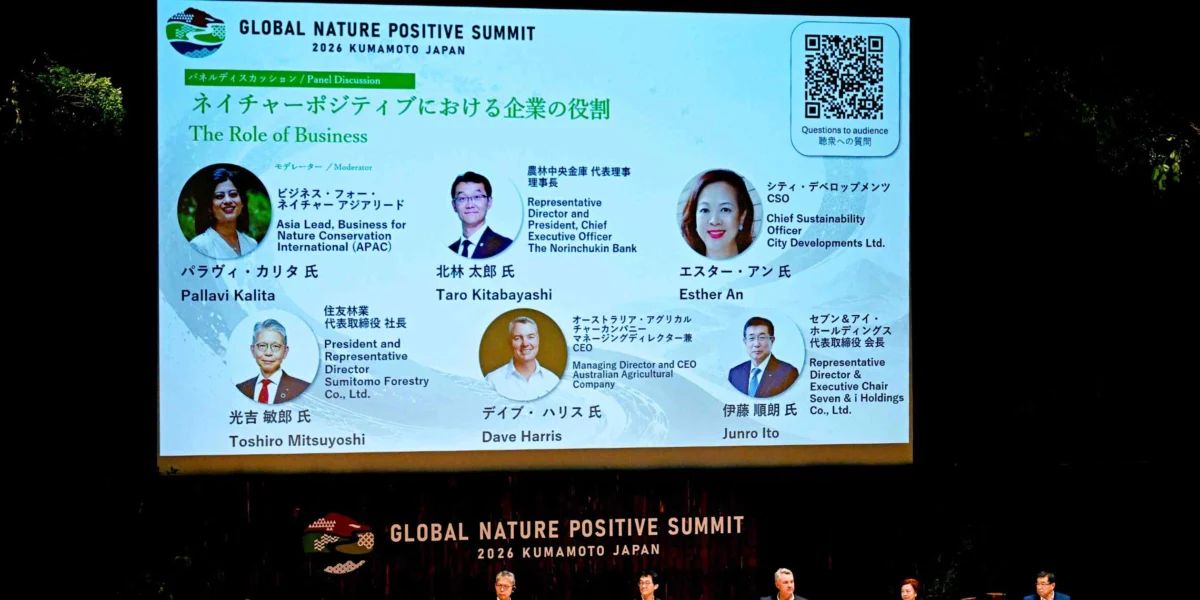
KUMAMOTO, Japan — Corporations’ responsibility to halt and reverse the loss of natural capital — nature’s own assets such as groundwater and biodiverse forests — took center stage on Tuesday at an international conference in southern Japan, where four benchmarks to assess businesses’ restoration efforts were announced. The Global Nature Positive Summit 2026, hosted in Kumamoto, a prefecture renowned for its rich natural landscapes and commitment to environmental stewardship, marks a significant stride in translating abstract conservation goals into measurable corporate actions. The initiative aims to provide a standardized framework for companies seeking to demonstrate genuine progress in their nature-positive commitments, moving beyond aspirational statements to quantifiable outcomes.
The Urgency of Nature-Positive Action
The summit convened under the shadow of escalating global biodiversity loss and environmental degradation. Scientific consensus points to an alarming rate of species extinction, ecosystem collapse, and the depletion of vital natural resources. The Intergovernmental Science-Policy Platform on Biodiversity and Ecosystem Services (IPBES) has repeatedly warned that one million animal and plant species are now threatened with extinction, many within decades, a rate unprecedented in human history. This ecological crisis poses profound risks not only to planetary health but also to economic stability and human well-being, impacting everything from food security and water availability to climate regulation and disease prevention.
The concept of "nature-positive" signifies a commitment by businesses and governments to not only minimize their negative environmental impact but to actively contribute to the restoration and enhancement of ecosystems. This shift in perspective acknowledges that natural capital is a fundamental economic asset, underpinning many of the world’s most critical industries. The Kumamoto summit was specifically designed to address the challenge of how to accurately and credibly measure this positive contribution, a crucial step in ensuring accountability and driving meaningful change.
New Benchmarks: Quantifying Corporate Restoration
The four newly announced benchmarks are intended to provide a robust and transparent system for evaluating corporate nature-positive initiatives. While specific details of each benchmark are still being elaborated by the organizing committee, preliminary information suggests a focus on measurable outcomes across several key areas:
- Biodiversity Net Gain: This benchmark will likely focus on ensuring that development projects or operational changes result in an overall increase in biodiversity. This moves beyond simply avoiding harm to actively improving ecological health, perhaps through habitat restoration, species reintroduction programs, or the creation of new ecological corridors. Measuring this will involve detailed ecological surveys, species counts, and habitat quality assessments before and after interventions.
- Ecosystem Functionality and Resilience: Beyond species counts, this benchmark aims to assess the health and functionality of entire ecosystems. This could include measuring indicators like water purification capacity, carbon sequestration rates, soil health, and the resilience of ecosystems to climate change impacts or other stressors. Advanced remote sensing, hydrological modeling, and soil science will be critical for this assessment.
- Natural Resource Stewardship: This benchmark will likely evaluate how companies manage their use of natural resources, such as water, timber, and land. It will emphasize sustainable extraction practices, circular economy principles, and the regeneration of depleted resources. Tracking water usage efficiency, forest regrowth rates, and land rehabilitation progress will be key components.
- Community and Indigenous Rights Integration: Recognizing the intrinsic link between environmental health and social well-being, this benchmark will likely assess how nature-positive initiatives respect and integrate the rights, knowledge, and participation of local communities and indigenous peoples, who are often the frontline stewards of biodiversity. This will involve qualitative assessments of engagement processes, benefit-sharing mechanisms, and adherence to international human rights standards.
The development of these benchmarks has been a multi-year process, involving extensive consultation with scientists, environmental NGOs, industry leaders, and government representatives. The goal is to create a universally applicable framework that can be adapted to various sectors and geographical contexts, thereby fostering a global movement towards genuine nature-positive business practices.
Background: Kumamoto’s Environmental Leadership
Kumamoto Prefecture was chosen as the host for the Global Nature Positive Summit 2026 due to its strong track record in environmental conservation and sustainable development. Situated on the island of Kyushu, Kumamoto is blessed with diverse natural landscapes, including the active volcano Mount Aso, the pristine Kuma River basin, and a rich coastal environment. The prefecture has long been a leader in promoting initiatives such as sustainable agriculture, ecotourism, and the protection of its vital water resources, exemplified by the well-managed underground water systems that supply much of the region.
This regional commitment to environmental preservation provided a fitting backdrop for an international discussion on corporate responsibility. Previous efforts in Kumamoto, such as initiatives to protect the Kuma River from pollution and to promote regenerative farming practices, have demonstrated the tangible benefits of prioritizing ecological health. The success of these local endeavors has inspired a broader recognition of the interconnectedness of environmental, economic, and social prosperity. The prefecture’s proactive stance on environmental issues, including its recovery efforts following the 2016 Kumamoto earthquakes which underscored the importance of resilient natural systems, positions it as an ideal venue for setting new global environmental standards.
Chronology of the Summit and its Precursors
The announcement of the new benchmarks is the culmination of a series of international dialogues and preparatory meetings that began several years prior.
- 2023-2024: Initial Framework Development and Consultation: Following the growing momentum behind corporate sustainability and the increasing recognition of nature loss as a critical global issue, a coalition of international organizations, environmental think tanks, and leading corporations initiated discussions on the need for standardized nature-positive metrics.
- 2024: Formation of the Global Nature Positive Task Force: A dedicated task force was established, comprising experts from diverse fields including ecology, economics, corporate governance, and social sciences. This group was tasked with drafting the foundational principles and potential metrics for evaluating nature-positive actions.
- 2025: Pilot Programs and Stakeholder Engagement: Pilot programs were launched with a select group of companies across various sectors to test proposed metrics and gather feedback. Extensive stakeholder consultations were held through workshops, webinars, and direct engagement with businesses, NGOs, and governmental bodies worldwide.
- Early 2026: Refinement of Benchmarks: Based on the feedback from pilot programs and consultations, the proposed benchmarks underwent significant refinement. The scientific rigor and practical applicability of each metric were scrutinized to ensure they were both ambitious and achievable.
- July 14, 2026: Announcement at the Global Nature Positive Summit: The finalized four benchmarks were officially announced during the plenary session of the Global Nature Positive Summit 2026 in Kumamoto, Japan, marking a pivotal moment in the journey towards corporate accountability for nature.
Supporting Data and the Scientific Imperative
The urgency underscored at the Kumamoto summit is backed by a growing body of scientific evidence. The World Economic Forum’s Global Risks Report has consistently identified biodiversity loss and ecosystem collapse as among the most severe risks facing humanity. For instance, the 2024 report listed "Biodiversity loss and ecosystem collapse" as the third most severe global risk in the short term and the second most severe in the long term.
Economically, the estimated value of nature’s contributions to humanity, often referred to as ecosystem services, is staggering. Studies by organizations like the UN Environment Programme (UNEP) and the Natural Capital Project estimate these services to be worth trillions of dollars annually, far exceeding global GDP. The degradation of these services directly impacts industries such as agriculture, fisheries, forestry, tourism, and pharmaceuticals. For example, the decline in pollinator populations, crucial for a significant portion of global food crops, is estimated to cost the agricultural sector billions of dollars annually. Similarly, the degradation of coral reefs, vital for coastal protection and tourism, represents a substantial economic loss.
The new benchmarks aim to translate this understanding into concrete corporate actions. By providing clear measurement criteria, they will enable investors to better assess environmental, social, and governance (ESG) risks and opportunities, potentially redirecting capital towards companies genuinely committed to sustainability. They will also empower consumers and civil society to hold businesses accountable for their environmental impact.
Official Responses and Future Implications
The announcement was met with cautious optimism from various stakeholders. Representatives from leading environmental organizations expressed hope that the benchmarks would provide the necessary clarity and accountability to drive meaningful change.
"For too long, ‘nature-positive’ has been a buzzword with unclear definitions," stated Dr. Anya Sharma, Director of Global Policy at the Nature Conservancy. "These benchmarks, if rigorously applied and independently verified, have the potential to transform corporate environmental stewardship from a marketing exercise into a genuine driver of ecological restoration. The focus on measurable outcomes, particularly in biodiversity net gain and ecosystem functionality, is precisely what is needed."
Industry bodies, while acknowledging the importance of the initiative, emphasized the need for practical implementation and flexibility. "We are committed to supporting our members in achieving nature-positive outcomes," said a spokesperson for the Global Business Council for Sustainability. "The key will be ensuring these benchmarks are adaptable to different business models and geographical realities, and that robust guidance and support are provided for their implementation. Collaboration between industry, science, and government will be paramount."
The implications of these benchmarks are far-reaching. They are expected to:
- Drive Innovation: Companies will be incentivized to develop new technologies and methodologies for ecological restoration, resource management, and impact measurement.
- Enhance Investor Confidence: Standardized metrics will provide investors with more reliable data to assess the sustainability performance of companies, potentially leading to increased investment in nature-positive businesses.
- Strengthen Regulatory Frameworks: The benchmarks could serve as a foundation for future government regulations and policy development aimed at promoting corporate responsibility for nature.
- Foster Global Collaboration: A common language for measuring nature-positive impact will facilitate greater collaboration among businesses, governments, and civil society organizations on a global scale.
The success of these benchmarks will ultimately depend on their widespread adoption, rigorous implementation, and independent verification. The Global Nature Positive Summit 2026 in Kumamoto has laid a critical foundation, setting a new standard for how corporations engage with and contribute to the health of the planet. The coming years will reveal the true impact of these ambitious initiatives as the world watches to see if businesses can indeed move beyond simply minimizing harm to actively healing the natural world. The commitment to quantifying this healing process is a significant step in that vital direction.
