


The United Nations has recently signaled a profound shift in the international approach to the climate crisis, moving from a primary focus on prevention to a strategy of "coping and containment." This pivot comes as scientific data increasingly suggests that the goal of limiting global temperature increases to 1.5 degrees Celsius (2.7 degrees Fahrenheit) above pre-industrial levels—a cornerstone of the 2015 Paris Climate Accord—is becoming physically and politically unattainable within the current trajectory. While the international body characterizes this shift as a "strategic retreat" regarding the 1.5-degree threshold, the energy industry is responding with a surge of infrastructure deployments designed to mitigate the worst effects of a warming planet through advanced storage, renewable natural gas, and ecologically sensitive solar development.
The UN Emissions Gap and the "Strategic Retreat"
A comprehensive report issued by the United Nations Environment Program (UNEP) last Wednesday paints a stark picture of the current state of global climate efforts. The document, described by climate scientists as one of the bleakest to date, admits that humanity has missed the critical window to prevent exceeding the safe temperature threshold agreed upon nearly a decade ago. To maintain the 1.5-degree limit, global temperatures must remain below that level across a 20-year average; however, current emission levels and the slow pace of fossil fuel phase-outs suggest an "overshoot" is now inevitable.

The report emphasizes that every five years of delay in significant emissions reductions adds at least a tenth of a degree to peak warming. This "overshoot" phase will require a massive, unprecedented investment in carbon capture technology and a total cessation of fossil fuel expansion to eventually bring temperatures back down to safer levels. In the interim, the UN warns of a period characterized by increased weather-related disasters, mass extinctions, and crumbling economies. UN Secretary-General António Guterres noted that the planet is entering "uncharted waters," further exacerbated this year by a "supersized" El Niño event that has pushed sea surface temperatures to record highs.
Despite the grim outlook, the report stops short of resignation. Instead, it calls for a dual-track approach: aggressive containment of existing emissions and a rapid transition to a "coping" infrastructure. This involves hardening energy grids, diversifying power sources, and deploying technologies that can balance the intermittency of renewable energy.
Battery Storage Expansion in the ERCOT Market
In direct response to the need for grid reliability amidst extreme weather, the private sector is accelerating the deployment of battery energy storage systems (BESS). In Harlingen, Texas, East Point Energy—a subsidiary of the Norwegian multinational energy firm Equinor—has announced the commencement of operations at the Citrus Flatts Energy Center. This 100-megawatt (MW) / 200-megawatt-hour (MWh) facility represents a significant addition to the Electric Reliability Council of Texas (ERCOT) grid.

Citrus Flatts is Equinor’s second operational battery project in Texas, following the 10 MW/20 MWh Sunset Ridge site completed last year. Together, these facilities provide enough electricity to power approximately 30,000 homes for two hours during periods of peak demand or grid instability. Notably, these projects operate on a "fully merchant" basis, meaning they sell power directly into the market without long-term government contracts, signaling growing investor confidence in the economic viability of storage technology.
Equinor’s broader strategy involves integrating flexible energy solutions into attractive power markets. Beyond Texas, the company is developing an 80 MW/160 MWh portfolio in the PJM Interconnection market, specifically in Virginia, with commercial operations expected by early 2025. This expansion is critical as Texas and other states face increasingly frequent heatwaves and winter storms that strain traditional generation assets.
Long-Duration Storage and Data Center Decarbonization
The surge in artificial intelligence and data processing has created a massive new demand for "around-the-clock" clean power. In Kanawha County, West Virginia, a collaborative project between MN8 Energy, Google, and Eos Energy Enterprises is breaking new ground in how this demand is met. The Mammoth Solar project, situated on a reclaimed coal mine, integrates 86 MW of utility-scale solar with two distinct storage technologies.

The project features 70 MW/280 MWh of traditional lithium-ion storage for short-duration needs, paired with 10 MW/100 MWh of Eos’s Z3 zinc-based long-duration energy storage (LDES). Unlike lithium-ion batteries, which typically discharge over four hours, the aqueous zinc chemistry utilized by Eos is designed for 10-hour discharge cycles. This allows the facility to provide dependable capacity across more hours of the day, effectively turning intermittent solar generation into a dispatchable resource that matches the flat load profile of Google’s regional data centers.
This project is the first commercial-scale LDES deployment in West Virginia and serves as a blueprint for the "re-industrialization" of coal country. By repurposing former mining lands for advanced energy manufacturing and generation, the project addresses both the environmental necessity of the energy transition and the economic needs of traditional energy communities. The solar component is slated for operation in 2028, with the full storage suite coming online by 2030.
The Rise of Agricultural Renewable Natural Gas
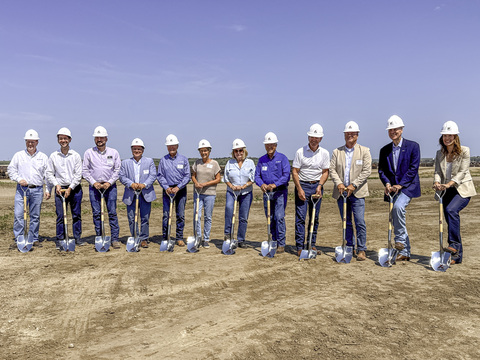
While solar and batteries address the electricity sector, the decarbonization of the gas grid and transportation sector is being tackled through agricultural innovation. NeoGenyx, a subsidiary of Ameresco, recently broke ground on a large-scale renewable natural gas (RNG) facility at the Adams Land & Cattle feedlot in Broken Bow, Nebraska.

The facility utilizes anaerobic digesters to capture manure from the feedlot and convert it into biogas. Once refined to pipeline-quality RNG, the site is expected to produce 1.2 million MMBtu annually. This process serves a dual purpose: it prevents methane—a potent greenhouse gas—from escaping into the atmosphere and provides a renewable fuel source for heavy transportation and industrial heating.
The environmental impact is substantial, with an estimated reduction of 63,700 metric tons of greenhouse gas emissions annually. This is equivalent to the carbon sequestration capacity of approximately 63,800 acres of U.S. forest. Furthermore, the process yields beneficial byproducts, such as livestock bedding and high-quality fertilizer, creating a circular economy within the agricultural sector. Nebraska Governor Jim Pillen and other officials have hailed the project as a model for how American agriculture can integrate into the global energy economy while maintaining traditional operations.
Conservation-Minded Solar Development in Washington
In the Pacific Northwest, Cypress Creek Energy has reached commercial operation at its Ostrea Solar project in Yakima County, Washington. The 104 MWdc facility is backed by a long-term power purchase agreement (PPA) with Microsoft, highlighting the tech industry’s role as a primary driver of renewable energy procurement.

The Ostrea project is notable for its emphasis on "shrubsteppe" conservation. Shrubsteppe is a dry, open ecosystem dominated by woody shrubs and perennial grasses, and it is increasingly rare in Washington due to agricultural and urban development. During the planning phase, Cypress Creek worked with state wildlife agencies to modify the project design, setting aside 275 acres of critical habitat and establishing wildlife corridors for migratory species like Rocky Mountain elk.
The project also utilized native seed mixes and pollinator-friendly plants to revegetate the site, demonstrating that utility-scale solar can be compatible with local biodiversity goals. From an economic perspective, the $180 million project is expected to generate $13.3 million in local tax revenue and created 300 construction jobs paid at prevailing wage rates.
Analysis of Global Energy Implications
The transition from a "prevention-only" mindset to one of "containment and adaptation" reflects the complex reality of current global climate policy. While the UN’s recent reports are undoubtedly somber, the flurry of activity in the private sector suggests that the infrastructure of the future is already being built. The common thread among these projects—from Texas batteries to West Virginia zinc storage and Nebraska RNG—is the pursuit of "dispatchability" and "reliability."
As the world inevitably enters a period of higher temperatures and more volatile weather, the energy transition is no longer just about reducing carbon; it is about building a grid that can survive the consequences of past emissions. The integration of long-duration storage and the decarbonization of hard-to-abate sectors like agriculture are essential components of this new strategy.
Furthermore, the involvement of major corporate entities like Google and Microsoft indicates that the demand for carbon-free energy is now a fundamental requirement for industrial growth. These companies are not merely buying "offsets" but are actively funding the construction of new, high-tech capacity that strengthens the grids they inhabit.
The path forward, as outlined by both the UN and industry leaders, is a difficult one. It requires a massive acceleration in the deployment of existing technologies and a rapid commercialization of emerging ones. While the 1.5-degree goal may be slipping away, the "war" for a stable and habitable planet continues, with the energy industry serving as the primary front line in the era of coping and containment.
