

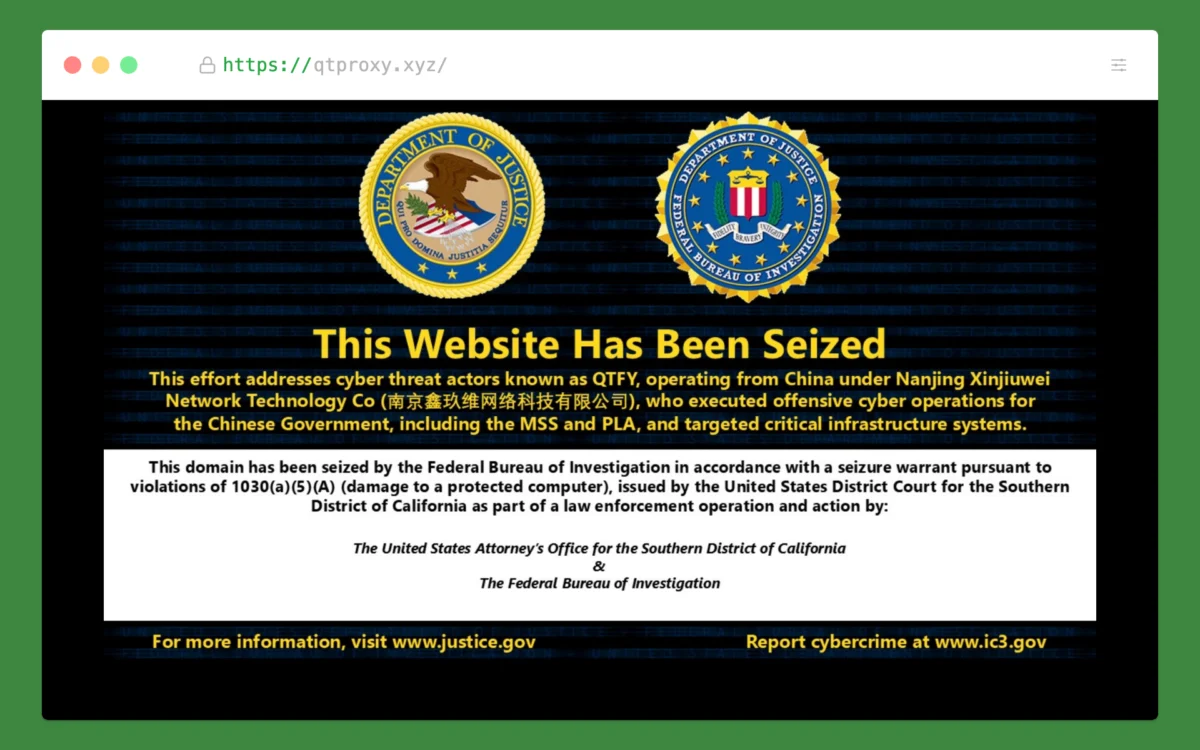
The Federal Bureau of Investigation (FBI), in a coordinated effort with the U.S. Department of Justice, has successfully seized a critical network of domains that served as the command and control infrastructure for a vast, China-backed botnet, effectively neutralizing its capacity to launch sophisticated cyberattacks against American targets. This decisive action, detailed in a Justice Department statement released on Wednesday, represents a significant blow to state-sponsored hacking operations designed to compromise sensitive U.S. systems, including those belonging to hospitals, defense contractors, and various federal government departments. The seizure denies the operators, allegedly linked to the Chinese government, access to the platforms essential for coordinating their malicious activities, rendering the extensive botnet inoperable and severing a vital link in China’s cyber espionage apparatus.
Unpacking the Operation: QTFY and Nanjing Xinjiuwei Network Tech
The Justice Department’s investigation revealed that the China state-sponsored group responsible for these pervasive cyber intrusions is known as QTFY. This entity was reportedly run by Nanjing Xinjiuwei Network Tech, a Chinese company specifically implicated in the creation and operation of a botnet comprising thousands of compromised internet-connected devices. The primary function of this intricate network was to act as an obfuscation layer, designed to conceal the origins and true nature of malicious traffic, thereby making the hackers’ activities exceptionally difficult to detect and trace. By routing their attacks through this vast network of unwitting compromised machines, the state-sponsored actors aimed to mask their digital fingerprints, adding layers of complexity to attribution efforts by U.S. intelligence and law enforcement agencies.
Prosecutors detailed that QTFY did not merely operate this botnet for its own purposes but also offered sophisticated computer hacking services to a clientele that notably included Chinese government hackers working directly for the Ministry of State Security (MSS). This arrangement underscores a broader strategy often employed by state actors: leveraging commercial or quasi-commercial entities as fronts or service providers to execute sensitive intelligence-gathering operations, thereby creating a degree of plausible deniability and insulating the direct government actors from immediate exposure. The botnet’s capacity to serve as a conduit for MSS-backed operations highlights the strategic importance of this takedown in disrupting a critical component of China’s state-sponsored cyber toolkit.
A Chronicle of Intrusion: Targets and Timeline
The scope of the attacks facilitated by the QTFY botnet is alarming, with intrusions dating back to as early as 2018. The list of compromised entities reads like a roster of critical American institutions, encompassing the National Aeronautics and Space Administration (NASA), the Federal Reserve, and key federal departments including Energy, Justice, and Health and Human Services. Perhaps most strikingly, the U.S. Senate was reportedly compromised as recently as 2026, according to a government affidavit filed earlier this week, which sought the court order to seize the botnet’s domains. This broad spectrum of targets — from national security and economic policy to public health and legislative functions — illustrates the comprehensive nature of China’s alleged cyber espionage goals, aiming to acquire sensitive data, intellectual property, and strategic insights across multiple sectors.
The targeting of hospitals is particularly egregious, raising concerns not only about data theft but also potential disruption to healthcare services, especially given the increased vulnerability of such institutions to cyber threats. Defense contractors represent invaluable sources of military and technological secrets, while federal agencies house vast amounts of classified and sensitive operational data. The Federal Reserve, as the central bank of the United States, holds critical economic and financial information, making it a prime target for foreign intelligence agencies seeking economic advantage or disruption. The consistent targeting over an extended period underscores the persistent and strategic nature of these cyber campaigns, designed to incrementally exfiltrate information and maintain a foothold within vital U.S. networks.
The Mechanism of Disruption: Technical Details of the Seizure
The success of the FBI’s operation hinged on a precise technical maneuver: the seizure of specific domains that were "hardcoded" into the botnet’s operational code. The Justice Department explained that these domains were indispensable for the botnet’s communication and essential operations, serving as the primary command and control (C2) servers. In the world of botnets, C2 servers act as the central nervous system, issuing instructions to compromised devices (bots) and receiving exfiltrated data. By seizing these specific domains, U.S. authorities effectively cut off the botnet’s ability to communicate with its operators and, crucially, to receive new commands or transmit stolen information.
This method of disruption is highly effective because it exploits a fundamental dependency within the botnet’s architecture. When the hardcoded domains are no longer under the control of the malicious actors and instead display an FBI seizure notice, the individual compromised devices become "orphaned." They can no longer connect to their designated C2 infrastructure, rendering them incapable of executing further attacks, receiving updates, or sending data back to the attackers. This strategy is a sophisticated form of "sinkholing," where traffic intended for malicious domains is redirected to servers controlled by law enforcement, allowing for analysis and disruption. The statement confirmed that this action made the botnet and its command and control servers "inoperable," a testament to the surgical precision of the FBI’s intervention.
The Role of Public-Private Partnership: Lumen’s Contribution
The success of this operation was significantly bolstered by critical intelligence sharing between government agencies and the private sector. Network giant Lumen, a prominent telecommunications and cybersecurity company, played a crucial role in identifying and tracking the activities of the QTFY botnet. In a public blog post, Lumen revealed that it had been observing the hackers profiling and targeting government agencies, as well as entities within the defense and aerospace sectors, for at least the past year. This sustained monitoring and subsequent sharing of threat intelligence with the FBI proved instrumental in understanding the botnet’s infrastructure, its targets, and its modus operandi, ultimately enabling law enforcement to pinpoint the critical domains for seizure.

This collaboration highlights the increasing necessity of public-private partnerships in the fight against sophisticated cyber threats. Private cybersecurity firms often possess unique visibility into global network traffic and attack patterns, given their extensive infrastructure and client base. Their ability to detect, analyze, and report malicious activity provides invaluable actionable intelligence to government agencies, which can then leverage their legal authority and investigative capabilities to disrupt these operations. Such partnerships are a cornerstone of modern cybersecurity defense, creating a more resilient and informed ecosystem capable of confronting persistent state-sponsored adversaries.
Broader Context: China’s Cyber Espionage Landscape
This botnet takedown is not an isolated incident but rather fits into a larger, well-documented pattern of state-sponsored cyber espionage activities attributed to the People’s Republic of China. For years, U.S. intelligence agencies and cybersecurity experts have consistently identified China as one of the most prolific and sophisticated actors in cyber espionage, primarily focused on intellectual property theft, economic espionage, and strategic intelligence gathering. Reports from various U.S. government bodies, including the Office of the Director of National Intelligence and the Department of Homeland Security, have frequently highlighted the extensive scale and scope of Chinese cyber operations targeting U.S. government networks, critical infrastructure, defense industrial base, and private sector companies.
China’s motivation for such widespread cyber intrusions is multifaceted, driven by ambitions to accelerate its technological development, bolster its military capabilities, gain economic advantage, and enhance its geopolitical influence. The use of proxy companies like Nanjing Xinjiuwei Network Tech and the Ministry of State Security’s involvement align with established intelligence practices, where state intelligence services often operate through a network of front companies, academic institutions, and seemingly legitimate businesses to mask their true objectives and operational control. This creates a complex web of attribution challenges, requiring extensive forensic analysis and intelligence gathering to definitively link attacks back to state actors.
The U.S. government has, in recent years, adopted a more aggressive stance against these persistent threats, moving beyond mere public attribution to active disruption and legal action. This includes indictments of Chinese military personnel and intelligence officers, sanctions against entities involved in cyber espionage, and now, direct technical actions like domain seizures. These measures aim not only to deter future attacks but also to impose costs on adversaries, making it more difficult and expensive for them to conduct malicious cyber activities.
Implications for National Security and Future Cybersecurity
The disruption of the QTFY botnet carries significant implications for U.S. national security and the ongoing evolution of cybersecurity strategies. Firstly, it represents a concrete victory in denying an adversary a critical tool for espionage, likely forcing the Chinese actors to rebuild or retool their infrastructure, which incurs time, resources, and increased risk. This "cost imposition" strategy is a key component of modern cyber defense.
Secondly, the successful execution of this seizure sends a strong message to other state-sponsored actors that the U.S. is capable and willing to take proactive, offensive measures to defend its networks and interests. It demonstrates a shift towards a more "defend forward" posture, where the U.S. actively works to disrupt threats at their source before they can inflict maximum damage.
However, the challenge remains immense. The adversarial landscape is constantly evolving, with state-sponsored groups continually developing new tactics, techniques, and procedures (TTPs). While one botnet is dismantled, new ones are likely being constructed. This incident underscores the perpetual arms race in cyberspace and the need for continuous vigilance, investment in cybersecurity infrastructure, and robust intelligence-sharing mechanisms.
The targeting of critical sectors like healthcare, defense, and government agencies highlights the need for these entities to maintain the highest levels of cybersecurity hygiene, including robust patching, multi-factor authentication, network segmentation, and regular security audits. The incident also reinforces the importance of international cooperation in combating cybercrime and state-sponsored hacking, as these threats transcend national borders.
In conclusion, the FBI’s seizure of the QTFY botnet domains marks a critical operational success in the ongoing battle against state-sponsored cyber espionage. By dismantling a key piece of infrastructure used by China-backed hackers to target sensitive U.S. institutions, the U.S. government has demonstrated its resolve and capability to protect its national security and economic interests in the digital realm. Yet, this victory is but one chapter in a long and complex struggle, underscoring the enduring imperative for a robust, multi-layered approach to national cybersecurity.
