

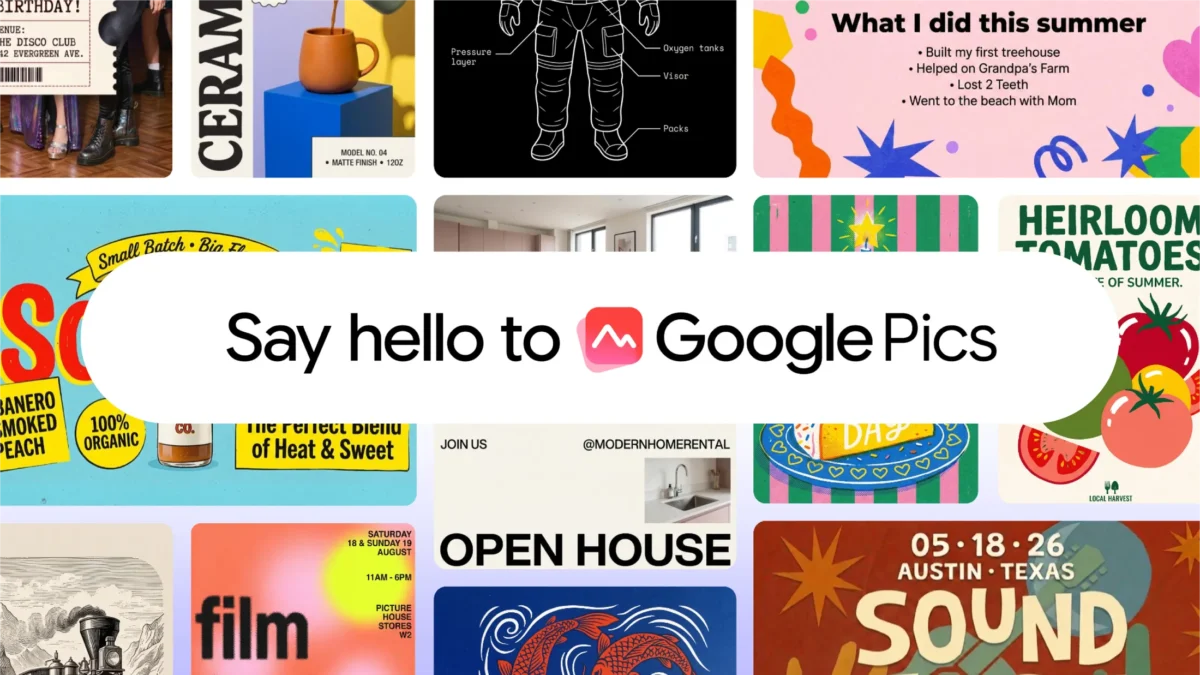
Google has officially announced its entry into the burgeoning creative design market with a new artificial intelligence-powered image creation and editing tool named Google Pics. This innovative application is set to become an integral part of its robust Google Workspace suite, catering specifically to business customers, and will also be accessible to premium subscribers of Google AI Pro and Ultra tiers. The move signifies a strategic expansion for Google, leveraging its advanced AI capabilities to carve out a significant presence in a sector currently dominated by established players like Adobe and Canva.
Introduction: Google Pics Unveiled & Strategic Intent
The introduction of Google Pics marks a pivotal moment in Google’s enterprise software strategy, aiming to democratize design capabilities for millions of users within its ecosystem. The company confirmed that Google Pics, powered by its proprietary Nano Banana image-generation model, will commence its rollout to the majority of Workspace customers and those subscribed to Google AI Pro or Ultra in the coming weeks. This phased deployment underscores Google’s commitment to integrating sophisticated AI functionalities directly into the everyday tools used by businesses and individuals.
Google Pics is engineered to streamline common design tasks encountered in both professional and personal spheres. Its functionality is geared towards generating a variety of visual assets, including posters, social media graphics, and diverse illustrations. This focus positions Google Pics as a direct competitor to popular, user-friendly design platforms, but with a distinctive AI-first approach that emphasizes prompt-driven creation over traditional template-based or manual design processes.
Deep Dive into Functionality: Beyond Basic Creation
At its core, Google Pics is a generative AI tool, meaning users interact with it primarily through text prompts to describe the desired image. This contrasts sharply with conventional design software where users typically start from a blank canvas or pre-designed templates. The application’s suite of features extends beyond mere image generation, incorporating advanced editing capabilities. Users will be able to isolate and transform specific objects within images, modify or translate text embedded in visuals, and leverage other sophisticated manipulation tools.
A key differentiator for Google Pics is its support for collaborative editing, a hallmark feature of the Google Workspace environment. This allows multiple users to work on a single design simultaneously, fostering teamwork and accelerating creative workflows within organizations. Furthermore, the tool boasts the ability to generate several different variations of a requested image from a single prompt, offering users a diverse selection to choose from and refine, thereby enhancing creative flexibility and efficiency.
The integration strategy is equally significant. Google Pics will be natively built into Google Workspace applications, initially launching within Google Docs and Google Slides starting today. This deep integration means users can access and utilize Google Pics functionalities directly within their document and presentation creation processes, eliminating the need to switch between different applications. The company has also announced plans to extend this integration to Google Drive at a later stage, further embedding the design tool into the central hub of Workspace productivity.
The Power Behind the Pixels: Nano Banana and Google’s AI Prowess
The technological backbone of Google Pics is the Nano Banana image-generation model. While specific technical details of Nano Banana remain largely proprietary, its designation signals Google’s continued advancement in the field of generative AI, particularly in multimodal capabilities. Google has been at the forefront of AI research for years, investing heavily in large language models (LLMs) and diffusion models that underpin image generation. The success of models like DALL-E, Midjourney, and Stable Diffusion from other developers has spurred intense competition, pushing companies like Google to accelerate their own offerings.
Nano Banana likely benefits from Google’s vast computational resources and extensive datasets, allowing it to generate high-quality, contextually relevant images from textual descriptions. This model represents a culmination of Google’s long-term AI strategy, which has seen the company consistently push the boundaries of machine learning across various domains, from search and recommendations to natural language processing and computer vision. The deployment of Nano Banana within a consumer-facing product like Google Pics demonstrates Google’s confidence in its AI’s ability to deliver practical, valuable applications to a broad user base. This also aligns with Google’s broader strategy to infuse AI across its product portfolio, exemplified by the integration of its Gemini AI models into various services.
Navigating the Competitive Creative Landscape: Adobe, Canva, and Google’s Niche
Google’s entry into the creative design market with Google Pics immediately places it in direct competition with established giants such as Adobe Express and Canva. These platforms have cultivated massive user bases, each offering distinct value propositions.
Canva, founded in 2013, has revolutionized accessible design, boasting over 170 million monthly active users as of early 2024. Its success lies in its intuitive drag-and-drop interface, extensive library of templates, and a vast marketplace where artists, illustrators, and photographers can contribute their work and earn royalties. This community-driven model provides a rich ecosystem of design assets. Canva’s market capitalization has been estimated at over $26 billion, reflecting its strong position in the market for everyday design.
Adobe Express, part of the broader Adobe Creative Cloud suite, offers a streamlined design experience, leveraging Adobe’s professional-grade tools like Photoshop and Illustrator in a simplified format. It targets users who need quick, professional-looking designs without the complexity of its full-fledged desktop applications. Adobe, with its decades of experience in creative software, holds a dominant share in the professional design market, with its Creative Cloud ecosystem generating billions in revenue annually.
Google Pics, however, carves out a distinct niche. Unlike Canva, which relies heavily on a marketplace for pre-existing templates and graphics created by human artists, Google Pics emphasizes creation based on AI. The core promise is to generate novel visual content from scratch using AI prompts, rather than assembling pre-made components. This differentiation is crucial: while Canva facilitates the use of human-created assets, Google Pics aims to create assets through AI.
Similarly, Google Pics diverges from Adobe Express. While Adobe Express simplifies professional tools for broader accessibility, it still fundamentally operates within a traditional design paradigm where creators manipulate elements. Google Pics, conversely, is a tool where users "prompt to create," rather than "design something new from scratch" in the conventional sense. This AI-first, prompt-driven approach positions Google Pics as a complementary, yet potentially disruptive, force in the creative software landscape, particularly for users seeking rapid, AI-generated visual content without extensive design expertise. The global market for creative design software is projected to reach over $15 billion by 2028, with AI-powered tools expected to drive significant growth within this segment.
Rollout Strategy and Accessibility: Workspace and Premium Tiers
The rollout strategy for Google Pics is meticulously planned, beginning with its integration into Google Docs and Slides. This initial phase targets existing Google Workspace customers, encompassing a vast array of businesses, educational institutions, and government entities that rely on Google’s productivity suite. Google Workspace boasts over 3 billion users globally, with millions of paying business customers. By embedding Google Pics directly into these widely used applications, Google aims to ensure seamless adoption and immediate utility for its enterprise clients.
Access to Google Pics will also extend to subscribers of Google AI Pro and Ultra. These premium tiers of Google’s AI offerings are designed for users seeking advanced AI capabilities, likely including more powerful models, higher usage limits, and enhanced features. This tiered access model suggests that Google views Google Pics as a premium AI service, capable of driving subscriptions to its advanced AI offerings while also adding significant value to its core Workspace product. The "coming weeks" timeline indicates a rapid deployment, highlighting Google’s agility in bringing new AI innovations to market. This strategy allows Google to leverage its existing user base for both Workspace and its AI services, creating a powerful synergy.
Ethical Dimensions and Artist Concerns: The AI Training Data Debate
The announcement that Google Pics’ underlying AI model, Nano Banana, was "trained on artists’ work" immediately raises critical ethical and legal questions that have been at the forefront of the generative AI debate. The use of vast datasets, often scraped from the internet without explicit consent or compensation to the original creators, has sparked widespread concern among artists, illustrators, and photographers globally.
Artist advocacy groups, such as the Artists’ Rights Alliance and the National Association of Artists, have vociferously criticized AI companies for what they perceive as unauthorized use of copyrighted material for commercial gain. They argue that training AI models on existing artworks constitutes copyright infringement and devalues human creativity by generating derivative works without acknowledging or compensating the original artists. This has led to several high-profile lawsuits against AI developers, challenging the legality of current AI training practices.
In contrast to platforms like Canva, which actively facilitate a marketplace for human artists to publish and earn royalties from their work, Google Pics’ AI-first approach bypasses this direct compensation model for individual artwork used in training. While Google, like other AI developers, typically asserts "fair use" for training purposes, the legal landscape is still evolving, and artist communities continue to demand transparency, opt-out mechanisms, and fair compensation for the use of their intellectual property. The integration of such an AI tool into Google Workspace could prompt renewed scrutiny and potentially amplify calls for regulatory frameworks to address these complex issues, influencing Google’s future policies regarding AI ethics and creator compensation.
Transforming Business Workflows: Efficiency and Innovation in the Enterprise
The integration of Google Pics into Google Workspace is poised to significantly transform business workflows, particularly in areas requiring visual content creation. For marketing teams, sales departments, internal communications, and HR, the ability to rapidly generate and edit images within Docs and Slides can drastically cut down on time and resources spent on design tasks.
Imagine a marketing manager needing a quick social media graphic for a new campaign. Instead of waiting for a graphic designer or struggling with complex software, they can use Google Pics directly within Google Docs, input a prompt, generate several options, make quick edits, and then seamlessly incorporate it into their communication. This level of immediacy and accessibility can accelerate content creation cycles, allowing businesses to respond more quickly to market trends and internal needs.
For small and medium-sized businesses (SMBs) that may not have dedicated design teams, Google Pics offers a powerful tool to elevate their visual communication without incurring significant costs for external designers or specialized software. It empowers employees with basic design capabilities, fostering a more creative and self-sufficient workforce. This enhanced productivity and democratization of design tools represent a significant value proposition for Google Workspace customers, reinforcing the suite’s utility beyond traditional productivity applications.
Industry Reactions and Analyst Perspectives: A Shifting Paradigm
Industry analysts have been quick to weigh in on Google’s strategic move. "Google’s entry with Google Pics is a clear signal that generative AI is no longer a niche technology but a core component of future enterprise software," stated Dr. Elena Petrova, a lead analyst at TechInsights Group. "By embedding it directly into Workspace, Google leverages its massive installed base and makes AI-driven design incredibly accessible. This will undoubtedly put pressure on Adobe and Canva to accelerate their own AI integrations and differentiate further."
Other analysts point to the potential for Google Pics to become a "sticky" feature within the Workspace ecosystem. "The deep integration into Docs and Slides is critical," commented Mark Jensen, a senior researcher at Digital Trends Institute. "It eliminates friction and makes Google Pics an indispensable part of the creative process for Workspace users. This isn’t just a standalone tool; it’s an enhancement to their entire productivity suite, potentially increasing Workspace stickiness and driving premium AI subscriptions."
However, the ethical considerations surrounding AI training data remain a point of discussion. "Google will face continued scrutiny regarding the provenance of its training data and its stance on artist compensation," noted Jensen. "While the ‘fair use’ argument holds in some jurisdictions, public sentiment and legislative efforts are pushing for greater transparency and equitable practices. How Google addresses these concerns will be crucial for its long-term reputation and adoption among creative professionals."
The Road Ahead: Google’s Vision for Creative AI and Workspace Evolution
The launch of Google Pics is not merely about a new image tool; it represents a significant step in Google’s broader vision for the future of work and creativity, deeply intertwined with artificial intelligence. The company’s strategy appears to be to infuse AI capabilities into every facet of its Workspace ecosystem, transforming how users interact with documents, presentations, spreadsheets, and now, visual content.
Future iterations of Google Pics could see even more advanced features, such as video generation, 3D model creation, or seamless integration with other Google services like YouTube or Google Photos. The potential for Google to create a fully integrated, AI-powered creative suite within Workspace is immense. This could lead to a scenario where businesses can generate entire marketing campaigns, complete with text, images, and even short videos, all within the Google ecosystem, driven by AI prompts.
This move also positions Google as a key player in the "creative automation" space, where routine or complex design tasks are handled by AI, freeing up human designers to focus on higher-level strategic and conceptual work. As AI models become more sophisticated, the line between AI-generated content and human-created content will continue to blur, making tools like Google Pics increasingly powerful and pervasive.
Conclusion: A New Era for Google in Creative Design
Google Pics signifies Google’s bold and strategic entry into the creative design market, underpinned by its advanced AI research and extensive Workspace ecosystem. By offering an AI-first, prompt-driven image creation and editing tool, Google aims to empower millions of business customers and premium AI subscribers with accessible, efficient, and collaborative design capabilities. While challenges remain, particularly concerning the ethical implications of AI training data, Google’s move is set to reshape the competitive landscape, drive innovation in creative workflows, and solidify its position as a dominant force in the evolving world of AI-powered productivity. The coming weeks will provide the first real-world test of Google Pics’ impact as it rolls out, signaling a new era for Google in visual creativity.
