

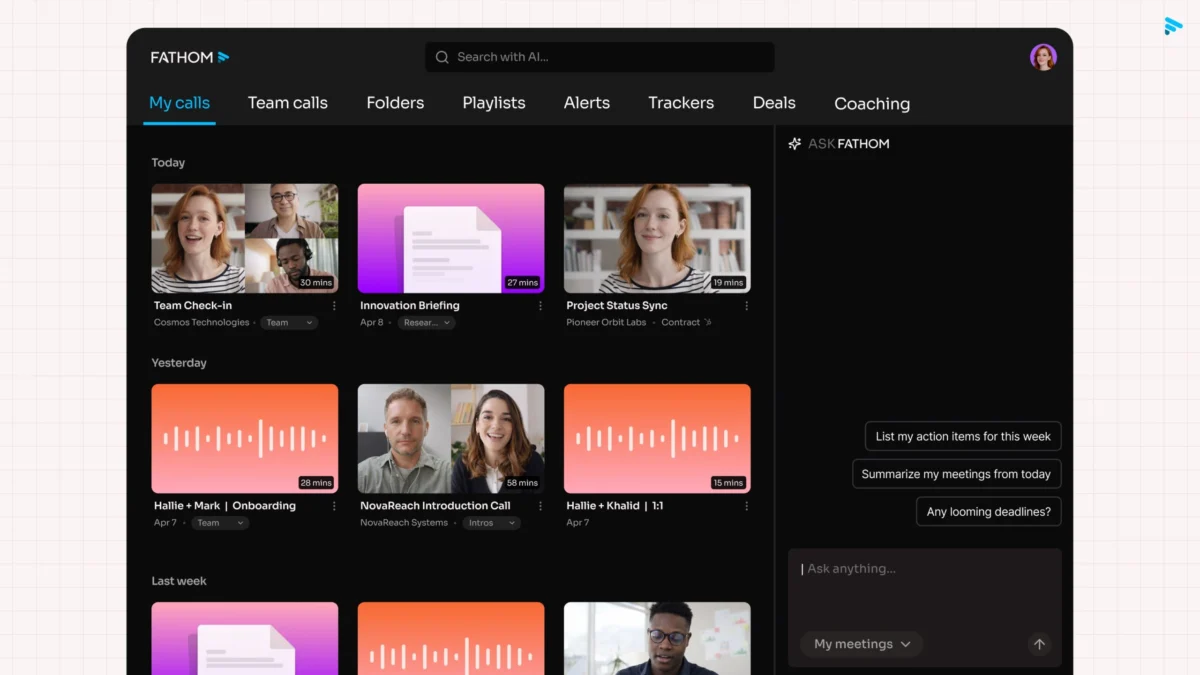
San Francisco, CA – In a significant move aimed at streamlining virtual collaboration and combating the pervasive issue of "bot overcrowding" in online meetings, Fathom, a prominent startup specializing in AI note-taking tools, has rolled out a transformative update to its platform. This new iteration allows its application to transcribe and summarize all attended calls without the conspicuous presence of an AI assistant bot joining the virtual meeting room. The update, announced on April 15, 2026, marks a pivotal shift in how AI-powered productivity tools integrate into daily professional workflows, prioritizing discretion and enhanced user experience.
The Growing Challenge of Virtual Meeting Overcrowding
The proliferation of remote and hybrid work models over the past several years has dramatically increased reliance on online meeting platforms. Concurrently, the market for AI-powered meeting assistants has exploded, with numerous solutions offering transcription, summarization, and action item generation. While these tools undeniably boost productivity by offloading mundane note-taking tasks, their widespread adoption has inadvertently led to a new form of digital clutter: "bot overcrowding." It has become increasingly common for multiple participants in a single meeting to each have their own AI assistant bot join the call, resulting in a virtual room populated not just by human attendees but also by a collection of silent, digital auditors. This phenomenon, while seemingly minor, contributes to a sense of a crowded digital space and can raise subtle privacy and data governance questions among participants.
Fathom’s latest update directly confronts this challenge, positioning itself as a more seamless and less intrusive alternative. By enabling its application to operate in a "bot-less" mode, Fathom aims to restore a more focused and human-centric environment to virtual meetings, allowing users to leverage AI’s benefits without the overhead of additional virtual participants.
Fathom’s Innovative Bot-less Approach and Core Enhancements
The core of Fathom’s innovation lies in its ability to capture meeting audio and, uniquely, video directly from the user’s desktop environment, eliminating the need for a dedicated bot to be invited to the call. This method is not entirely novel, as several other desktop applications, including Granola, Talat, Notion, and even ChatGPT, have previously offered client-side transcription capabilities. However, Fathom differentiates itself by significantly enhancing these functionalities, particularly through its focus on highly accurate speaker diarization and the ability to record video alongside audio.
Richard White, CEO of Fathom, emphasized the importance of accurate speaker diarization in an interview with TechCrunch, stating, "A lot of these bot-less tools don’t indicate who said what in their captured transcript." He elaborated on a common pain point: the difficulty users face when trying to recall specific context or attribute statements correctly in past meetings, often leading to misattributions when querying their meeting notes. Fathom’s dedicated effort in this area ensures that its transcripts not only capture the spoken words but also precisely identify each speaker, thereby preserving crucial contextual information and making past conversations far more retrievable and actionable. This granular level of detail is vital for compliance, accountability, and accurate follow-up in professional settings.
Furthermore, Fathom offers users various recording modes, allowing for flexible capture based on individual preferences and privacy considerations. The inclusion of video recording capabilities is a significant differentiator, providing a richer contextual record of meetings that goes beyond mere transcription, capturing non-verbal cues and shared screen content that can be critical for understanding decisions and discussions.
The Technological Leap: AI Advancements Paving the Way
The development of this bot-less functionality, according to CEO Richard White, has been made possible by "AI improvements in the last six months across various models." This statement highlights the rapid pace of innovation within the artificial intelligence domain, particularly in areas like natural language processing (NLP), speech-to-text conversion, and speaker recognition. Advances in transformer models and more efficient on-device AI processing have enabled applications to perform complex tasks like real-time, accurate transcription and diarization locally, or with minimal cloud dependency, without the need for a separate bot instance.
These technological leaps are not just about raw processing power but also about the refinement of AI algorithms to handle nuances of human speech, including accents, overlapping dialogue, and varied acoustic environments. The ability to distinguish between multiple speakers with high accuracy, even in challenging audio conditions, is a testament to the sophistication of contemporary AI models. This trend towards more powerful and localized AI is also a response to growing concerns about data privacy and security, as processing data closer to the source can reduce reliance on third-party cloud services for sensitive meeting content.

Beyond Basic Transcription: AI Querying and Data Protocols
Fathom’s update extends beyond mere transcription and diarization, introducing powerful features that transform raw meeting data into actionable intelligence. The company is now enabling users to leverage AI to query their meeting database, making it a more robust and intelligent knowledge repository. For businesses, this means the ability to feed the system broader contextual information, allowing for more insightful queries and the generation of more relevant summaries or action items across multiple meetings and projects. Imagine asking a question like, "What were the key decisions made regarding Project X in the last quarter, and who was responsible for each?" and receiving an intelligently compiled answer based on all relevant meeting transcripts.
Crucially, Fathom is also releasing a Model Context Protocol (MCP) server. This protocol is designed to allow users to pull their meeting data and seamlessly integrate it into their own AI tools and workflows. This move underscores a commitment to data portability and user control, recognizing that organizations increasingly rely on a diverse ecosystem of AI applications. The MCP server facilitates interoperability, ensuring that the valuable insights captured by Fathom can enrich other enterprise AI solutions, such as internal knowledge bases, CRM systems, or project management platforms.
Lessons from Competitors: The Granola Incident and Data Ownership
The introduction of the Model Context Protocol is particularly timely, especially in light of recent user complaints faced by a competitor, Granola. Granola, another prominent AI meeting note-taker, recently made changes to its on-device database, which inadvertently broke AI workflows that relied on transcript data from that source. This incident highlighted the critical importance of stable data access and flexible integration for users who are building their own AI-powered productivity layers on top of existing tools.
Fathom’s MCP directly addresses this concern by providing a standardized and reliable mechanism for data extraction and integration. By offering an open protocol, Fathom aims to build trust with its user base, particularly enterprise clients, who prioritize data ownership, control, and the ability to customize their AI ecosystems without fear of disruptions caused by vendor-side changes. This strategic decision positions Fathom as a more enterprise-friendly solution, acknowledging the growing demand for flexible and interconnected AI tools in complex organizational environments.
Future Trajectories and Broader Market Implications
Looking ahead, Fathom has ambitious plans to further expand its capabilities. CEO Richard White indicated that the company is actively working on enhancing transcription accuracy and offering more diverse ways for users to capture meetings. A particularly exciting development on the horizon is the planned release of an iOS app designed to record in-person meetings. This extension of functionality would enable Fathom to serve a broader range of professional interactions, blurring the lines between virtual and physical meeting documentation and providing a unified repository for all professional conversations.
The broader implications of Fathom’s update are significant for the burgeoning market of AI productivity tools. This shift towards bot-less, client-side, and highly accurate diarized transcription, coupled with robust data integration protocols, signals a maturation of the AI assistant landscape. Users are increasingly demanding solutions that are not only powerful but also discreet, secure, and interoperable.
The move away from visible bots addresses a subtle but persistent user friction point, contributing to a more natural and less "monitored" feeling in virtual meetings. This could lead to higher adoption rates among users who might have been hesitant due to privacy concerns or the perceived awkwardness of having an extra "participant" in their calls. Furthermore, the emphasis on speaker diarization elevates the utility of meeting transcripts from mere records to intelligent, searchable databases of who said what, when, and in what context.
As AI continues to embed itself deeper into the fabric of daily work, companies like Fathom are at the forefront of defining what intelligent assistance looks like. Their focus on user experience, data integrity, and interoperability will likely set new standards for the industry, pushing competitors to innovate further in areas beyond just basic transcription. The ultimate beneficiaries will be professionals and organizations seeking to harness the full power of AI to enhance productivity, improve knowledge retention, and foster more effective collaboration in an increasingly digital world. The market is clearly moving towards intelligent, integrated, and unobtrusive AI solutions, and Fathom’s latest update places it firmly in a leadership position within this evolving paradigm.
