

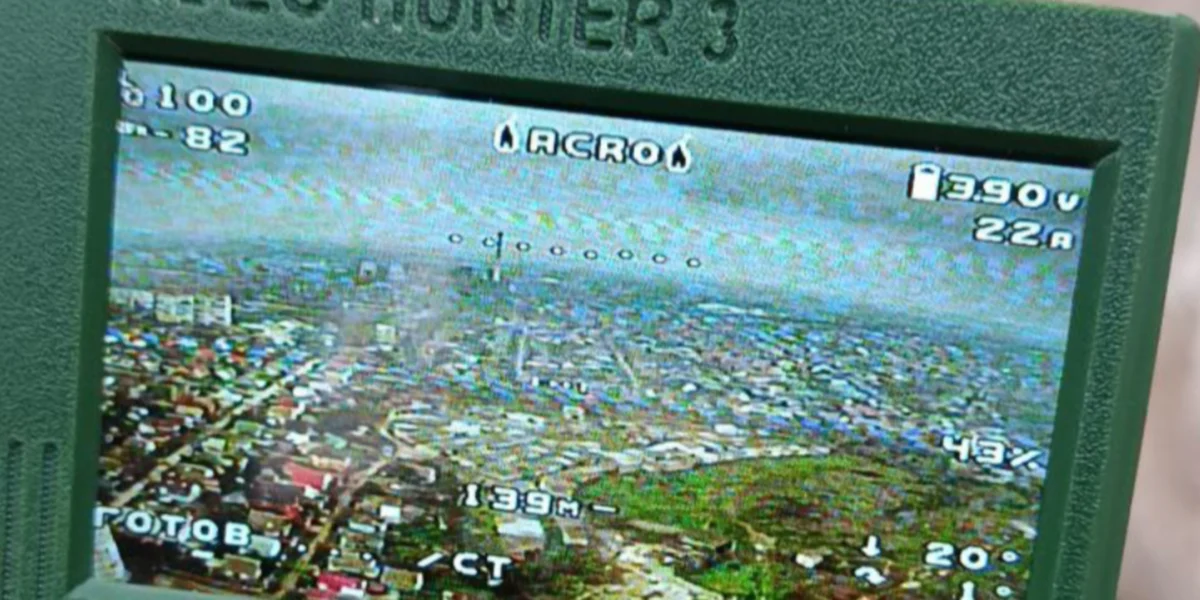
"Here, you don’t wear a seatbelt," says a taxi driver in Kherson in Southern Ukraine. "If a drone comes, you have to get out of the car immediately." This stark declaration encapsulates the pervasive and evolving threat of aerial surveillance and attack that has become an indelible feature of life in Ukraine’s southern frontlines, particularly in cities like Kherson. The constant hum of unseen engines, the chilling possibility of an incoming projectile, and the necessity of split-second reactions have reshaped daily routines, transforming ordinary civilian spaces into precarious zones where survival often hinges on vigilance and adaptability. The image of a handheld drone detector, displaying an intercepted video transmission from a Russian drone, serves as a potent visual testament to this new, deeply integrated dimension of warfare.
The proliferation of drones, from small reconnaissance units to larger, weaponized platforms, has fundamentally altered the nature of conflict in Ukraine. Initially deployed by both sides for intelligence gathering and tactical observation, their capabilities have rapidly expanded, leading to their integration into offensive operations. For Russia, which possesses a significant drone manufacturing capacity and has received drone components from international partners, these unmanned aerial vehicles (UAVs) represent a cost-effective and adaptable means to project power, gather battlefield intelligence, and inflict damage with reduced risk to personnel. Ukraine, though initially at a disadvantage in drone technology, has shown remarkable innovation and resilience, developing its own indigenous drone programs and leveraging Western assistance to counter and even surpass Russian capabilities in certain areas.
The Evolving Threat Landscape in Kherson
Kherson, a strategically vital port city on the Dnipro River, has been a focal point of the conflict since the early days of the full-scale invasion. Its proximity to Russian-occupied territories and its crucial logistical importance have made it a consistent target for shelling and aerial attacks. The civilian population has endured prolonged periods of occupation, liberation, and ongoing bombardment. The introduction and increasing sophistication of drones have added another layer of danger to an already precarious existence.
The taxi driver’s advice is not an exaggeration. The ability of drones to loiter overhead, identifying targets with increasing precision, means that stationary vehicles, including taxis and personal cars, can quickly become vulnerable. The immediate reaction to disembark and seek cover, even if it means abandoning a vehicle temporarily, is a learned survival mechanism. This applies not only to transportation but to all aspects of daily life. Farmers working in fields, construction crews on sites, and even residents going about their daily errands must maintain a constant awareness of the sky.
Chronology of Drone Warfare in Ukraine
The use of drones in warfare is not new, but the scale and intensity seen in Ukraine are unprecedented.
- Pre-2022: Drones were primarily employed by militaries for reconnaissance and surveillance, with limited offensive capabilities.
- Early 2022 (Invasion): Both Russian and Ukrainian forces utilized drones for battlefield observation. Russia deployed its Orlan-10 reconnaissance drones extensively. Ukraine, with its burgeoning domestic drone industry and Western support, began to deploy FPV (first-person view) drones for reconnaissance and targeted strikes.
- Mid-2022 onwards: The use of FPV drones for kamikaze attacks, carrying small explosives, became increasingly prevalent. These drones, often piloted by operators wearing VR goggles, offered a low-cost, highly maneuverable way to target individual soldiers, vehicles, and even fortified positions.
- Late 2022 – 2023: Russia escalated its use of Shahed-136 (often referred to as "kamikaze" drones) and other Iranian-supplied UAVs, targeting Ukrainian energy infrastructure and cities far from the front lines. Ukraine responded by improving its air defense systems and developing counter-drone technologies.
- 2024 – Present: The conflict has seen a continuous arms race in drone technology. Both sides are developing more advanced drones with longer ranges, improved payload capacity, AI-driven targeting, and enhanced electronic warfare countermeasures. The focus has shifted towards swarm tactics, where multiple drones operate in concert, and the development of specialized drones for specific missions, such as mine clearance or electronic jamming.
In Kherson, this evolving drone warfare means that the threat is not static. What was a nuisance for reconnaissance a year ago might now be a direct attack vector. The constant adaptation by both military forces and civilians is a testament to the dynamic nature of this conflict.
Supporting Data: The Pervasive Presence of UAVs
Quantifying the exact number of drones deployed and intercepted in a conflict zone is challenging due to the fog of war and the clandestine nature of military operations. However, various reports and analyses offer a glimpse into the scale of drone activity:
- Intercept Rates: Ukraine’s air defense forces regularly report downing dozens, and sometimes hundreds, of drones daily, particularly during large-scale Russian aerial assaults. For instance, in the winter of 2022-2023, Ukraine’s air defense units claimed to have intercepted over 80% of the Shahed drones launched by Russia during certain periods.
- Drone Production: Estimates suggest that both Russia and Ukraine are producing thousands of drones per month. Ukraine’s domestic production, supported by significant international investment and technology transfer, has grown exponentially. Reports indicate that Ukraine aims to produce over a million drones in 2024. Russia, while having its own industrial base, has also relied on imports and components from partner nations.
- Targeting Capabilities: The effectiveness of drone strikes is evident in damage assessments. Reconnaissance drones provide real-time intelligence that allows artillery and missile strikes to be more precise. Kamikaze drones, while often carrying smaller payloads, can be highly effective against specific targets like armored vehicles or exposed personnel. The use of drones for artillery spotting has significantly improved the accuracy of conventional artillery fire for both sides.
- Counter-Drone Technologies: The market for counter-drone systems has exploded. These range from sophisticated radar and electronic jamming systems to directed energy weapons and even specialized anti-drone guns. The development and deployment of these technologies are a direct response to the pervasive threat of UAVs.
Official Responses and Civilian Adaptations
The Ukrainian government has prioritized the development of its drone capabilities and the enhancement of its air defense network. President Volodymyr Zelenskyy has repeatedly called for increased Western assistance in the form of advanced drone technology and air defense systems.
"We are doing everything possible to strengthen our air defense and to develop our own drone production," a Ukrainian Ministry of Defense spokesperson stated in a recent briefing. "The enemy is constantly evolving its tactics, and we must stay ahead. Civilian safety remains a paramount concern, and we are working to protect our cities and towns from aerial threats."
However, the sheer scale of the threat means that complete protection is impossible, especially in areas close to the front lines. This has led to widespread civilian adaptations:
- Shelter-in-Place Protocols: Many communities have established clear protocols for seeking immediate shelter when drone activity is detected. This often involves designated public shelters, basements, and reinforced structures.
- Early Warning Systems: Local authorities and volunteer networks often implement informal early warning systems, sharing information about drone sightings through encrypted messaging apps and community alerts.
- Camouflage and Concealment: Civilians have become more adept at camouflaging vehicles and structures to make them less visible to aerial reconnaissance.
- Psychological Resilience: The constant threat has necessitated a degree of psychological adaptation. While fear is ever-present, a sense of resilience and routine has also emerged, allowing life to continue under challenging circumstances.
Broader Impact and Implications
The pervasive use of drones in the Ukraine conflict has profound implications for future warfare:
- Democratization of Air Power: Drones, particularly FPV and commercially available models adapted for military use, have lowered the barrier to entry for aerial warfare. This means that smaller states and even non-state actors can potentially acquire and deploy aerial capabilities that were once the exclusive domain of major powers.
- The Future of Surveillance: Drones are revolutionizing intelligence, surveillance, and reconnaissance (ISR). Their ability to loiter, capture high-resolution imagery and video, and even conduct electronic intelligence gathering means that the battlefield is becoming increasingly transparent, albeit for those with the means to observe.
- Urban Warfare Transformation: Cities are becoming increasingly complex battlegrounds. Drones can navigate urban environments, providing close-quarters intelligence and delivering precision strikes that can impact buildings and infrastructure with devastating effect. This necessitates new urban defense strategies and civilian protection measures.
- The Ethical and Legal Dimension: The use of autonomous or semi-autonomous drones raises significant ethical and legal questions regarding accountability for casualties, the distinction between combatants and civilians, and the potential for unintended escalation. International bodies are grappling with how to regulate these technologies.
- Economic and Industrial Impact: The drone arms race is driving significant investment in research and development, manufacturing, and counter-drone technologies. This has created new industries and spurred innovation but also contributes to a global proliferation of advanced military hardware.
In Kherson, the taxi driver’s advice is a microcosm of a global shift in warfare. The hum of a drone overhead is no longer a distant threat but an immediate, tangible reality that demands constant vigilance, adaptation, and a profound reassessment of how civilians coexist with the evolving landscape of conflict. The screen of a drone detector, showing an intercepted video transmission, is not just a technical display; it is a window into a new era of warfare, where the sky itself has become a contested and dangerous domain.
