

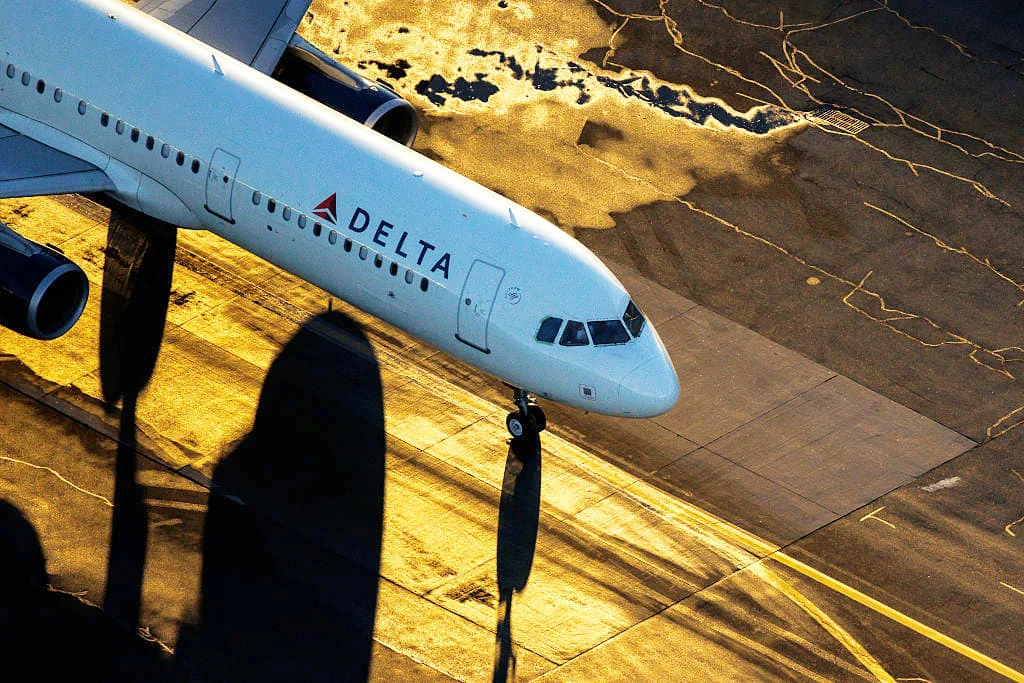
Delta Air Lines, a bellwether for the U.S. aviation industry, has significantly revised its long-term profit projections for 2026, lowering its outlook due to the persistent pressure of elevated fuel prices. The airline now anticipates full-year earnings per share (EPS) on an adjusted basis to fall between $5.10 and $5.60, a considerable reduction from its prior forecast in July of $6.50 to $7.50 per share. This adjustment underscores the profound impact of volatile energy markets on even the most robust carriers. Concurrently, the company also trimmed its free cash flow outlook for the current year to $2.5 billion, down from an earlier expectation of up to $4 billion. Despite these financial revisions, CEO Ed Bastian expressed unwavering confidence in the strength of consumer demand, asserting that higher airfares have not deterred travelers from booking flights across all segments.
Financial Revisions: A Deeper Dive into the Numbers
The revised financial guidance comes as a direct consequence of a dramatic surge in jet fuel prices, which have nearly doubled in the U.S. Gulf of Mexico region, climbing from $2.19 per gallon a year ago to $4.34 per gallon as of Thursday, according to FactSet data. This increase alone has translated into an estimated $6 billion rise in fuel costs for Delta this year, a burden that even the airline’s strategic refinery in Trainer, Pennsylvania, designed to mitigate such volatility, could not entirely offset.
For the third quarter, encompassing the traditionally busy summer travel season, Delta reported adjusted earnings of $1.76 per share, missing Wall Street’s consensus estimates. This marks the first instance in two years that the airline has fallen short of analyst expectations, signaling the acute challenges posed by the current operating environment. Net income for the quarter stood at $756 million, or $1.15 per share, representing a substantial 47% decline from $1.42 billion, or $2.17 per share, reported in the same period a year earlier.
Despite the earnings miss, revenue figures painted a more optimistic picture of traveler engagement. Operating revenue for the third quarter jumped 21% to $20.19 billion. When adjusted for sales from its refinery, maintenance business, and profit-sharing, revenue increased 16% from the previous year, reaching $17.59 billion. A significant trend observed in these figures is the continued strength of premium travel. Delta’s premium revenue grew an impressive 18% in the third quarter to $6.82 billion, now constituting a larger portion of its total sales. In contrast, main cabin sales rose 12% to $6.8 billion, highlighting a sustained willingness among travelers to pay for enhanced experiences and comfort, even in the face of escalating prices. Looking ahead, Delta’s fourth-quarter guidance anticipates a 20% increase in revenue over the same period last year, a forecast that, when adjusted for the refinery’s benefit, surpasses the 16% rise seen in the third quarter.
The Fuel Price Conundrum: A Persistent Headwind
The dramatic escalation in fuel prices is the primary antagonist in Delta’s revised financial narrative. Geopolitical tensions, particularly those emanating from the Middle East, have played a significant role in driving up crude oil prices, which in turn affect jet fuel costs. The "Iran war" mentioned in the original context likely refers to broader regional instability and its impact on global oil supplies and market sentiment, rather than a direct, declared war involving Iran at the time of reporting. Such events frequently introduce volatility and upward pressure on energy commodities, directly impacting industries like aviation that are heavily reliant on fuel.
Delta, uniquely among U.S. airlines, operates its own refinery in Trainer, Pennsylvania. Acquired in 2012, the Monroe Energy refinery was a strategic move designed to provide Delta with a competitive advantage by hedging against volatile fuel costs and ensuring a stable supply of jet fuel. By processing crude oil into jet fuel and other refined products, Delta aimed to reduce its exposure to market fluctuations and gain greater control over a major operating expense. While this refinery has historically offered a buffer, the sheer magnitude of the recent fuel price surge—a $6 billion increase in annual fuel costs—demonstrates that even this sophisticated hedging mechanism has limits in mitigating extreme market movements. The situation underscores the inherent vulnerability of the airline industry to global energy prices, regardless of individual strategies. This challenge is not unique to Delta; the surge in fuel prices since early 2023 has put a damper on airline profits across the board, even as carriers have largely been able to flex their pricing power.
Resilient Consumer Demand: A Silver Lining
Despite the significant cost pressures, the unwavering strength of consumer demand remains a crucial factor underpinning Delta’s operational performance. CEO Ed Bastian articulated this resilience, noting that "The consumer response continues to be quite strong. We’re seeing it across all channels, all cabins of service, all geographies, business, leisure." This sentiment reflects a broader trend observed in the post-pandemic era: a sustained appetite for travel, often dubbed "revenge travel," as consumers prioritize experiences after years of restrictions.

This robust demand has empowered airlines, including Delta, to pass along much of the increased fuel costs to passengers through higher fares. The latest inflation report in September revealed that airfares were up more than 23% from a year earlier, a stark indicator of this pricing power. This ability to increase ticket prices without significantly dampening demand speaks to several factors. Firstly, the aforementioned "revenge travel" phenomenon has seen consumers allocate a larger portion of their disposable income to travel and leisure. Secondly, a shift in consumer preferences towards experiences over goods, particularly among affluent segments, has further bolstered demand for premium travel services, as evidenced by Delta’s strong premium revenue growth. Thirdly, the airline industry has, to some extent, rationalized capacity post-pandemic, leading to fuller planes and less competitive pressure on pricing. This confluence of factors has created an environment where, despite inflationary pressures impacting household budgets, the desire to travel remains strong enough to absorb higher costs.
The In-Flight Connectivity Battle: Delta’s Strategic Choice and the Musk Controversy
Beyond the financial performance, Delta found itself in the spotlight recently due to a high-profile spat over in-flight Wi-Fi, highlighting the escalating competition among airlines to offer superior connectivity. Delta, which pioneered free Wi-Fi across its fleet almost four years ago, recently announced a partnership with Amazon’s Project Kuiper (Leo satellite internet) to enhance its on-board internet service, aiming for "living-room-quality speeds." This strategic move positions Delta alongside a burgeoning industry trend where airlines are racing to upgrade their connectivity offerings, recognizing it as a critical component of the modern travel experience.
This decision, however, drew criticism from an unexpected quarter: Elon Musk, CEO of SpaceX. Musk publicly lambasted Delta CEO Ed Bastian on X (formerly Twitter) after a travel blog, "View from the Wing," reported Bastian’s alleged comments at an internal event: "We do not want to be with Elon Musk. Trust me." Musk retorted, suggesting Bastian would "lose his job over this." The controversy underscores the intense competition in the satellite internet sector, where SpaceX’s Starlink has emerged as a dominant player, securing partnerships with major carriers such as United Airlines, American Airlines, Southwest Airlines, and Alaska Airlines, as well as numerous international airlines.
Bastian, in an interview with CNBC’s Phil LeBeau, largely brushed off the public exchange, stating that "everyone’s entitled to their opinion" and emphasizing that "There’s no tit for tat as far as I’m concerned." He clarified that Delta had engaged in discussions with SpaceX six years prior but found that Starlink "weren’t ready to scale" at that time. This suggests that Delta’s decision was rooted in a long-term strategic evaluation of technological readiness, scalability, and partnership suitability, rather than a personal animosity. The choice of Amazon Leo forges a significant alliance in the in-flight connectivity market, potentially diversifying the options available to airlines and fostering innovation within the sector. It also signals Delta’s commitment to delivering a premium, reliable service, aligning with its broader strategy of attracting and retaining high-value customers.
Broader Industry Implications and Outlook
Delta’s revised outlook and third-quarter performance offer a microcosm of the broader challenges and opportunities facing the global aviation industry. As the country’s most profitable airline and typically the first to report results, Delta’s pronouncements often serve as an indicator for the sector. The persistent high fuel costs, exacerbated by geopolitical uncertainties, remain the most significant headwind, threatening to erode profitability even amidst robust passenger demand. This dynamic places immense pressure on airlines to manage operational efficiencies, explore further hedging strategies, and maintain pricing power without alienating customers.
From an investor perspective, the lowered guidance could lead to cautious sentiment, despite the underlying strength in revenue generation and consumer willingness to pay. Analysts will be closely monitoring how Delta and its peers navigate this delicate balance between managing escalating costs and capitalizing on sustained travel demand. The ability of airlines to continue passing on higher fuel costs to consumers without triggering a significant slowdown in bookings will be critical to their financial health in the coming quarters.
The competitive landscape also continues to evolve, particularly in areas like in-flight services. Delta’s choice of Amazon Leo over Starlink highlights the strategic importance of technology partnerships in enhancing the passenger experience. As airlines increasingly compete on factors beyond just price and schedule, the quality of amenities like Wi-Fi becomes a key differentiator, influencing brand perception and customer loyalty. The industry is in a continuous state of adaptation, balancing operational imperatives with evolving consumer expectations.
Conclusion: Awaiting Smoother Airs
In summary, Delta Air Lines finds itself at a pivotal juncture, navigating turbulent economic and geopolitical currents. While the airline has demonstrated remarkable resilience in stimulating and capturing strong consumer demand, particularly in premium segments, the specter of elevated and volatile fuel prices casts a long shadow over its profitability outlook. The revised 2026 profit forecast and the missed Q3 earnings estimates serve as a stark reminder that even industry leaders are susceptible to macro-economic pressures. CEO Ed Bastian’s steadfast confidence in the traveler’s enduring desire to fly offers a silver lining, suggesting that the underlying demand structure remains robust. However, the path to achieving its long-term financial targets will undoubtedly require astute cost management, strategic pricing, and continued innovation, as Delta and the broader aviation industry await smoother, less costly airs.
