

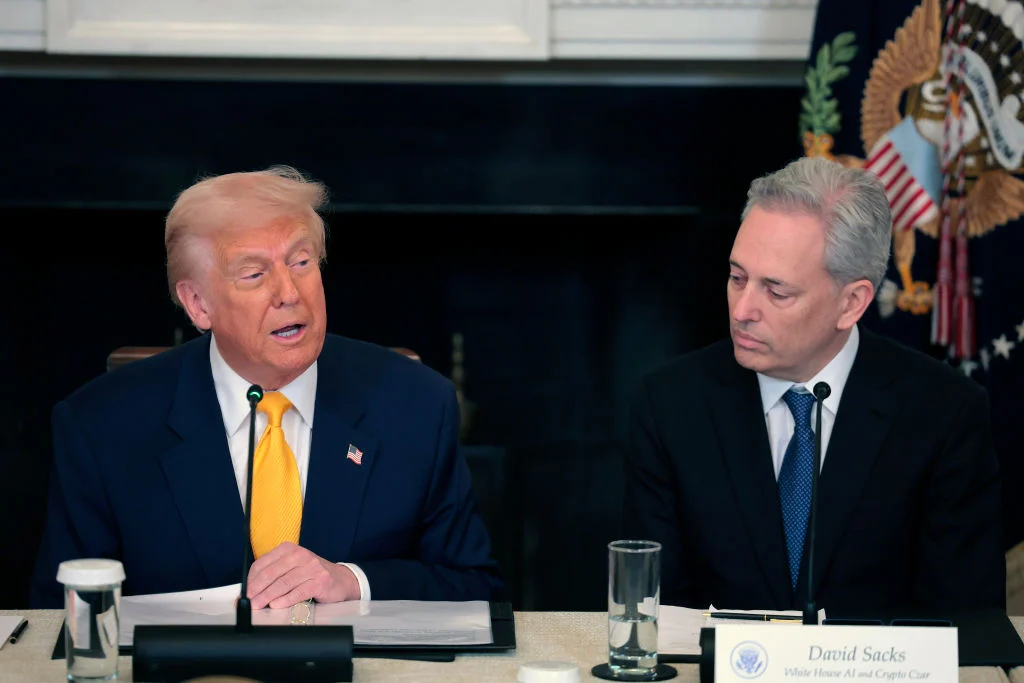
David Sacks, the influential entrepreneur, investor, and podcaster, has officially concluded his impactful tenure as a special government employee focusing on artificial intelligence and cryptocurrency policy within the Trump administration. Following a non-consecutive 130-day stint, Sacks confirmed his transition to a new capacity as co-chair of the President’s Council of Advisors on Science and Technology (PCAST), where he will serve alongside senior White House technology adviser Michael Kratsios. This strategic move, announced during a Bloomberg interview on Thursday, signifies a shift in Sacks’ engagement with federal policy, broadening his advisory scope while repositioning his direct influence within the governmental hierarchy.
From Direct Influence to Strategic Counsel: The Evolution of Sacks’ Role
Sacks’ previous role, often colloquially termed "AI and crypto czar," afforded him a direct channel to President Trump, allowing him to actively shape nascent policies in the rapidly evolving sectors of artificial intelligence and digital assets. This position placed him at the heart of policy formation, where his insights as a prominent Silicon Valley figure were intended to guide the administration’s approach to these critical technological frontiers. His involvement underscored the Trump administration’s growing recognition of the economic and strategic importance of AI and blockchain technologies, particularly in an era of intense global technological competition. The "non-consecutive" nature of his 130-day service, while not explicitly detailed, suggests periods of intense focus interspersed with his private sector commitments, a common arrangement for special government employees who bring specialized expertise from outside traditional government structures.
However, his new appointment as co-chair of PCAST, while prestigious, inherently places him at a greater remove from the immediate power centers of Washington. PCAST functions as a federal advisory body, tasked with studying complex issues, generating comprehensive reports, and submitting recommendations up the chain of command. Unlike a direct policy-making role, PCAST’s influence is consultative, relying on the persuasive power of its research and expert consensus to inform executive decisions. Sacks himself acknowledged this shift, telling Bloomberg, "I think moving forward as co-chair of PCAST, I can now make recommendations on not just AI but an expanded range of technology topics. So yes, this is how I’ll be involved moving forward." This broader mandate, encompassing an array of scientific and technological domains, reflects a strategic decision to leverage Sacks’ expertise across a wider spectrum, moving beyond the specific niches of AI and crypto.
A Deep Dive into PCAST: History, Mandate, and Shifting Influence
The President’s Council of Advisors on Science and Technology boasts a rich history, tracing its origins back to the administration of Franklin D. Roosevelt, though it has evolved significantly in form and function over the decades. Its core mission has consistently been to provide the President with independent advice on matters of science, technology, and innovation, drawing upon the expertise of leading scientists, engineers, and industry professionals. Throughout its existence, PCAST has served as a critical interface between the scientific community and the executive branch, translating complex technical advancements and challenges into actionable policy recommendations.
The council’s impact, however, has historically varied considerably depending on the administration’s engagement and priorities. During President Barack Obama’s two terms, PCAST was notably productive, churning out an impressive 36 reports over eight years. This prolific output included influential studies on topics ranging from advanced manufacturing to cybersecurity, and critically, two of its recommendations directly led to concrete policy changes. A prominent example was an FDA rule that opened the market for over-the-counter hearing aids, a policy change that significantly improved accessibility and affordability for millions of Americans. This period demonstrated the potential for PCAST to be a powerful engine for evidence-based policy innovation, with its recommendations directly informing and shaping regulatory frameworks.
In stark contrast, President Trump’s first-term council experienced significant delays and a more limited output. It took nearly three years for the administration to even name its initial members, and subsequently, the council produced only a handful of reports, making no particular mark on the national policy landscape. This slower pace and reduced impact underscored the fact that the effectiveness of an advisory body like PCAST is heavily dependent on the administration’s commitment to soliciting and acting upon its counsel. President Biden’s PCAST, while more active than its immediate predecessor, skewed heavily academic, comprising Nobel laureates, MacArthur fellows, and National Academy members. While it issued a modest number of reports, its composition reflected a different strategic emphasis, prioritizing fundamental scientific research and academic rigor.
The "Star Power" Council: An Unprecedented Industry Gathering
The current iteration of PCAST, co-chaired by David Sacks and Michael Kratsios, represents a radical departure from its predecessors, particularly in its composition. Sacks made a point to Bloomberg of highlighting what he termed "the most star power of any group like this ever assembled," a claim that is difficult to dispute given the roster of initial members. This council is built almost entirely from the executive suites of the companies that are not just shaping, but actively defining, the global technology landscape.
The initial 15 members include an astonishing collection of industry titans: Jensen Huang, CEO of Nvidia, a company at the forefront of AI computing and semiconductor innovation; Mark Zuckerberg, CEO of Meta Platforms, a dominant force in social media and metaverse development; Larry Ellison, Chairman and CTO of Oracle, a veteran software and cloud computing giant; Sergey Brin, co-founder of Google, a pioneer in search, AI, and numerous other tech domains; Marc Andreessen, a legendary internet entrepreneur and venture capitalist known for his insights into software and crypto; Lisa Su, CEO of AMD, a formidable competitor in high-performance computing and graphics; and Michael Dell, founder and CEO of Dell Technologies, a global leader in hardware and IT solutions. The sheer concentration of billionaires and industry leaders on this council is unprecedented, signaling a deliberate strategy to directly integrate the perspectives of the most influential figures in the private tech sector into federal advisory processes.
The implications of such a composition are multifaceted. On one hand, it promises an unparalleled level of industry insight and practical experience. These individuals are not merely academics theorizing about technology; they are the architects and operators of the companies driving technological change on a global scale. Their collective understanding of market dynamics, innovation cycles, and the practical challenges of technological deployment could provide invaluable counsel to the President. On the other hand, it raises questions about potential conflicts of interest, given that these executives continue to lead companies that operate within or are directly impacted by government policies and regulations. While the advisory nature of PCAST mitigates some of these concerns compared to a direct policy-making role, the influence wielded by such figures, even in an advisory capacity, remains substantial.
Strategic Focus Areas and the National AI Framework
The new PCAST has outlined an ambitious agenda, with Sacks confirming to Bloomberg that the council will tackle critical areas including artificial intelligence, advanced semiconductors, quantum computing, and nuclear power. These domains represent some of the most strategically important and technologically complex challenges and opportunities facing the United States today. Near-term attention, Sacks noted, will be directed towards pushing President Trump’s recently released national AI framework.
The framework is specifically designed to address what Sacks characterized as a "mess of conflicting state-level rules" governing AI. He articulated the challenge by stating, "You’ve got 50 different states regulating this in 50 different ways, and it’s creating a patchwork of regulation that’s difficult for our innovators to comply with." This fragmented regulatory landscape, where each state might develop its own standards for data privacy, algorithmic transparency, or AI ethics, poses a significant hurdle for companies operating nationally or internationally. A unified national framework aims to provide clarity, predictability, and a level playing field for innovation, preventing a "race to the bottom" or an impediment to scaling AI technologies. This approach aligns with broader calls from the tech industry for a more coherent and consistent regulatory environment to foster innovation while ensuring responsible development.
Beyond AI, the focus on advanced semiconductors underscores their critical role in national security and economic competitiveness. The global semiconductor industry is highly concentrated, and geopolitical tensions have highlighted the vulnerabilities of supply chains. Advising on this area could involve strategies for domestic manufacturing, research and development investments, and international collaborations. Quantum computing, still in its nascent stages, promises revolutionary advancements but also presents immense technical and security challenges, making strategic guidance essential. Finally, the inclusion of nuclear power reflects a growing interest in clean, reliable energy sources, particularly in the context of climate change and energy independence. PCAST’s recommendations could influence policies related to next-generation reactors, waste management, and regulatory streamlining to accelerate deployment.
The Iran Controversy: A Shadow Over the Transition?
While Sacks presented his transition as a logical evolution of his advisory role, its timing coincided with a public controversy that raised questions about his alignment with the administration’s foreign policy. Earlier this month, on the popular "All In" podcast that he co-hosts, Sacks publicly urged the administration to find an exit from the U.S.-backed war with Iran. He outlined a series of worsening scenarios, including attacks on oil infrastructure in neighboring countries, the destruction of desalination plants, and the chilling possibility of nuclear use by Israel, advocating for a "polite way out" of the conflict.
President Trump’s response was swift and publicly dismissive. When questioned by reporters, Trump stated that Sacks "hadn’t spoken to him" about the war, creating a clear public distance between the advisor’s personal views and the administration’s official stance. This public divergence on such a sensitive foreign policy matter, particularly from an advisor with a direct line to the President, naturally invited speculation about its potential role in Sacks’ transition.
When pressed on the podcast episode by Bloomberg, Sacks figuratively threw his hands in the air, emphasizing the separation of his roles. "I’m not on the foreign policy team or the national security team," he stated, reiterating that his podcast comments represented his personal view, not an official one. This explanation seeks to compartmentalize his public commentary from his government service, a common strategy for individuals who straddle both public and private spheres. However, for a special government employee, especially one with direct access to the President, the line between personal opinion and perceived official endorsement can often become blurred in the public eye, potentially creating political complexities for the administration.
Ethical Scrutiny and the Return to Private Life
Sacks’ previous role as "AI and crypto czar" had already drawn significant scrutiny from ethics experts and lawmakers. TechCrunch had reported on the ethics waivers Sacks obtained to maintain financial stakes in AI and crypto companies while simultaneously shaping federal policy in both areas. This arrangement sparked "sharp criticism" due to the inherent potential for conflicts of interest. Critics argued that allowing an advisor to hold significant financial interests in the very sectors they are tasked with regulating or influencing creates a perception, if not a reality, of undue influence and self-serving policy recommendations. The blurred lines between private financial gain and public service raised concerns about the integrity of the policy-making process.
With his transition to PCAST co-chair, and his subsequent description of himself as "unencumbered," Sacks is ostensibly free to resume a more traditional investor and entrepreneur role without the same direct policy-making implications. While PCAST is an advisory body, the ethical considerations might be less acute than in a role where he was directly "shaping policy." A spokesperson for Craft Ventures, the venture capital firm Sacks co-founded and where he remains a partner, has not yet responded to questions regarding his next steps in the private sector. However, the move allows Sacks to operate in a capacity where his industry ties are framed as assets for expertise rather than potential conflicts for direct policy influence, though the distinction can remain nuanced.
Broader Implications for Tech Policy and Governance
The transformation of David Sacks’ role and the unique composition of the new PCAST carry significant implications for the future of technology policy under the Trump administration and potentially beyond. The decision to stack the advisory council with industry billionaires, rather than primarily academics or career scientists, signals a clear intent to prioritize private sector insights and potentially, to accelerate the adoption of tech-friendly policies.
The central question remains: will this unprecedented "star power" translate into greater influence for PCAST than its historical track record suggests? While an advisory body does not possess legislative power, the collective gravitas and direct experience of these tech leaders could lend significant weight to their recommendations. Their insights into the practicalities of innovation, market forces, and global competition could be invaluable in formulating policies that are both forward-looking and implementable. However, the challenge will be to synthesize diverse industry perspectives into coherent, actionable advice that serves the broader national interest, rather than specific corporate agendas.
Furthermore, Sacks’ shift highlights the ongoing tension and evolving relationship between Silicon Valley and Washington. As technology becomes increasingly central to economic prosperity, national security, and daily life, the demand for tech expertise within government will only grow. The model of bringing in prominent private sector figures for temporary government service offers a way to tap into this expertise but simultaneously raises complex questions about ethical boundaries, the influence of money in politics, and the potential for a revolving door between industry and government. The current PCAST, with its high-profile members and ambitious agenda, will serve as a critical test case for how an industry-led advisory body can effectively inform and shape national policy in an era of rapid technological transformation. The effectiveness of this council in navigating the intricate interplay of innovation, regulation, and public interest will be closely watched by both the tech community and policymakers alike.
