


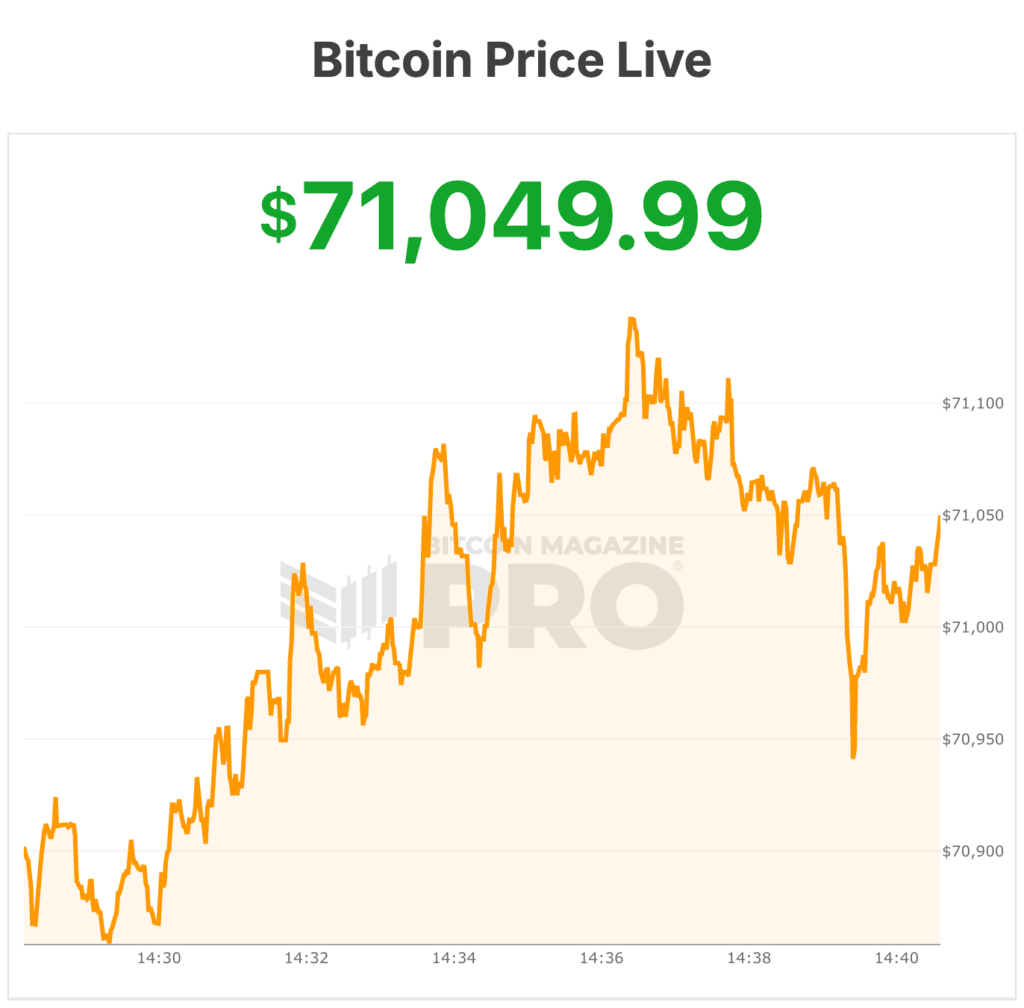
Bitcoin commenced the trading week with a dramatic ascent, breaching the significant $71,000 mark before experiencing a subsequent retracement. This pronounced volatility underscores the cryptocurrency market’s heightened sensitivity to geopolitical developments, particularly the escalating tensions between the United States and Iran. Over the preceding weekend, Bitcoin had languished below $68,000, leaving investors in a state of cautious anticipation as they navigated a complex landscape of conflicting reports concerning potential peace talks in the Middle East.
The surge on Monday followed an announcement by U.S. President Donald Trump, who indicated a five-day postponement of planned strikes against Iranian power plants. President Trump cited "very good and productive" conversations with Tehran aimed at achieving a "complete and total resolution" of hostilities. In the immediate aftermath of this statement, Bitcoin’s price experienced a rapid climb. According to data from Bitcoin Magazine Pro, the leading cryptocurrency reached an intraday high of $71,811. This rally, however, proved to be ephemeral, with Bitcoin subsequently easing back to trade around the $70,000 level. The brief upward momentum also led to the liquidation of approximately $791 million in leveraged crypto positions, with $425 million of those being long positions that were forcibly closed.
The short-lived nature of this rally was attributed to subsequent dispatches from Iran. The Iranian Ministry of Foreign Affairs, through state media channels, explicitly denied that any talks had occurred in the manner described by President Trump. A statement from the ministry declared, "We are not the party that started this war, and all these requests should be referred to Washington." This assertion from Tehran highlighted the continued uncertainty and lack of definitive de-escalation surrounding the conflict, reintroducing a layer of risk into market sentiment. Consequently, the market’s reaction mirrored these mixed signals, characterized by significant volatility in early-week trading.
Bitcoin’s Enduring Resilience Amidst Geopolitical Storms
Despite the intraday fluctuations, Bitcoin has demonstrated remarkable resilience when viewed over a broader time horizon. Since February 28, a period marked by U.S.-Israeli airstrikes, retaliatory Iranian attacks, and the subsequent closure of the Strait of Hormuz—a critical chokepoint for global oil trade—Bitcoin has seen a substantial increase of roughly 7%. This performance significantly outpaced traditional safe-haven assets and equity markets. For comparative context, during the same timeframe, the S&P 500 index experienced a decline of 4.6%, while gold saw a more pronounced drop of 17%. As of recent reports, gold was trading near $4,428 per ounce, illustrating a divergence in performance between these asset classes.
Analysts attribute Bitcoin’s outperformance in this turbulent environment to several factors, including the ongoing market deleveraging process that has been underway since October 2025. In that month, Bitcoin reached an all-time high of $126,080, a peak from which it has since corrected significantly. The current market structure, characterized by a reduction in highly leveraged positions, may contribute to Bitcoin’s ability to absorb geopolitical shocks with less dramatic price drops compared to previous cycles. This deleveraging can lead to a more stable foundation for future price appreciation, as it reduces the risk of cascading liquidations during periods of market stress.
Broader Market Dynamics and Inflationary Pressures
The volatility experienced by Bitcoin in the early part of the week was further amplified by broader macroeconomic factors. U.S. 10-year Treasury yields, a key indicator of investor confidence and inflation expectations, climbed to 4.36% on Monday. This upward trend in yields reflects growing concerns about inflation, which have been exacerbated by the recent surge in oil prices. Brent crude, a global benchmark for oil prices, had previously climbed past $107 per barrel following the February closure of the Strait of Hormuz. While oil prices saw an 8% retreat on Monday, the interplay between oil market fluctuations, inflation expectations, and the performance of risk assets like Bitcoin remains a critical dynamic for market participants to monitor. Higher oil prices typically translate into increased transportation costs and production expenses, feeding into broader inflationary pressures that can erode the purchasing power of fiat currencies and, by extension, increase the appeal of inflation-hedging assets.
Technical Analysis and Future Price Outlook
From a technical perspective, Bitcoin’s price action on the daily chart indicates that it remains confined within a symmetrical triangle pattern. This pattern typically suggests a period of consolidation, where buying and selling pressures are in equilibrium, and a significant breakout in either direction is often anticipated.
- Bullish Scenario: A sustained close above the $75,000 level within the current week could signal a continuation of the upward trend. According to analysis from Bitcoin Magazine Pro, such a breakout could pave the way for further price appreciation, targeting potential levels of $85,000 and subsequently $90,000. These targets represent significant milestones, potentially signaling a new phase of price discovery.
- Bearish Scenario: Conversely, a breakdown below the $67,000 mark would indicate a loss of bullish momentum. Such a decline could reopen the path for Bitcoin to retest recent lows, potentially testing the $65,000 or even lower levels, depending on the market’s reaction to renewed selling pressure.
At the time of publication, Bitcoin’s price was trading in close proximity to the $71,000 mark, indicating that the market was still digesting the recent events and the conflicting narratives surrounding geopolitical de-escalation. The coming days will be crucial in determining which of the technical scenarios is more likely to unfold, with geopolitical developments and macroeconomic indicators continuing to play a pivotal role in shaping investor sentiment.
The Strategic Importance of the Strait of Hormuz
The events of late February and early March, which saw significant geopolitical friction in the Persian Gulf, highlighted the critical strategic and economic importance of the Strait of Hormuz. This narrow waterway, connecting the Persian Gulf to the open ocean, is one of the world’s most vital oil transit points. Approximately 20% of global oil production passes through the Strait of Hormuz annually. Disruptions to this trade route can have immediate and profound impacts on global energy markets, leading to sharp increases in oil prices and, consequently, contributing to inflationary pressures worldwide.
The closure of the Strait, even if temporary, sent shockwaves through the financial world. The potential for a sustained blockade or conflict in this region poses a significant threat to global economic stability. For assets like Bitcoin, which are often viewed through the lens of a potential hedge against traditional financial system instability and currency debasement, such geopolitical risks can paradoxically increase their appeal. Investors may seek to diversify their holdings into assets perceived as less susceptible to the direct impacts of regional conflicts and the potential for a decline in fiat currency values. This dynamic can explain, in part, Bitcoin’s ability to maintain a degree of resilience despite the broader market uncertainties.
Deleveraging and its Impact on Bitcoin’s Price Action
The concept of market deleveraging, as mentioned in relation to Bitcoin’s performance, refers to the process of reducing debt and financial leverage within the market. In the context of cryptocurrency trading, high leverage can amplify both gains and losses. When prices move sharply against a highly leveraged position, it can trigger automatic liquidations, creating a cascading effect that drives prices down even further.
The period of deleveraging since Bitcoin’s peak in October 2025 suggests that a significant portion of speculative, highly leveraged positions have been unwound. This process, while painful for those caught in it, can ultimately lead to a healthier market. With less speculative excess and fewer highly leveraged traders at risk of liquidation, the market becomes more stable and less prone to extreme, rapid price swings driven by forced selling. This reduction in systemic risk can allow Bitcoin to better withstand external shocks, such as geopolitical news, and to consolidate or advance on more fundamental buying pressure. The market’s ability to absorb the news of potential Iranian strikes and then recover from the subsequent volatility suggests a maturation of the cryptocurrency market, where narratives and fundamental factors may be gaining more traction over purely speculative, high-leverage plays.
The Interconnectedness of Global Markets
The events of the past week serve as a potent reminder of the interconnectedness of global markets. Geopolitical developments in one region can rapidly influence commodity prices, inflation expectations, and investor sentiment across the globe. The cryptocurrency market, while often perceived as a separate ecosystem, is demonstrably influenced by these broader macroeconomic and geopolitical forces.
The U.S. 10-year Treasury yield’s sensitivity to oil prices, and in turn, the impact of oil prices on inflation, directly affects the risk appetite of investors in all asset classes. When inflation concerns rise and bond yields increase, investors may become more risk-averse, leading to a reallocation of capital away from growth assets like technology stocks and cryptocurrencies towards safer havens. However, in situations of extreme geopolitical uncertainty, traditional safe havens like gold can also experience volatility, potentially driving investors towards alternative assets like Bitcoin, which some view as a digital store of value or a hedge against systemic risk.
The technical analysis of Bitcoin’s symmetrical triangle pattern further emphasizes the current state of equilibrium in the market. This consolidation phase suggests that traders are waiting for a clear catalyst to drive the price in a definitive direction. Whether that catalyst will be a further de-escalation of tensions between the U.S. and Iran, a shift in global monetary policy, or a significant development within the cryptocurrency industry itself remains to be seen. The market is poised for a move, and the direction will likely be dictated by the unfolding narrative in both the geopolitical and economic spheres.
Conclusion
Bitcoin’s recent price action, characterized by a sharp surge and subsequent retreat, exemplifies the complex interplay between geopolitical events, macroeconomic conditions, and investor sentiment in the digital asset market. While the immediate volatility was triggered by shifting U.S.-Iran relations, Bitcoin’s broader resilience and outperformance against traditional assets highlight its evolving role in a volatile global landscape. The market’s ability to absorb shocks, coupled with technical indicators suggesting a period of consolidation, indicates that Bitcoin remains a significant asset to watch. As the geopolitical situation continues to evolve and broader economic factors like inflation and interest rates are closely monitored, the cryptocurrency market, and Bitcoin in particular, will undoubtedly remain a focal point for investors seeking to navigate an increasingly unpredictable global financial environment. The upcoming days and weeks will be critical in determining whether Bitcoin can break out of its current consolidation pattern and reassert its upward trajectory, or if renewed geopolitical instability or unfavorable macroeconomic conditions will lead to a test of lower price levels. The market’s sensitivity to these external factors remains a defining characteristic, underscoring the dynamic nature of cryptocurrency investments.
