

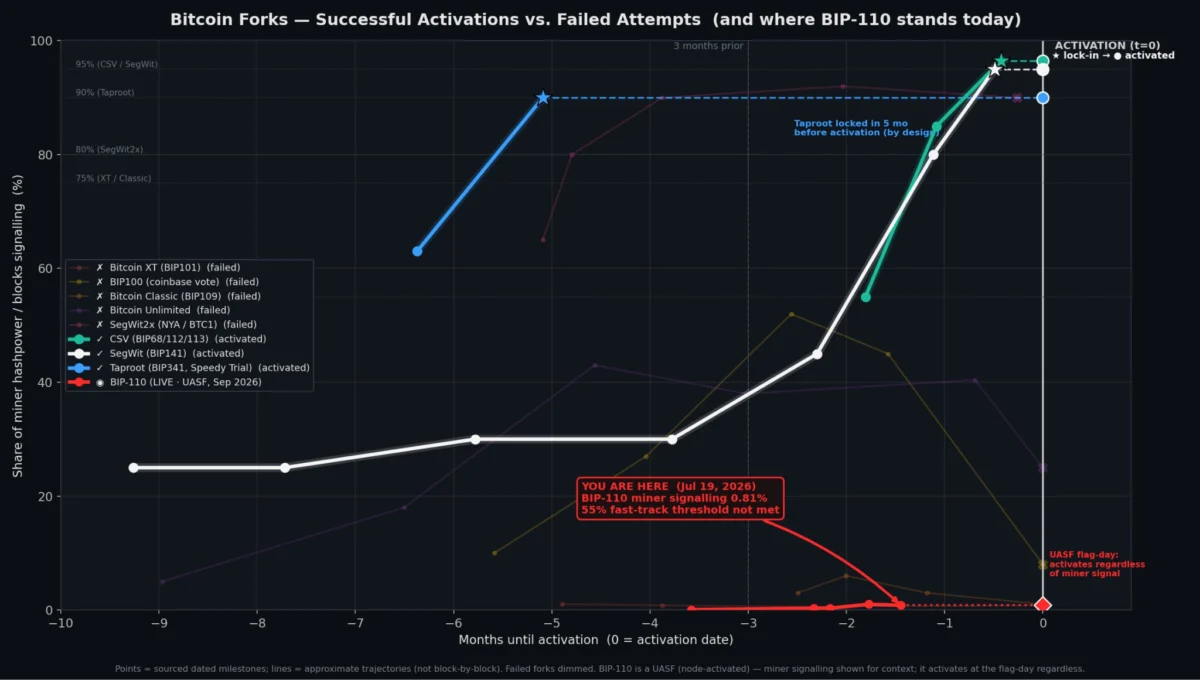
The Bitcoin network is currently facing a potential consensus change proposed by BIP-110, a Bitcoin Improvement Proposal aiming to implement a "Reduced Data Temporary Softfork." Spearheaded by pseudonymous developer Dathon Ohm and gaining traction within the Knots community, an alternative Bitcoin implementation led by early contributor Luke Dashjr, BIP-110 seeks to curtail the types and quantities of arbitrary data that can be embedded within consensus-valid transactions by limiting certain Bitcoin scripting capabilities. As BIP-110 approaches a mandatory signaling period, its viability hinges on significant miner support, a metric that currently stands at less than one percent, suggesting a significant challenge to its adoption. This proposal has ignited a vigorous debate within the Bitcoin community, highlighting fundamental disagreements about the nature and function of Bitcoin nodes and the mechanisms of network consensus.
The Genesis of BIP-110 and the Knots Movement
BIP-110, officially titled "Reduced Data Temporary Softfork," was formally introduced to the Bitcoin Improvement Proposals repository. Its core objective is to introduce limitations on the data that can be included in Bitcoin transactions, ostensibly to reduce network bloat and enhance efficiency. The proposal’s proponents, largely associated with the Knots community, argue that this is a necessary step to counter what they perceive as undesirable development trajectories within Bitcoin Core, the primary open-source development community and reference implementation for Bitcoin. The Knots community, comprising individuals who run nodes on hardware like Start9 and Umbrel, has rallied around this alternative implementation as a protest against perceived decisions made by Bitcoin Core developers.
The proposal is currently on a path towards a mandatory signaling period, a critical phase where miners indicate their support for the proposed changes. If BIP-110 garners sufficient support from miners, it could lead to a fork in the main consensus rules as currently implemented by Bitcoin Core. The success of such a proposal is heavily reliant on miner signaling. As of the latest available data, miner signaling for BIP-110 remains exceptionally low, hovering at less than one percent. This starkly contrasts with the significant support required for a consensus change of this magnitude. While a majority of senior Bitcoin developers have expressed opposition or indifference to BIP-110, the movement has nonetheless generated considerable discussion on social media platforms, underscoring a growing divergence of opinions within the ecosystem.
The Centrality of the Bitcoin Node: A Point of Contention
A significant portion of the discourse surrounding BIP-110 and the broader philosophical debates within Bitcoin centers on the definition and perceived power of a Bitcoin full node. Influential figures, such as author and podcaster Knut Svanholm, have articulated perspectives that elevate the role of the full node to a near-sovereign status within the network. Svanholm’s recent assertion that "Every person on Earth is a node in the Bitcoin network. Most to a minuscule extent, of course, but every node is first and foremost a person, not a machine. Which tools we use to interact with the network (and, by extension, to which extent they influence the network) is entirely dependent on the choices we make" has been a focal point of discussion.
While such pronouncements carry a certain poetic or philosophical resonance, they are fundamentally misaligned with the technical realities of Bitcoin. The term "Bitcoin node," in its precise technical definition, refers to a computer that maintains a full copy of the Bitcoin blockchain, including all transaction history, block headers, and transaction-related data. The primary function of such a node is to independently verify the integrity of the Bitcoin supply and transaction history against the network’s established consensus rules.
The benefits derived from running a Bitcoin full node are multifaceted. Firstly, it enhances user privacy. Many popular Bitcoin wallets, particularly mobile applications, rely on third-party servers to query a user’s balance and transaction history. By connecting to a user-operated local Bitcoin node, these privacy concerns are mitigated, as public addresses and balances are not exposed to external entities. Secondly, running a node allows users to remain synchronized with the network and confirm their adherence to consensus rules. For individuals involved in Bitcoin mining or contributing significant hashing power, a full node is essential for assembling blocks and selecting transactions to include, though this is an increasingly challenging endeavor due to high network difficulty and competition. Even emerging decentralized mining pool models, like Ocean, which aim to give retail miners more influence over block composition, still require substantial hashing power to compete in the proof-of-work race.
Furthermore, Bitcoin nodes play a crucial role in transaction relaying. Tens of thousands of nodes communicate through a decentralized flood network, facilitating censorship resistance. This architecture ensures that even controversial transactions can reach miners through a small number of nodes, bypassing potential filters, as demonstrated by initiatives like Peter Todd’s "relay libre." This inherent design makes it difficult for a localized group of nodes to unilaterally filter transactions from entering the blockchain.
Crucially, a large majority of Bitcoin nodes, operating independently, cannot unilaterally alter the network’s consensus rules. Such a change would require substantial economic activity channeled through these nodes, as seen with exchanges representing millions of users. It would also necessitate broad support from protocol developers, application developers, and the investor community. The notion that Bitcoin operates as a "node democracy" is a misconception; the network’s governance structure, as outlined by Satoshi Nakamoto in the Bitcoin white paper, is fundamentally based on "one CPU cycle, one vote," reflecting the proof-of-work mechanism. Miners, who expend computational resources, are highly sensitive to investor sentiment and developer consensus, contributing to a robust and resilient global monetary protocol that is inherently difficult to modify. A Bitcoin node’s ultimate function is to confirm connection to the network with the most accumulated proof-of-work and adherence to consensus rules. Altering these rules on one’s own node effectively means one is no longer operating on the Bitcoin network as defined by its global consensus. This resistance to change is a core feature, ensuring Bitcoin’s stability as a form of money.
Historical Precedents and the Dynamics of Consensus
Understanding the dynamics of Bitcoin consensus requires examining historical events and the interplay of various stakeholders. The Bitcoin Capitalization Analysis Project (BCAP), an open-source initiative led by Ren Crypto Fish, Steve Lee, and Lyn Alden, identified six key stakeholder groups crucial to protocol upgrades: Economic Nodes, Investors, Media Influencers, Miners, Protocol Developers, and Users & Application Developers.
Historically, during periods of consensus crisis, Bitcoin nodes have indeed been instrumental in signaling support for competing versions of the network. The 2017 Bitcoin Cash fork is often cited as an instance where economic nodes demonstrated significant influence over miners. The User Activated Soft Fork (UASF) of 2017, also known as BIP-148, provides another compelling case study. This proposal faced considerable opposition, with a majority of mining pools and their collective hashrate supporting the Segwit2x hard fork, a position amplified by the New York Agreement, which garnered support from numerous exchanges and corporations.
Despite this opposition, the Bitcoin node-supported soft fork ultimately prevailed. This victory, however, was not solely attributable to the nodes themselves. It was underpinned by substantial backing from protocol developers, investors, and media influencers, conferring significant economic weight and "rough consensus" to the node-supported chain. In contrast, BIP-110 currently lacks the widespread support of protocol developers. Prominent investors, such as Michael Saylor, have publicly voiced opposition or remained neutral, a stark difference from the broad backing seen in previous consensus events.
The 2017 Bitcoin Cash fork also illuminated the tiered influence of different types of Bitcoin nodes. An exchange’s node, for example, carries vastly more weight than that of a retail user due to the immense volume of transactions it processes. Similarly, a major mining pool’s node possesses greater influence than that of a hobbyist solo miner, as it more consistently participates in block creation and transaction selection.
The majority of Bitcoin users, particularly those relying on mobile wallets, delegate their consensus decision-making to third-party node operators. While users can theoretically "vote with their money" by migrating their economic activity to wallets or nodes aligned with their preferred vision of Bitcoin, their individual influence is diminished when relying on mobile wallets that connect to third-party servers, many of which operate on Bitcoin Core-compatible backends. Exchanges, in turn, represent a significant aggregation of user capital and, consequently, have a substantial say in consensus matters. In some instances, exchanges have facilitated user votes, weighted by holdings, effectively returning the decision-making power to end-users based on their capital.
The Current Landscape: Apathy and Resistance
The current signaling period for BIP-110 has seen a notable lack of enthusiastic participation. Foundry, one of the world’s largest Bitcoin mining pools, has initiated a process to poll its miners, allowing them to vote on BIP-110 using their hashrate. A significant positive vote could lead Foundry to signal for BIP-110, though this outcome appears unlikely. Conversely, miners who do not actively vote will effectively signal their support for the status quo, implicitly aligning with Bitcoin Core’s consensus. This dynamic suggests that apathy towards BIP-110 could inadvertently benefit Bitcoin Core. Supporters of BIP-110 would need to persuade a majority of Foundry’s hash rate to actively vote against the consensus favored by the Bitcoin Core developer community and its widely adopted implementation.
The current data on miner signaling paints a clear picture of BIP-110’s struggle for adoption. As of early [Insert current month and year], less than one percent of blocks mined during the current difficulty adjustment period are signaling support for BIP-110. This makes it one of the least supported soft fork attempts in Bitcoin’s history, according to various data aggregators.
[Insert Image: A chart or graphic visually representing the low miner signaling for BIP-110 compared to historical soft fork attempts. If possible, use the image provided in the source material or a similar representation.]
Implications and Future Outlook
The persistent lack of broad consensus across key Bitcoin stakeholder groups – developers, investors, miners, and major economic nodes – strongly suggests that BIP-110 is unlikely to be adopted as a network-wide consensus change. The most probable outcome, should signaling efforts persist without significant traction, is a chain split in the coming weeks. Such a split could have considerable implications, particularly for Lightning Network wallets operating on BIP-110-compliant nodes. The resulting bifurcated chain would likely be a new, smaller blockchain that might need to alter its proof-of-work algorithm to maintain its economic viability and security.
The debate surrounding BIP-110 serves as a potent reminder of the complex, multi-faceted nature of Bitcoin governance. It underscores that while individual nodes play a vital role in verifying transactions and ensuring network integrity, the power to alter fundamental consensus rules is distributed across a wider ecosystem of economic participants, developers, and miners. The current trajectory of BIP-110 indicates a significant misunderstanding of these dynamics by its proponents, leading to a proposal that, while debated, is unlikely to fundamentally alter the Bitcoin protocol as it currently stands. The resilience of Bitcoin’s consensus mechanism, designed to be resistant to arbitrary changes, appears to be holding firm against this particular proposal.
