

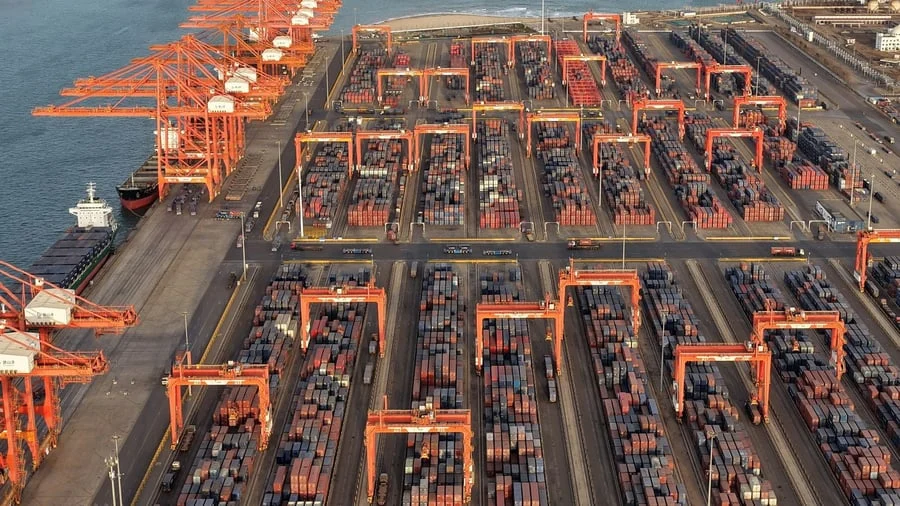
Shanghai – China’s export sector has demonstrated a surprising resilience, posting robust growth in July, according to recent data released by Chinese customs authorities. This unexpected surge has been largely attributed to a global investment boom in Artificial Intelligence (AI), which has helped to offset disruptions in global trade, including those caused by adverse weather conditions. The latest figures reveal a year-on-year increase in exports of 23.9 percent, while imports saw a substantial rise of 27.5 percent. This dynamic led to a slight decrease in China’s trade surplus, which fell from $125.62 billion in June to $112.5 billion in July. Despite this marginal reduction, the underlying trend of China exporting more goods than it imports remains firmly in place.
Deep Dive into Trade Figures and Key Drivers
The strong export performance in July paints a picture of a dynamic Chinese economy, particularly in its high-tech sectors. The impressive growth figures are not uniform across all product categories. A significant driver of this export boom has been the surging demand for AI-related electronics and other advanced technology products, including a notable increase in electric vehicle (EV) shipments. Specifically, the export of semiconductors nearly doubled compared to the previous year, while other high-tech products saw a 40.7 percent increase. This surge is further amplified by the global AI boom, which has created shortages and driven up prices for semiconductors and electronic components, benefiting Chinese manufacturers who are increasingly positioning themselves as key suppliers in these critical markets.
The latest customs data indicates that the value of goods exported from China to Germany in July reached $12.3 billion, marking a 17.4 percent increase compared to the same period last year. Conversely, China’s imports from Germany saw a slight decline of 2.7 percent, totaling $7.9 billion. This widening trade gap between the two economic powerhouses is a continuation of a longer-term trend. From January to July, Chinese exports to Germany climbed by 18.8 percent to $79.7 billion, while imports from Germany grew by a more modest 1.1 percent to $53 billion. Consequently, China’s trade surplus with Germany expanded to approximately $27 billion in the first seven months of the year.

Impact on Global Trade Dynamics and Geopolitical Landscape
The escalating trade surplus with major economies like Germany is fueling concerns across Europe and beyond regarding increased Chinese competition. Many German manufacturers, particularly in the automotive and mechanical engineering sectors, are facing a dual challenge: losing market share within China to increasingly capable domestic competitors and confronting these same strengthened Chinese rivals on their home turf and in other international markets. This competitive pressure is not merely an economic issue; it is increasingly intertwined with geopolitical considerations.
The European Union is reportedly considering more stringent measures to address its widening trade deficit with China. Meanwhile, the United States has already implemented new trade restrictions. In this evolving landscape, an anticipated summit between Chinese President Xi Jinping and former U.S. President Donald Trump in September looms large, with trade policy expected to be a central topic of discussion.

A Tale of Two Economies: China’s Internal Disconnect
The robust export performance, while boosting China’s trade balance, simultaneously exacerbates an underlying imbalance within the Chinese economy. While the global demand for Chinese high-tech goods is strong, domestic demand remains persistently weak. This has led economists to describe China as increasingly divided into two distinct economic spheres.
One sphere is the globally competitive technology sector, driven by advancements in AI, electric vehicles, batteries, robotics, and semiconductors. This sector is characterized by innovation, rapid growth, and strong export potential. The other sphere encompasses the broader traditional economy, which is grappling with a host of challenges. These include a struggling property market, substantial debt burdens carried by local governments, an aging demographic, cautious consumer spending, and a general erosion of confidence in the future economic outlook. This dichotomy presents a significant policy challenge for Beijing.

Expert Perspectives and Policy Recommendations
Economists are urging the Chinese government to implement proactive measures to address the weaknesses in the domestic economy. Zhu Tian, an economist based in Shanghai, emphasized the need for a strategic shift in policy focus. "In my view, the debate should concentrate on how to revive aggregate domestic demand in the short term," Zhu told Handelsblatt. He posited that once demand recovers, employment, profits, and household incomes across a broad spectrum of the economy would naturally follow suit with stronger growth.
Despite the internal economic challenges, China’s overall economic growth remains on track to meet its official target. The Chinese economy grew by 4.7 percent in the first half of 2026, positioning it well to achieve the government’s annual target of 4.5 to 5 percent. However, many economists express skepticism about the significance of these official growth targets, viewing them more as political benchmarks rather than accurate reflections of the real economic situation. The divergence between the high-performing export-oriented tech sector and the struggling domestic economy suggests a complex and potentially fragile economic environment.

Trade Dynamics Beyond Germany: A Global Picture
While the trade relationship with Germany warrants close attention due to its economic significance, China’s trade patterns reveal a broader global engagement. In contrast to the stagnant import growth from Germany, China’s imports from other regions have shown considerable expansion. For instance, imports from the Southeast Asian ASEAN states surged by 36 percent, from Russia by 26.8 percent, from African nations by 25 percent, and from the United States by 15.3 percent. Concurrently, China has also amplified its exports to these regions, with shipments to ASEAN countries increasing by 38.4 percent and to African nations by 18.2 percent. This indicates a diversified export strategy and a growing integration of China into various global supply chains, beyond its traditional partners.
The "China Shock" and European Concerns
The growing economic prowess of China, particularly in advanced manufacturing and technology, is a recurring theme in discussions about global economic competition. In Germany, the concept of a "China shock" is being increasingly discussed, referring to potential job losses and economic disruption stemming from intense Chinese competition and overcapacity. The findings of a recent survey by the European Council on Foreign Relations underscore this sentiment. The survey suggests that German voters are among the most China-critical in Europe, more likely to categorize China as a rival or even an adversary compared to voters in other EU member states. This public sentiment can influence political decisions and trade policies.

Historical Context and Future Outlook
China’s ascent as a global manufacturing powerhouse has been a decades-long process. Following its accession to the World Trade Organization (WTO) in 2001, China experienced a period of unprecedented export-led growth. This integration into the global economy led to significant advancements in its industrial capabilities and a dramatic reduction in poverty within the country. However, this growth has also been accompanied by persistent trade imbalances and concerns about unfair trade practices, intellectual property theft, and state-subsidized industries.
The current surge in exports, driven by the AI revolution, marks a new chapter in China’s economic evolution. The country is no longer solely a producer of low-cost manufactured goods; it is rapidly becoming a leader in cutting-edge technologies. This shift presents both opportunities and challenges for the global economy. For nations like Germany, which rely heavily on exports and high-value manufacturing, adapting to this new competitive landscape will be crucial for maintaining their economic standing. The ongoing trade negotiations and geopolitical alignments will play a significant role in shaping the future of global trade and China’s position within it. The coming months and years will likely see continued efforts by various nations to rebalance trade relationships and address the multifaceted implications of China’s evolving economic power.

First publication: August 7, 2026, 7:29 AM.
