

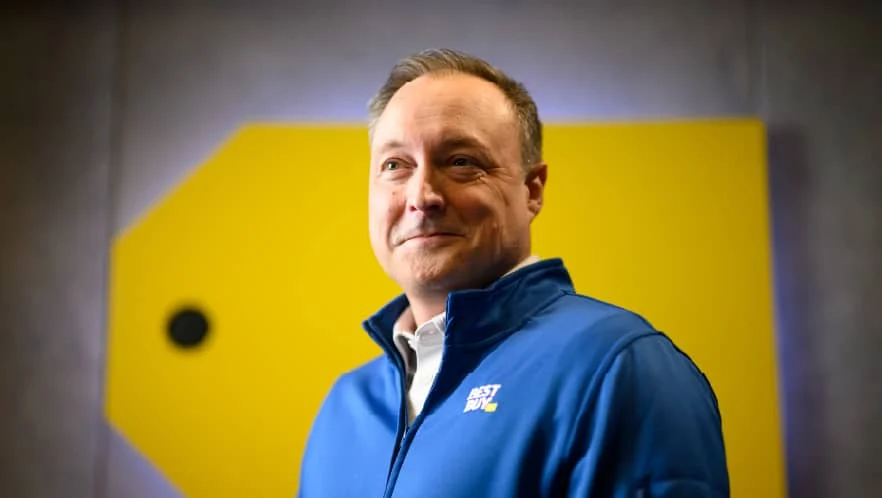
Best Buy, the prominent consumer electronics retailer, stands at a pivotal moment as it prepares for a leadership transition, with Jason Bonfig set to assume the role of Chief Executive Officer this fall. Bonfig inherits a company grappling with several years of declining sales and a challenging macroeconomic environment, necessitating a strategic overhaul to revitalize its market position and financial performance. His exclusive insights shared with CNBC outline a multi-faceted approach centered on store format innovation, a renewed focus on customer experience, and a strategic embrace of artificial intelligence, all aimed at steering the company back to sustainable growth.
The Mandate for Change: A Retail Giant at a Crossroads
For several years, Best Buy has contended with significant headwinds that have impacted its top and bottom lines. The company has explicitly attributed its slumping sales to a confluence of factors: persistently lower consumer confidence stemming from inflationary pressures and rising interest rates, a perceived slowdown in groundbreaking tech innovation, and a sluggish housing market that typically drives demand for new home electronics and appliances. This challenging backdrop has been reflected in Best Buy’s stock performance, which has seen a decline of approximately 20% over the past five years, a stark contrast to its peak trading price of $138 per share reached in late 2021.
The financial strain is evident in recent reporting. For the current fiscal year, Best Buy has issued comparable sales guidance ranging from a modest decline of 1% to an increase of 1%, signaling continued caution. While its most recent quarterly results did manage to outperform Wall Street’s tempered expectations, this followed a series of significant declines. Notably, in the third fiscal quarter of 2026, the company reported a net income of $140 million, a substantial drop from $273 million in the same period a year prior. Beyond these domestic pressures, the retailer has also faced external challenges, including the impact of tariffs on imported goods and the soaring global prices of memory chips, which directly contribute to increased costs for a wide array of consumer electronics. This complex operational landscape underscores the urgent need for a decisive and innovative strategy under new leadership.
Jason Bonfig’s Vision: Four Pillars for Revival
As he steps into the top leadership role, Jason Bonfig has articulated a clear strategic framework, built upon four foundational pillars designed to reshape Best Buy’s trajectory. These include: advancing Best Buy as a premier retail and technology company, significantly improving its market reach, enhancing the overall customer experience, and reinforcing its identity as a human-powered organization. These pillars are not merely theoretical; Bonfig intends to operationalize them through tangible initiatives, particularly by capitalizing on the burgeoning artificial intelligence (AI) boom and positioning Best Buy as a crucial player in the next chapter of technological adoption.
Bonfig’s confidence in the underlying strength of Best Buy, despite recent stagnation, is palpable. He views his strategy not as a radical departure but as an evolution, building upon the foundations laid by his predecessor, Corie Barry. "Corie had an amazing strategy, and my strategy is built on top of that," Bonfig stated, emphasizing a continuity of vision coupled with fresh execution. He rejects the notion that Best Buy has "lost its momentum," instead characterizing the recent period as a unique market phase influenced by the "pull-forward" demand observed during the COVID-19 pandemic. This period, he explains, created an unprecedented demand curve for technology as consumers upgraded home setups, subsequently resetting the technology life cycle for many and forcing vendors to prioritize production over innovation. Now, as the market normalizes, Bonfig sees an opportunity to re-engage consumers with renewed focus and strategic agility.
Expanding Reach: The Strategic Rollout of Smaller Formats
A cornerstone of Bonfig’s strategy to improve market reach and drive sales is the strategic expansion into new, smaller-format stores. This week, Best Buy unveiled two such locations: one in Jonesboro, Arkansas, and another in Cape Cod, Massachusetts, serving as tangible examples of this new direction. Bonfig explained to CNBC that these smaller stores are crucial for penetrating markets that cannot sustain a traditional-sized Best Buy but are nonetheless viable for the brand.
Traditional Best Buy stores vary significantly in size, with medium-format stores typically ranging from 20,000 to 25,000 square feet, and flagship locations, such as the one in New York City, exceeding 40,000 square feet. The new small-format stores, by contrast, are designed to be more agile, ranging from 12,000 to 15,000 square feet. The Jonesboro store, at 18,000 square feet, represents a significant return for Best Buy to a community where its previous location was destroyed by a tornado. Bonfig highlighted its significance: "It’s a great example of a vibrant market, a place where customers are interested in our brand, but not a market that could support a 30,000- or 35,000-square-foot store." He added that an 18,000-square-foot footprint allows Best Buy to effectively showcase its key categories and meet local needs.
The Cape Cod opening, at 28,000 square feet, is slightly larger than the new small-format standard but still exemplifies the principle of "the right size store in the right location in the right node." This nuanced approach to store sizing reflects a deep understanding of local market demographics and consumer behavior. Bonfig emphasized that placing a store closer to customers not only increases the frequency of physical visits but also significantly boosts digital engagement. When Best Buy enters a new, smaller community, the company observes an uptick in both in-store visits and the use of its mobile app and digital channels. This omnichannel effect underscores the strategic value of physical presence, even in an increasingly digital retail landscape.
The success of smaller formats is not entirely new to Best Buy. Its Canadian counterpart, Best Buy Canada, has been an early adopter and innovator in this space, often moving more rapidly than its U.S. operations. Best Buy Canada has seen success with locations as compact as 7,000 square feet, providing a proven model for the U.S. expansion. Bonfig clarified that these smaller stores are not intended to replace existing, larger formats but rather to enhance Best Buy’s overall footprint and reach previously underserved markets. "It’s actually an enhancement of what we’re doing today," he stated, "But it actually allows us to reach more customers and more markets that we just were not in before." This strategy is critical in an era where consumers expect both convenience and personalized service, blending the advantages of physical retail with the efficiency of digital platforms.
Navigating Macroeconomic and Industry Headwinds
Best Buy’s journey toward revitalization is set against a backdrop of complex macroeconomic forces and industry-specific challenges. The "pull-forward behavior" from consumers during the COVID-19 pandemic, as identified by Bonfig, led to an unprecedented surge in demand for electronics as people adapted to working, learning, and entertaining themselves from home. This phenomenon, akin to what was observed in the home improvement sector, created an artificial demand curve that subsequently led to a "lull" as the market normalized and consumers held onto their recently acquired tech for longer. This reset of the technology life cycle meant that many consumers were simply not in the market for new devices, impacting sales across the board.
Beyond the pandemic’s lingering effects, Best Buy has also been caught in the crosscurrents of global supply chain disruptions and geopolitical factors. The imposition of tariffs on imported goods, particularly from Asia, has directly increased procurement costs, which retailers must either absorb or pass on to consumers, potentially dampening demand. Simultaneously, the soaring prices of memory chips—a critical component in virtually all consumer electronics, from smartphones to laptops and smart appliances—have further inflated the cost of goods. This volatile pricing environment makes it challenging for retailers to maintain competitive pricing while safeguarding profit margins. Industry analysts have noted that Best Buy’s ability to navigate these external pressures will be crucial to its financial recovery, requiring astute inventory management, diversified sourcing, and strategic pricing.
Embracing Innovation: AI and the Future of Consumer Electronics Retail
A significant component of Jason Bonfig’s strategic vision is Best Buy’s proactive engagement with the artificial intelligence boom. Recognizing AI not just as a buzzword but as a transformative technology, Bonfig aims to leverage its potential both on the corporate side of the business and in enhancing the customer experience. Best Buy is actively investing in and exploring new AI-powered products, such as Meta’s augmented reality glasses, signaling a commitment to being at the forefront of emerging tech.
The company is also developing its own AI tools for customer use and forging strategic partnerships with leading AI innovators like OpenAI and Google. This collaborative approach suggests an intent to integrate AI across various touchpoints, from personalized recommendations to streamlined customer support. Bonfig highlighted the emergence of "agentic commerce," where AI platforms facilitate transactions, noting, "Agentic commerce and commerce through AI platforms is happening today. We’re seeing traffic there, and we want to make sure that the Best Buy experience is represented." This forward-looking perspective indicates Best Buy’s ambition to remain relevant and competitive in an evolving digital marketplace where AI-driven interactions are becoming increasingly common.
However, Bonfig also tempered expectations, emphasizing that AI is intended to be an enhancement, not a replacement, for the human element that has long been a hallmark of Best Buy’s service. This aligns with his fourth pillar of focusing on being a "human-powered company," suggesting a future where technology amplifies human expertise rather than superseding it. This balanced approach acknowledges the power of AI while reinforcing the value of expert advice and personalized interactions that differentiate Best Buy from purely online competitors.
The Human Touch: Prioritizing Customer Experience
At the core of Bonfig’s strategy is a deep-seated belief in the importance of the customer experience. He has made it clear that defining success during his tenure will ultimately be measured by the customer response. This customer-centric approach manifests in several ways, from optimizing product selections to ensuring seamless service. For instance, Bonfig specifically mentioned upgrading TV selections and working closely with customers to facilitate the replacement of their existing televisions, a high-value category that often requires expert consultation and installation.
The "human-powered company" pillar underscores Best Buy’s commitment to its knowledgeable associates. In an era where many retailers are cutting staff or relying solely on digital self-service, Best Buy aims to differentiate itself by offering expert advice and personalized support. This includes not just in-store consultations but also the Geek Squad services, which provide technical support and installation, thereby enhancing the overall value proposition for consumers. By combining the convenience of physical stores, the efficiency of digital platforms, and the expertise of its human workforce, Best Buy seeks to create a holistic customer journey that fosters loyalty and drives repeat business. This blend of high-tech and high-touch service is seen as crucial for navigating a market where consumers demand both cutting-edge products and reliable, informed guidance.
Broader Implications and Outlook
The strategic shifts at Best Buy under Jason Bonfig carry broader implications for the retail sector and the future of consumer electronics. The embrace of smaller-format stores signals a growing trend among big-box retailers to adapt to changing demographics and urban planning, moving away from sprawling superstores towards more localized, efficient footprints that can serve a wider array of communities. This strategy also aligns with the ongoing evolution of omnichannel retail, where physical stores increasingly serve as showrooms, fulfillment centers, and hubs for customer service, complementing a robust online presence.
Best Buy’s focus on AI integration, particularly "agentic commerce," positions it at the forefront of how consumers might interact with retailers in the coming years. Should this prove successful, it could set a precedent for how traditional retailers can leverage advanced technology to personalize shopping experiences and streamline transactions, potentially narrowing the competitive gap with e-commerce giants. However, the challenge remains significant. Reigniting consumer demand for electronics in a saturated market, particularly after the pandemic-induced spending spree, will require more than just new store formats and AI. It will necessitate compelling product innovation from manufacturers and a sustained improvement in consumer sentiment.
As Jason Bonfig prepares to officially take the helm this fall, the market will be closely watching for signs of execution and tangible results from his ambitious strategy. His confidence in Best Buy’s core strengths and the "tremendous amount of momentum" he perceives, despite recent challenges, sets an optimistic tone for a company at a critical juncture. The success of his vision will not only determine Best Buy’s future but could also offer valuable lessons for the broader retail industry grappling with seismic shifts in consumer behavior and technological advancement.
