

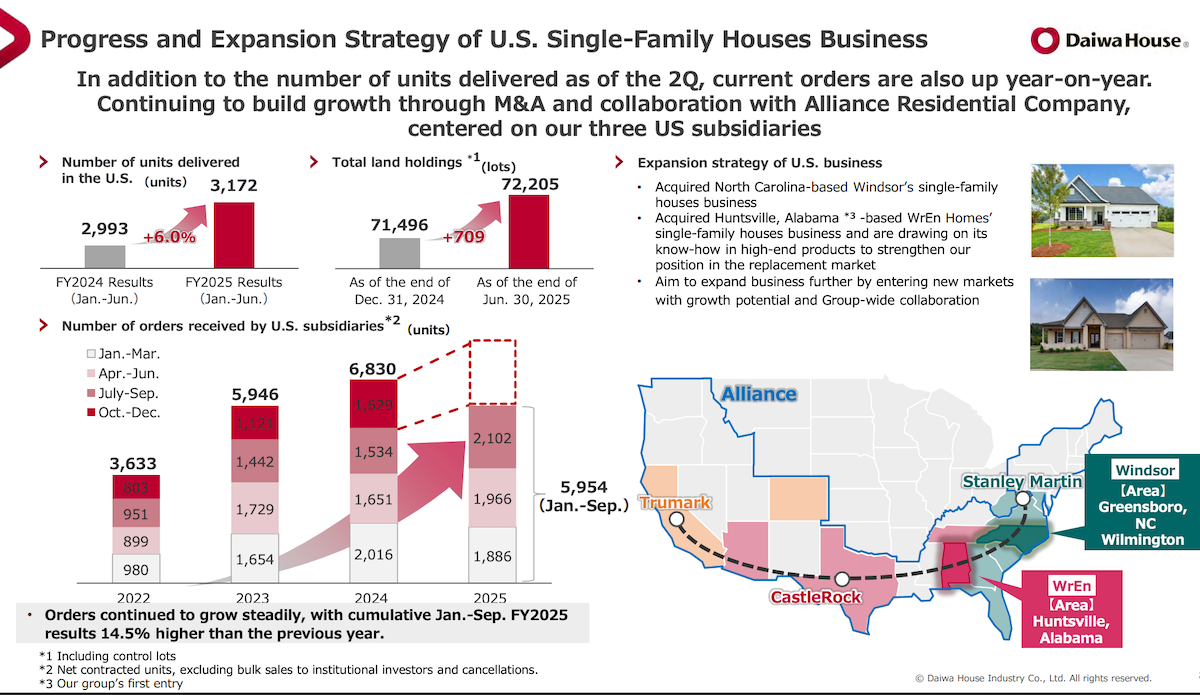
The global real estate conglomerate Daiwa House Industry has reached a definitive turning point in its international growth strategy, signaling the successful completion of a decade-long initiative to establish a comprehensive residential construction footprint across the United States. This milestone is punctuated by the acquisition of Washington-based JK Monarch by Trumark Homes, a prominent subsidiary of Daiwa House. The move not only secures a critical foothold in the Pacific Northwest but also effectively connects the final link in what the company refers to as the "Smile States"—a geographic arc of high-growth markets stretching from the Mid-Atlantic and Southeast, through Texas and the Sun Belt, and up the West Coast.
As Daiwa House prepares to unveil its 8th Medium-Term Management Plan this May, the acquisition serves as both a retrospective victory and a prospective foundation. By integrating JK Monarch’s operations, Daiwa House has surpassed the primary objectives of its previous 10-year expansion cycle, evolving from a regional participant into a top-tier national contender in the American housing market.
A Strategic Anchor in the Pacific Northwest
The acquisition of JK Monarch represents a calculated entry into the Puget Sound and Tri-Cities areas of Washington, regions characterized by robust economic drivers and significant barriers to entry. Founded in 2011 by Bill Bartels, JK Monarch emerged during the recovery phase of the Great Financial Crisis, a period that necessitated extreme operational discipline and a focus on high-value, rather than high-volume, production.
For Trumark Homes, the decision to acquire an established entity rather than pursuing a "de novo" or organic startup approach was driven by the need for immediate local expertise. Washington’s regulatory environment and land entitlement processes are notoriously complex, mirroring the challenges Trumark has successfully navigated in its home state of California.
Gregg Nelson, co-founder and co-CEO of Trumark Homes, noted that the alignment of corporate cultures was a primary catalyst for the deal. JK Monarch had developed a reputation for precision in land acquisition and deep-seated relationships with local trade partners and municipalities. However, the company had reached a ceiling dictated by its private capital structure. By joining the Daiwa House platform, JK Monarch gains access to "patient capital," allowing the Washington division to develop its existing land bank and aggressively pursue new opportunities that were previously out of reach due to liquidity constraints.
The Architecture of the Smile States
The completion of the Washington acquisition formalizes the "three-platform" operating system that Daiwa House has spent years refining. This strategy utilizes three distinct, regionally anchored "sister companies" to manage growth across the most economically vibrant corridors of the U.S.:

- Stanley Martin Homes: Acquired in 2017, this platform manages the East Coast, Mid-Atlantic, and Southeast markets. It recently expanded its own reach through the $221 million acquisition of United Homes Group (UHG) and the 2025 integration of Windsor Homes.
- CastleRock Communities: Acquired in 2021, this entity focuses on the Southern U.S., with a heavy emphasis on the high-demand Texas markets.
- Trumark Homes: Acquired in 2020, Trumark serves as the Western platform. Since its merger with Daiwa House, the company has achieved a 50% compounded annual growth rate (CAGR), expanding from California into Colorado and now Washington.
This federated model allows each company to maintain its local brand identity and leadership while benefiting from the massive scale of the Daiwa House Group. The "Smile Zone" strategy targets metropolitan areas where job growth, particularly in technology and healthcare, remains resilient. With the addition of the Pacific Northwest, Daiwa House now has a contiguous presence in nearly every major U.S. growth hub.
Chronology of an Expansion: 2017–2026
The trajectory of Daiwa House’s U.S. expansion reveals a steady, disciplined progression of capital deployment:
- 2017: Initial entry into the U.S. market with the acquisition of Stanley Martin Homes, providing an immediate presence in the Washington D.C. metro area and surrounding states.
- February 2020: Acquisition of a majority stake in Trumark Homes, just as the global pandemic began to shift consumer preferences toward larger, suburban single-family dwellings.
- September 2021: Acquisition of CastleRock Communities, securing a dominant position in the Texas "Texas Triangle" (Houston, Dallas-Fort Worth, Austin, and San Antonio).
- 2024–2025: A period of rapid consolidation, including Stanley Martin’s acquisition of Windsor Homes and the $221 million take-private deal for United Homes Group.
- March 2026 (Projected Milestone): The JK Monarch deal marks the completion of the geographic "Smile."
- May 2026: Launch of the 8th Medium-Term Management Plan, focusing on operational synergy and a target of 10,000+ annual home deliveries.
Data-Driven Growth and Market Alignment
The financial and operational scale of this expansion is reflected in the group’s delivery targets. In 2024, the combined entities of Stanley Martin, CastleRock, and Trumark delivered approximately 7,095 single-family homes. With the current infrastructure and the addition of JK Monarch, the group is on track to exceed 10,000 deliveries by the end of 2026.
JK Monarch’s product alignment was a critical factor in the deal’s logic. The builder focuses on the "middle lane" of the housing market—homes ranging from 2,100 to over 4,400 square feet, priced between $700,000 and $1.1 million. This segment targets move-up and second-time move-up buyers, many of whom are employed in the technology sector. In Seattle, this demographic mirrors the tech-worker profile Trumark serves in the San Francisco Bay Area. These buyers are often less sensitive to interest rate fluctuations than entry-level buyers, providing a layer of insulation against macroeconomic volatility.
The Federated Operating Philosophy
A distinguishing feature of Daiwa House’s success in the U.S. is its rejection of a top-down, centralized management style. Unlike some international conglomerates that struggle with cross-cultural integration, Daiwa House has leaned into a "federated model" that prioritizes American leadership and local autonomy.
Trumark’s Gregg Nelson emphasizes that Daiwa House trusts regional presidents to make decisions based on local market intelligence. This philosophy extends down to the division level. Trumark’s acquisition of JK Monarch will not result in a total overhaul of the Washington team; instead, the existing leadership, led by Bill Bartels’ hand-picked team, will remain in place to execute the growth strategy.
This approach provides a competitive advantage in land acquisition. Sellers and trade partners often prefer dealing with locally recognized leaders rather than distant corporate headquarters. By providing the capital scale of a global giant while maintaining the "handshake" culture of a local builder, the Daiwa House platforms are uniquely positioned to secure the best land deals in supply-constrained markets.

Competitive Landscape and Global Implications
Daiwa House is not alone in its pursuit of the American dream. It is part of a broader trend of Japanese capital flowing into U.S. residential real estate, joined by competitors such as Sekisui House and Sumitomo Forestry. Sekisui House recently made waves with its $4.9 billion acquisition of MDC Holdings (Richmond American Homes), signaling that the competition for U.S. market share among Japanese firms is intensifying.
The rationale for this influx of capital is twofold: the Japanese domestic housing market is facing long-term decline due to a shrinking population, while the U.S. continues to suffer from a chronic undersupply of housing estimated at several million units. For Daiwa House, the U.S. represents the most reliable engine for long-term shareholder value.
Broader Impact and the Next Decade
As the 8th Medium-Term Management Plan approaches, the narrative for Daiwa House U.S. is shifting from "expansion" to "optimization." The geographic map is now largely complete, and the focus will turn toward leveraging the collective power of the three platforms.
Industry analysts expect the next phase to involve increased sharing of best practices in construction technology, supply chain management, and digital sales platforms. There is also potential for the integration of Daiwa House’s proprietary Japanese building technologies—such as prefabricated components or energy-efficient systems—into the American workflow, provided they can be adapted to local building codes and consumer tastes.
The acquisition of JK Monarch is more than just a business transaction; it is the closing of a chapter on a decade of aggressive growth and the opening of a new era of market dominance. With a presence in the Mid-Atlantic, the South, and the entirety of the West Coast, Daiwa House has built more than just homes—it has built a permanent, integrated infrastructure capable of weathering the cycles of the American economy. The "Smile" is now complete, and the industry is watching closely to see how wide that smile will grow in the decade to come.
