

Los Angeles, California – Uber Technologies, the global ride-hailing and food delivery giant, has announced a landmark agreement to invest up to $1.25 billion in electric vehicle manufacturer Rivian Automotive. This strategic partnership aims to deploy a substantial fleet of up to 50,000 autonomous Rivian R2 robotaxis across multiple international markets by the end of the decade, signaling a significant acceleration in the race for self-driving mobility solutions. The news, unveiled on Thursday, sent Rivian’s shares soaring by approximately 10% in premarket trading, while Uber’s stock remained relatively stable following the announcement.
The comprehensive tie-up outlines an initial commitment for Uber, or its designated fleet partners, to acquire 10,000 autonomous versions of Rivian’s highly anticipated R2 electric vehicle. This foundational purchase includes an option to expand the order by an additional 40,000 robotaxis, with deliveries commencing in 2030 and continuing through 2031. This ambitious plan positions both companies at the forefront of a renewed push into the autonomous vehicle sector, a market that analysts project could eventually reach multitrillion-dollar valuations.
Strategic Investment and Deployment Timeline
The financial component of the deal is structured with an initial investment of $300 million from Uber to Rivian. This first tranche is expected to be finalized soon, pending standard regulatory approvals. Subsequent investment tranches, totaling up to $1.25 billion, will be disbursed to Rivian as the company achieves specific, yet undisclosed, developmental and operational milestones through 2031. This phased investment approach underscores a shared commitment to measurable progress and risk management.
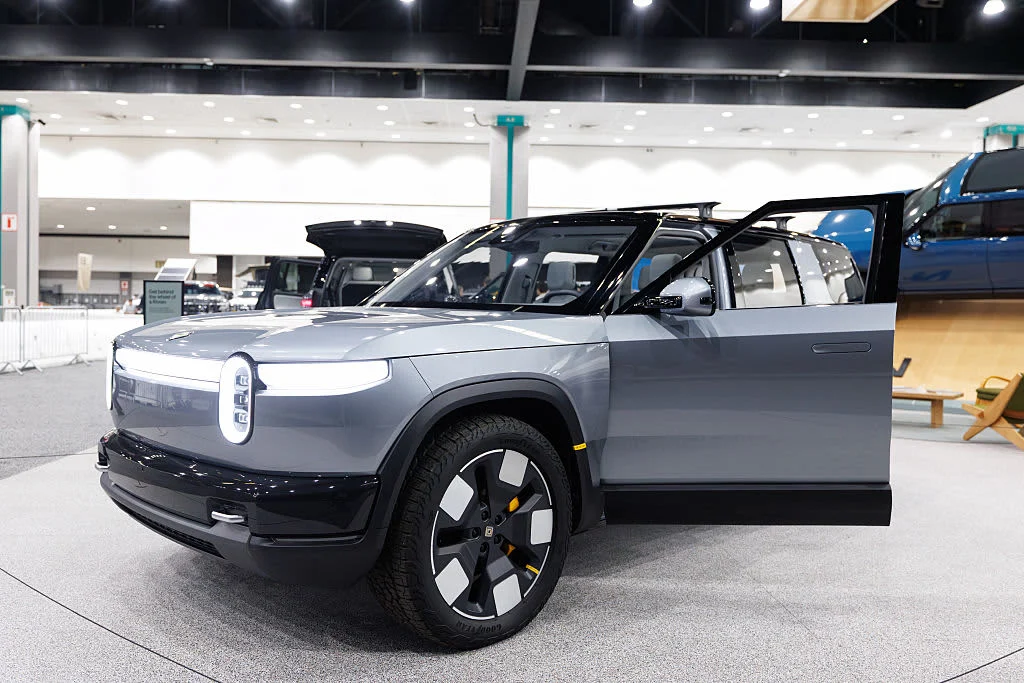
The deployment of these autonomous R2 vehicles is slated to begin with a targeted launch in San Francisco and Miami in 2028. Following these initial rollouts, the partnership envisions a rapid expansion to 25 major cities across the United States, Canada, and Europe. Notably, the agreement stipulates that these Rivian R2 robotaxis will operate exclusively on Uber’s platform, solidifying Uber’s position as a dominant player in the autonomous ride-hailing ecosystem. The choice of the R2, a more compact and cost-effective SUV platform compared to Rivian’s larger R1S and R1T models, highlights a strategic focus on scalability and urban mobility efficiency. The Rivian R2 was prominently displayed at the 2025 Los Angeles Auto Show at the Los Angeles Convention Center on November 23, 2025, garnering significant public and industry attention ahead of its anticipated consumer sales launch in spring 2026.
Uber’s Evolving Autonomous Strategy and Market Dynamics
This latest collaboration represents a pivotal moment in Uber’s long-standing, often tumultuous, journey into autonomous vehicles. The company famously divested its in-house self-driving unit, Advanced Technologies Group (ATG), to Aurora Innovation in 2020 after years of significant investment and challenging operational hurdles. This move signaled a strategic pivot away from proprietary hardware and software development towards an asset-light partnership model, leveraging the expertise of specialized autonomous technology developers.
Since then, Uber has actively forged alliances across the autonomous vehicle landscape. Prior to the Rivian deal, Uber had announced partnerships with several key players, including Lucid Motors for robotaxi deployment, Amazon’s Zoox, Stellantis, and tech powerhouse Nvidia, to integrate autonomous driving capabilities into its network. The agreement with Rivian, however, stands out due to its sheer scale and the direct financial investment in an EV manufacturer, underscoring a deeper integration and a long-term commitment to a specific vehicle platform.
Uber CEO Dara Khosrowshahi articulated the rationale behind the substantial investment in Rivian, stating, "We’re big believers in Rivian’s approach—designing the vehicle, compute platform, and software stack together, while maintaining end-to-end control of scaled manufacturing and supply in the U.S. That vertical integration, combined with data from their growing consumer vehicle base and experience managing the complexities of commercial fleets, gives us conviction to set these ambitious but achievable targets." Khosrowshahi’s remarks highlight Uber’s confidence in Rivian’s comprehensive, vertically integrated model as a key differentiator in the complex autonomous vehicle ecosystem.
The broader robotaxi market is currently experiencing a significant resurgence of interest and investment, following a period of cautious optimism and technological setbacks. Companies like Alphabet-backed Waymo have made considerable strides, launching and expanding commercial robotaxi services in several U.S. cities, including a recent expansion into Miami in early 2026. Other players like General Motors’ Cruise have faced regulatory and operational challenges, underscoring the complexities and high stakes involved in bringing fully autonomous services to market. Uber’s partnership with Rivian injects a new dynamic into this competitive landscape, potentially creating a formidable rival to existing leaders and accelerating the wider adoption of driverless mobility.

Rivian’s Strategic Ascent and Autonomous Ambitions
For Rivian, the Uber investment marks another significant validation of its technology and manufacturing capabilities, further bolstering its financial position. This deal follows closely on the heels of a monumental $5.8 billion software partnership with German automotive giant Volkswagen, announced in late 2024. These two major collaborations within a short timeframe illustrate Rivian’s growing influence and strategic importance within both the electric vehicle and autonomous driving sectors.
Rivian CEO RJ Scaringe has increasingly vocalized the company’s ambitions in the robotaxi space. During the company’s third-quarter 2025 earnings call in November and at its inaugural "Autonomy and AI Day" in December 2025, Scaringe laid out a compelling vision for Rivian’s autonomous future. He emphasized that the forthcoming R2 platform, coupled with Rivian’s advanced in-house technologies, would be instrumental in enabling the company to enter the robotaxi market.
At the "Autonomy and AI Day" event in Palo Alto, California, Scaringe and other Rivian executives showcased their developments in self-driving technology. They highlighted the emergence of new technological paradigms, including breakthroughs in artificial intelligence and more powerful semiconductor chips, as critical enablers for finally achieving widespread success with robotaxis. Scaringe underscored the company’s confidence in its proprietary systems, stating, "The scale of Rivian’s growing data flywheel coupled with RAP1 [Rivian Autonomy Processor], our state-of-the-art in-house inference platform, and our multi-modal perception platform make us incredibly excited for the rapid advancement of Rivian autonomy over the next couple of years." This holistic approach, integrating hardware, software, and data processing, is central to Rivian’s strategy for autonomous vehicle development.
The R2 platform, designed to be a more accessible and volume-oriented electric SUV, is inherently well-suited for commercial fleet applications like robotaxis. Its anticipated lower price point and efficient packaging make it an attractive option for large-scale deployments, offering a balance of passenger comfort and operational economics. This strategic move allows Rivian to diversify its revenue streams beyond direct consumer sales and capitalize on the burgeoning demand for autonomous commercial fleets.
Implications and Future Outlook
The Uber-Rivian partnership carries profound implications for both companies and the broader mobility industry. For Rivian, the deal provides a significant capital injection and guarantees a substantial volume of orders for its R2 platform, offering crucial financial stability and manufacturing scale as it expands its product line. It also validates Rivian’s advanced autonomous driving technology and its ability to attract major partners in a highly competitive field.
For Uber, this alliance could be a game-changer. By securing a dedicated fleet of 50,000 autonomous R2s, Uber positions itself to dramatically reduce operational costs associated with human drivers in the long term, potentially leading to increased profitability and more competitive pricing for consumers. This move could also significantly expand its market share in autonomous mobility, offering a unique and scalable service that leverages cutting-edge EV and self-driving technology. The exclusivity clause ensures that Uber will be the primary platform benefiting from this particular fleet, granting it a strategic advantage in the early stages of widespread robotaxi adoption.
Industry analysts suggest that this partnership could redefine the robotaxi race, particularly given the scale of deployment and the combined strengths of a leading ride-hailing network and an innovative EV manufacturer. However, challenges remain significant. Regulatory hurdles across diverse jurisdictions in the U.S., Canada, and Europe will require careful navigation. Public acceptance and trust in autonomous vehicles are still evolving, necessitating robust safety protocols and transparent communication. Furthermore, the technological timelines for achieving full Level 4 or Level 5 autonomy at scale, capable of operating reliably in a wide range of urban environments and weather conditions, are inherently ambitious.
Despite these challenges, the Uber-Rivian deal represents a powerful vote of confidence in the future of autonomous electric mobility. It signals a new era of strategic partnerships aimed at accelerating the transition to driverless transportation. As the initial deployments in San Francisco and Miami approach in 2028, the industry will be closely watching for signs of progress, performance metrics, and the realization of the ambitious vision laid out by Uber and Rivian. This collaboration marks a critical step towards a future where autonomous electric vehicles play a central role in urban transportation.
