


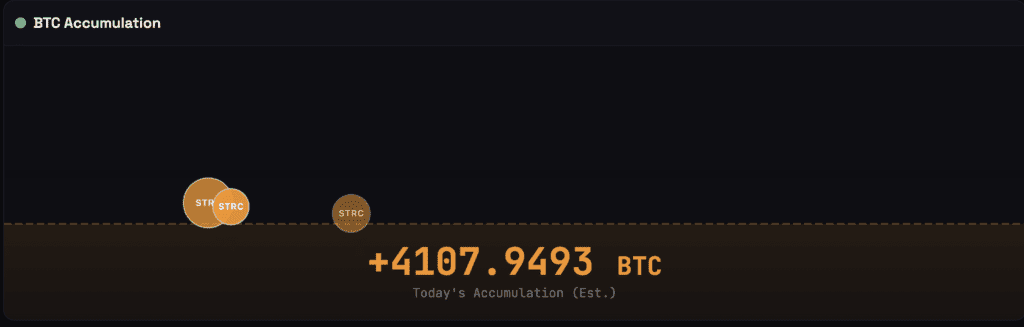
In a significant move underscoring its unwavering commitment to Bitcoin, Strategy, the prominent publicly traded company, is estimated to have acquired over 4,000 Bitcoin on Thursday, according to real-time trading data and specialized community tracking dashboards. This substantial single-day purchase, if confirmed, represents a new benchmark for capital raised through the firm’s preferred equity sales and signals an acceleration of its aggressive Bitcoin accumulation strategy. The acquisitions are reportedly funded by the issuance of its Variable Rate Series A Preferred Stock (STRC), a financial instrument Strategy has increasingly leveraged to bolster its digital asset reserves.
The latest surge in Bitcoin acquisition follows an already remarkable week for the company. On March 10, STRC recorded an impressive $409 million in daily trading volume, a figure that accompanied roughly 3% 30-day volatility and a one-month volume-weighted average price hovering around $99.78. On-chain indicators and community monitoring at the time suggested that this activity facilitated the purchase of more than 2,000 Bitcoin, which was already considered one of the largest single-day accumulations tied to the STRC instrument since its inception. Thursday’s estimated purchases of over 4,000 Bitcoin significantly surpassed this previous record, indicating a heightened pace of capital infusion and subsequent Bitcoin acquisition.
Strategy, already recognized as the largest public corporate holder of Bitcoin, has demonstrably increased its reliance on its preferred equity program to finance its ongoing expansion of Bitcoin holdings. Earlier this year, the company strategically amended its at-the-market (ATM) program. This crucial adjustment empowered multiple agents to concurrently offer and sell STRC shares. The enhancement in liquidity for the instrument has demonstrably streamlined Strategy’s ability to raise substantial capital swiftly, with the explicit intention of directing these funds towards further Bitcoin purchases.
Understanding Strategy’s STRC Mechanism
The Variable Rate Series A Preferred Stock (STRC) functions as a sophisticated financial bridge, effectively connecting traditional income-focused investors with Strategy’s Bitcoin-centric balance sheet. Income investors typically prioritize consistent payouts and capital preservation, while Strategy’s substantial Bitcoin holdings offer significant long-term upside potential, albeit accompanied by inherent short-term price volatility. The STRC structure is meticulously designed to harmonize these divergent investor profiles.
At its core, STRC is engineered to maintain demand and trading activity in close proximity to its $100 par value. Concurrently, it provides investors with a monthly dividend, translating to an approximate annual yield of 11.5%. In essence, this innovative financial product transmutes the economic characteristics of a corporate Bitcoin treasury into a format that is palatable and attractive to fixed-income investors who place a premium on predictable income streams.
The observed strong liquidity and relatively low volatility associated with STRC suggest a discernible shift within its investor base towards capital prioritizing yield. This evolving investor demographic can contribute to a stabilization of trading activity, presenting a contrast to instruments primarily driven by speculative market forces. These early indicators point towards a robust product-market fit for STRC, demonstrating its capacity to meet a clear demand among investors seeking yield exposure linked to Bitcoin, independent of speculative hype.
For corporate leaders contemplating the integration of Bitcoin into their treasury strategies, STRC offers a compelling pathway to embed Bitcoin within broader capital structures. It empowers companies to tap into diverse investor pools while concurrently building a unified strategic reserve anchored by the digital asset.
Recent Acquisition Activity and Strategic Financial Maneuvers

This recent aggressive buying spree follows a substantial acquisition disclosed in a recent SEC filing. Between March 2 and March 8 of the current year, Strategy announced its purchase of 17,994 Bitcoin for an aggregate of approximately $1.28 billion. This significant acquisition elevated the company’s total Bitcoin holdings to an impressive approximately 738,731 BTC, a figure representing roughly 3.5% of Bitcoin’s total circulating supply.
The financial breakdown of this preceding acquisition revealed a strategic combination of funding sources. Approximately $377.1 million was raised through the sale of STRC shares, while an additional $899.5 million was secured via common stock issuance. Analyzing these figures, STRC accounted for roughly 29.5% of the total funding for that five-day accumulation period. This translates to an estimated 5,300 Bitcoin acquired through preferred share sales during that timeframe.
The pace of Bitcoin acquisition on Thursday, if the current estimates hold true, could potentially surpass the average daily acquisition rate observed during that earlier, substantial buying window. This highlights the increasing efficiency and scale of Strategy’s capital-raising and Bitcoin acquisition mechanisms.
The Mechanics of Preferred Equity Sales
The process by which Strategy estimates capital raised through STRC involves sophisticated analysis of trading data. Real-time dashboards dedicated to tracking STRC trading activity endeavor to differentiate between shares directly issued by Strategy and those traded on the secondary market. Crucially, the company has previously indicated a strategic approach to issuing shares when the trading price of STRC exceeds its stated $100 par value. This disclosure allows analysts to approximate the capital raised when trading activity occurs above this predetermined threshold.
Broader Implications for Corporate Bitcoin Adoption
Strategy’s consistent and aggressive Bitcoin accumulation, particularly through innovative financial instruments like STRC, carries significant implications for the broader landscape of corporate Bitcoin adoption. The company’s success in leveraging preferred equity to finance Bitcoin purchases provides a tangible model for other corporations seeking to integrate digital assets into their treasury strategies.
The STRC instrument, by appealing to a different class of investors—those prioritizing steady income—effectively broadens the potential capital base for Bitcoin acquisition. This diversification of funding sources can reduce reliance on more volatile equity markets and provide a more stable avenue for long-term asset accumulation.
Furthermore, Strategy’s approach demonstrates a sophisticated understanding of financial engineering to align the risk and reward profiles of Bitcoin with traditional investment appetites. This strategic financial innovation could pave the way for a wider acceptance of Bitcoin as a corporate reserve asset, moving beyond the realm of speculative investment to a more integrated component of corporate finance.
The continued success of Strategy’s Bitcoin strategy, bolstered by its financing innovations, could inspire other publicly traded companies to explore similar avenues. This could lead to a significant increase in institutional demand for Bitcoin, potentially influencing its price stability and market capitalization over the long term.
As of the latest reporting, Bitcoin is trading in the vicinity of $70,000, while shares of MicroStrategy (MSTR), Strategy’s publicly traded entity, have experienced a slight decrease of approximately 0.75% on the day. This price action, while noted, does not diminish the significance of the company’s strategic Bitcoin accumulation efforts, which are driven by a long-term investment thesis.
Historical Context and Future Outlook
Strategy’s journey into Bitcoin began in earnest in 2020, with CEO Michael Saylor emerging as a prominent advocate for the digital asset as a store of value and a hedge against inflation. The company’s initial forays were funded through its cash reserves and debt financing. However, as its Bitcoin holdings grew, the need for more scalable and diversified funding mechanisms became apparent.
The introduction of the STRC instrument marked a significant evolution in this strategy. Launched with the explicit purpose of facilitating Bitcoin acquisition, STRC has proven to be a powerful tool in Strategy’s arsenal. Its ability to attract income-focused investors while linking their returns to Bitcoin’s performance has been a key differentiator.
The recent SEC filing detailing the substantial purchase between March 2 and March 8, along with the current estimates of Thursday’s acquisitions, paint a clear picture of an company actively executing its Bitcoin strategy at an accelerated pace. This aggressive accumulation is not merely opportunistic but appears to be a deeply ingrained aspect of Strategy’s long-term corporate vision.
The implications of this sustained buying pressure from a major corporate entity are multifaceted. It contributes to a narrative of increasing institutional adoption, potentially bolstering investor confidence in Bitcoin’s viability as a legitimate asset class. Moreover, by actively adding to its holdings during periods of market volatility, Strategy signals a conviction in Bitcoin’s long-term appreciation potential, a sentiment that can influence market sentiment and investor behavior.
While official confirmation from Strategy regarding Thursday’s precise Bitcoin acquisition figures typically follows through SEC filings or public disclosures, the real-time data and community tracking dashboards have historically provided reliable insights into the company’s trading activities. The consistency and scale of these estimated purchases suggest a strategic and deliberate approach to expanding its Bitcoin treasury.
The continued evolution of Strategy’s financial instruments and its aggressive pursuit of Bitcoin accumulation underscore a significant trend in corporate finance: the integration of digital assets as a core component of treasury management. As Strategy continues to innovate and execute its strategy, its actions will undoubtedly be closely watched by the broader financial community, potentially influencing the adoption and integration of Bitcoin by other corporations globally. The company’s commitment, demonstrated through substantial capital deployment, solidifies its position as a leading proponent of Bitcoin as a corporate asset.
