

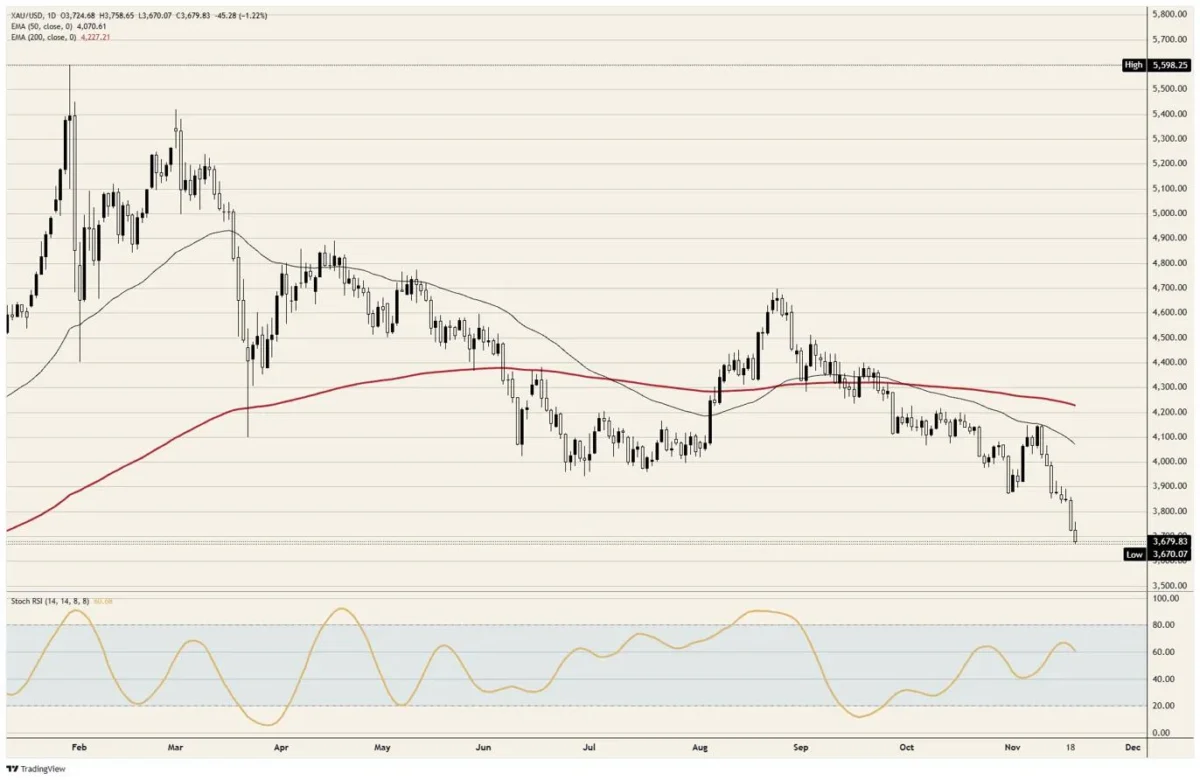
Financial markets are currently pricing in an approximately 95% probability of a quarter-point interest rate increase by the Federal Reserve in December, a development that has sent shockwaves through the precious metals sector. Gold (XAU/USD) has consequently plummeted to a fresh 14-month low, trading just below the $3,700 mark, representing a significant decline of roughly one-third from its January peak near $5,600. The yellow metal has either lost ground or remained largely flat for eight consecutive trading sessions, a downtrend initiated when October’s inflation data surpassed market forecasts, and is now down nearly 12% from its most recent swing high.
The Federal Reserve’s Stance and Future Path
The prevailing sentiment for higher interest rates gained substantial momentum following the release of the minutes from the Federal Reserve’s October meeting on Wednesday. These minutes revealed a near-unanimous consensus among almost all officials regarding the expectation of further rate increases. This hawkish stance was further underscored by remarks from Fed Governor Christopher Waller, who explicitly advocated for a more aggressive half-point rate hike, signaling a potential willingness among some policymakers to accelerate the tightening cycle if economic data warrants it. The market’s interpretation of these signals has been swift, with traders now pricing in a better-than-three-in-four chance of a second rate hike materializing as early as late January. This aggressive repricing of future rate expectations stems from the Fed’s unwavering commitment to curbing persistent inflation, even at the risk of impacting economic growth. The central bank’s primary mandate to maintain price stability has driven a series of unprecedented rate hikes over the past year and a half, pushing the federal funds rate from near-zero levels to its current target range, with further increases now firmly on the horizon. The "higher for longer" narrative, suggesting that interest rates will remain elevated for an extended period, continues to dominate discussions among economists and investors alike. This strategy is designed to ensure that inflation is definitively brought back down to the Fed’s 2% target, even if it entails a slower pace of economic expansion.
Gold’s Plunge: A Deep Dive into Market Dynamics
The current weakness in gold prices is intrinsically linked to the anticipated trajectory of interest rates. As a non-yielding asset, gold does not offer any interest payments or dividends to its holders. Consequently, each expected rate hike by the Federal Reserve effectively increases the opportunity cost of holding gold. Investors typically weigh the potential for capital appreciation in gold against the guaranteed returns offered by interest-bearing assets, particularly U.S. Treasury bonds, which are considered among the safest investments globally. When Treasury yields rise in response to Fed rate hikes, the attractiveness of holding gold diminishes significantly. The U.S. Dollar Index (DXY), a measure of the dollar’s value against a basket of six major currencies, is currently trading near multi-year highs, further exacerbating the pressure on gold. Since gold is universally priced in U.S. dollars, a stronger dollar makes gold more expensive for holders of other currencies, thereby reducing demand. This inverse correlation between the dollar and gold is a fundamental tenet of commodities trading. The recent appreciation of the dollar reflects the relative strength of the U.S. economy and the allure of higher U.S. interest rates compared to those offered by other major central banks, drawing capital into dollar-denominated assets. The confluence of rising interest rates and a robust dollar creates a formidable headwind for gold, explaining its current bearish trajectory.
The Inflationary Trigger: October’s CPI Report
The catalyst for gold’s recent eight-session decline can be directly traced back to the release of October’s Consumer Price Index (CPI) data. The report indicated that inflation remained stubbornly elevated, surpassing market forecasts and reigniting concerns that the Federal Reserve would need to maintain its aggressive tightening policy. While the headline CPI reading came in slightly lower than the previous month, core inflation, which excludes volatile food and energy prices, remained persistent. This resilience in core inflation signaled to markets that underlying price pressures were not dissipating as quickly as hoped, prompting a swift reassessment of the Fed’s likely actions. Prior to this report, there had been some cautious optimism that the Fed might be nearing the end of its rate hike cycle, with many analysts anticipating a pause or even a pivot in the coming months. The October CPI figures, however, effectively dashed those hopes, reinforcing the central bank’s commitment to its inflation-fighting mandate. The market’s immediate reaction was a sharp increase in the probability of a December rate hike and a hardening of expectations for subsequent increases, directly contributing to gold’s accelerated decline.
Gold’s Enduring Appeal: Safe-Haven and Central Bank Demand

Despite the current downturn, gold has historically played a multifaceted and crucial role in the global financial system. For centuries, it has served as a primary store of value and a widely accepted medium of exchange. Beyond its aesthetic appeal and use in jewelry, the precious metal is revered as a safe-haven asset, particularly during periods of geopolitical instability, economic uncertainty, or financial market turmoil. In such times, investors typically flock to gold, perceiving it as a reliable hedge against inflation and depreciating currencies, given that its value is not reliant on any specific issuer or government. This intrinsic characteristic of gold as a tangible asset, detached from sovereign debt or corporate performance, lends it a unique appeal in times of crisis.
Central banks globally remain the largest holders of gold, consistently diversifying their reserves to bolster the perceived strength of their economies and currencies. High gold reserves are often seen as a testament to a country’s solvency and financial stability, fostering trust among international investors. Data from the World Gold Council reveals that central banks added a staggering 1,136 tonnes of gold to their reserves in 2022, valued at approximately $70 billion. This marked the highest yearly purchase on record, underscoring a strategic shift towards increasing gold holdings. Notably, central banks from emerging economies, including China, India, and Turkey, have been particularly active in augmenting their gold reserves, signaling a broader trend of de-dollarization and diversification away from traditional reserve assets. This consistent institutional demand provides a fundamental floor for gold prices, even amidst periods of speculative selling.
Interpreting the Price Action and Broader Implications
The current XAU/USD daily chart, if visually represented, would clearly depict a steep downtrend, characterized by lower highs and lower lows, confirming the bearish sentiment. The break below key support levels has triggered further technical selling, with traders now looking towards psychological support zones below $3,700. The rapid depreciation from its January peak near $5,600 to current levels below $3,700 highlights the significant impact of the tightening monetary policy cycle on gold’s valuation.
Gold also maintains an inverse correlation with U.S. Treasuries, which, like the U.S. Dollar, are major reserve and safe-haven assets. When Treasury yields rise, offering more attractive returns, capital tends to flow out of gold and into these interest-bearing securities. Conversely, when the dollar depreciates or Treasury yields fall, gold tends to gain favor. Furthermore, gold is inversely correlated with risk assets, such as equities. A robust rally in the stock market typically weakens gold prices as investors seek higher returns in growth-oriented assets. Conversely, significant sell-offs in riskier markets often lead to a flight to the safety of precious metals.
The price of gold is influenced by a confluence of factors beyond just interest rates and the dollar. Geopolitical instability, such as regional conflicts or heightened international tensions, or fears of a deep economic recession can rapidly escalate gold prices due to its inherent safe-haven status. As a yield-less asset, gold tends to thrive in environments of lower interest rates, as the opportunity cost of holding it diminishes. Conversely, a higher cost of money, as dictated by central bank policies, typically weighs down on the yellow metal. Still, the most dominant influence on gold’s price, particularly for the XAU/USD pair, remains the behavior of the U.S. Dollar. A strong dollar generally keeps the price of gold contained, while a weaker dollar is likely to propel gold prices upward, making it more affordable for international buyers.
Looking Ahead: Key Economic Indicators and Fed Decisions
For investors, the immediate outlook for gold remains challenging as long as the Federal Reserve continues its hawkish stance and market expectations for further rate hikes persist. The focus will remain squarely on upcoming economic data, particularly inflation reports (CPI and PCE), employment figures, and GDP growth indicators, all of which will inform the Fed’s decisions. Any signs of cooling inflation or a significant weakening of the labor market could potentially lead the Fed to reconsider its aggressive tightening path, which would likely provide some relief for gold prices. Conversely, persistent inflation or a resilient economy could prompt the Fed to maintain its current trajectory or even accelerate hikes, further pressuring gold.
Beyond the immediate monetary policy cycle, the long-term appeal of gold as a diversifier and a hedge against systemic risks remains intact, especially given the continued strong demand from central banks globally. However, in the current environment dominated by high interest rates and a strong dollar, gold’s path of least resistance appears to be downwards. Market participants will closely monitor statements from Fed officials, the "dot plot" projections for future interest rates, and the evolving geopolitical landscape for clues on gold’s next significant move. The current situation underscores the dynamic interplay between macroeconomic policies, currency strength, and commodity valuations, making informed analysis crucial for navigating the complex financial markets.
