

WASHINGTON D.C. – An increasingly robust level of engagement between U.S. President Donald Trump and Chinese President Xi Jinping is inadvertently obscuring Beijing’s persistent and multifaceted strategy to gain a competitive edge over the United States, according to a stark assessment delivered to Congress on Wednesday. The report, compiled by a non-partisan congressional research body, cautions that while the direct interactions between the two leaders may appear to signal a period of stabilized or even improved bilateral relations, this perception belies a deeper, more concerning reality: China’s calculated advancements across economic, technological, and military domains continue to chip away at American global leadership.
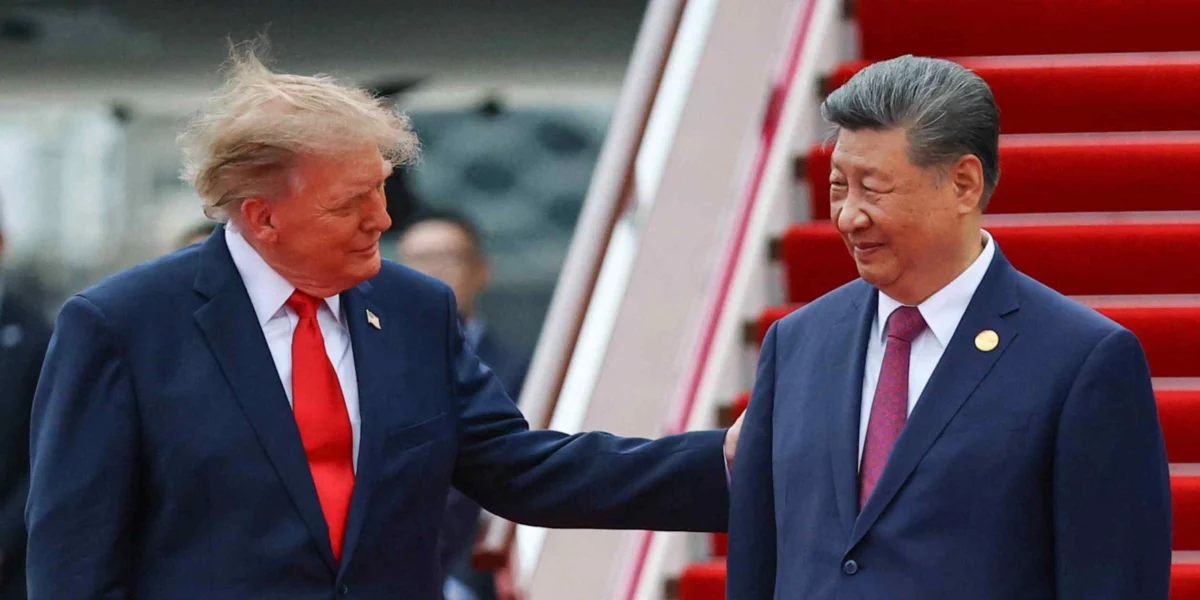
The report, which has not yet been publicly released but was discussed in closed-door briefings with key congressional committees, paints a picture of a strategic duality in Beijing’s approach. On one hand, China is actively pursuing dialogue and high-profile diplomatic engagements, exemplified by the recent meeting between Presidents Trump and Xi at the Asia-Pacific Economic Cooperation (APEC) Leaders Summit in Shenzhen on November 18, 2026. The image of the two leaders walking together at Shenzhen Airport, as captured by Reuters, might suggest a cooperative spirit. However, the report argues that this outward appearance of engagement serves as a strategic smokescreen, allowing China to consolidate its gains and accelerate its ambitions without drawing sufficient scrutiny or preemptive countermeasures from Washington.
The Strategic Ambiguity of High-Level Dialogue
The timing of the report’s release, following the significant APEC summit, is particularly noteworthy. President Trump’s arrival in Shenzhen on November 18, 2026, marked another instance of direct presidential diplomacy in a period characterized by frequent, if often tense, exchanges. These meetings have become a hallmark of the Trump administration’s foreign policy, emphasizing personal relationships and direct negotiation. While proponents of this approach argue it can de-escalate tensions and open avenues for pragmatic solutions, the congressional report suggests that China is adept at leveraging these interactions to its own advantage.
"The narrative that emerges from these high-level meetings often focuses on areas of immediate agreement or the absence of overt conflict," stated a senior congressional aide familiar with the report’s findings, speaking on condition of anonymity due to the sensitive nature of the information. "What this report highlights is that beneath the surface of these photo opportunities and carefully managed diplomatic exchanges, China is systematically executing a long-term strategy that fundamentally alters the global balance of power."
The report meticulously details China’s advancements in several critical sectors. Economically, it points to the continued expansion of the Belt and Road Initiative (BRI), a sprawling infrastructure and development project that has deepened China’s economic influence across Asia, Africa, and Europe. Despite international concerns regarding debt sustainability and transparency, the BRI has successfully integrated numerous countries into China’s economic orbit, creating new markets for Chinese goods and services and securing access to vital resources. Recent data from the International Monetary Fund (IMF) indicates that BRI-participating countries have seen a 3.5% increase in trade volume with China over the past five years, while their trade with the U.S. has stagnated.
Technological Supremacy: The New Arms Race
Technologically, the report flags China’s rapid progress in areas such as artificial intelligence (AI), quantum computing, and advanced telecommunications, particularly 6G networks. While the United States has historically led in many of these fields, China’s state-backed investment and focused research and development initiatives are narrowing the gap at an unprecedented pace. The report cites figures from a recent study by the Center for Strategic and International Studies (CSIS), which estimates that China’s R&D spending in AI has grown by an average of 18% annually since 2020, surpassing that of the U.S. in several sub-sectors.
This technological ascendancy has direct implications for national security and economic competitiveness. Control over next-generation technologies translates into advantages in areas ranging from cybersecurity and intelligence gathering to advanced manufacturing and military modernization. The report expresses particular concern over China’s efforts to establish global standards in these emerging fields, which could further entrench its technological dominance and create dependencies for other nations.
Military Modernization: A Shifting Geopolitical Landscape
Militarily, the report details China’s ongoing modernization of its People’s Liberation Army (PLA), with a particular focus on naval expansion and the development of anti-access/area-denial (A2/AD) capabilities. The rapid construction of new aircraft carriers, advanced submarines, and hypersonic missiles is reshaping the strategic calculus in the Indo-Pacific region and beyond. The report references open-source intelligence indicating that China’s naval fleet has grown by over 40% in the last decade, making it the largest in the world by number of vessels, though still trailing in tonnage and operational capacity compared to the U.S. Navy.
The report underscores that these military advancements are not merely defensive; they are designed to project power and challenge established U.S. alliances and security arrangements. The increased assertiveness in the South China Sea and the growing capabilities to operate further afield are seen as direct manifestations of this strategic intent.
A Timeline of Engagement and Advancement
The period leading up to and following the November 2026 APEC summit provides a microcosm of this dynamic.
- Late 2025 – Early 2026: Heightened diplomatic exchanges between U.S. and Chinese officials in preparation for the APEC summit. Discussions focused on trade imbalances, cybersecurity, and regional security issues.
- Mid-2026: China announces significant breakthroughs in quantum computing research, claiming a lead in developing stable quantum processors. This announcement garners international attention but is met with cautious skepticism in Washington, which relies on its own classified research.
- September 2026: President Trump and President Xi hold a series of virtual meetings to finalize agendas for the upcoming APEC summit. Public statements emphasize a desire for constructive dialogue.
- November 18, 2026: Presidents Trump and Xi meet in Shenzhen for the APEC Leaders Summit. The summit concludes with a joint statement calling for continued cooperation on climate change and global health, while glossing over deeper economic and security disagreements. The image of their walk at the airport becomes a widely circulated symbol of the engagement.
- November 20, 2026: The congressional report, compiled over the preceding eighteen months, is presented to relevant committees, offering a critical counter-narrative to the perceived optimism of the APEC summit.
Official Responses and Implications
While the full implications of the report’s findings are still being assessed, it is likely to fuel further debate within the U.S. policy establishment about the efficacy of current engagement strategies with China. Lawmakers from both sides of the aisle are expected to call for a more robust and unified approach to counter China’s strategic ambitions.
The report’s analysis suggests a potential misreading of China’s long-term objectives. By focusing heavily on managing immediate transactional issues or fostering personal rapport, the U.S. may be allowing China to steadily advance its strategic goals without adequate competitive pressure. The economic interdependence, while presenting opportunities for leverage, also creates vulnerabilities that China is increasingly adept at exploiting.
The report implicitly calls for a reassessment of U.S. policy, advocating for a more proactive and comprehensive strategy that addresses China’s multifaceted competition across all domains. This would likely involve increased investment in domestic R&D, strengthening alliances, and developing clearer red lines regarding China’s assertive actions. The implications for global stability and the future of international order are profound, as the report warns of a future where a strategically ascendant China reshapes global norms and institutions to its advantage, potentially at the expense of democratic values and U.S. leadership. The "unusually active" engagement, therefore, is not a sign of parity, but a carefully orchestrated maneuver within a much larger, ongoing strategic competition.
