

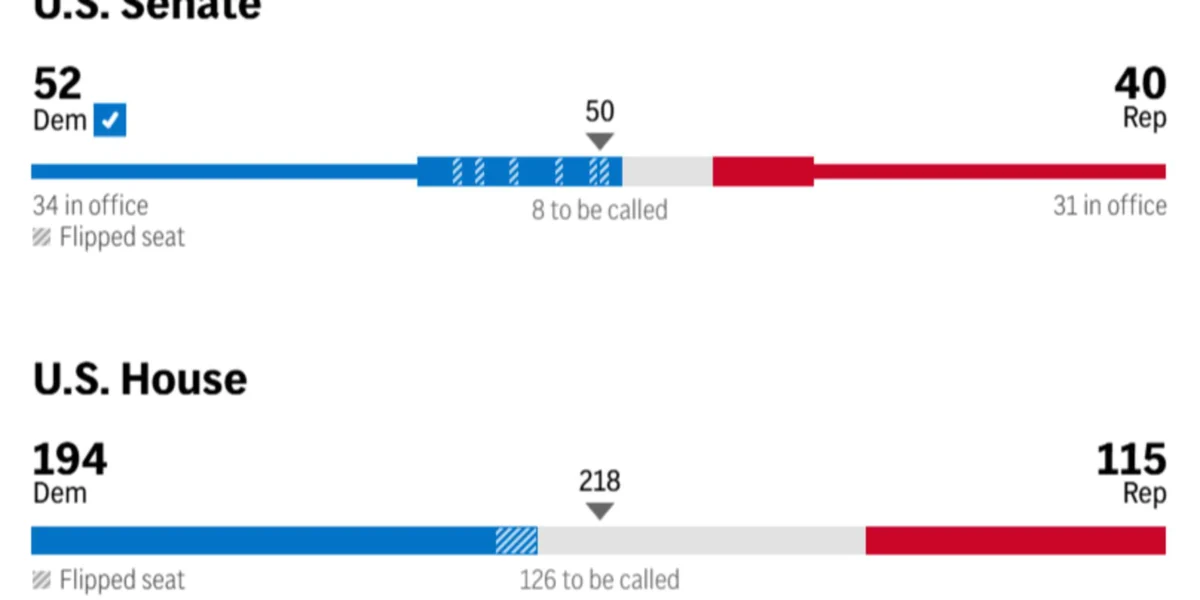
The opposition Democratic Party has secured control of the U.S. Senate and is on the cusp of reclaiming the House of Representatives, according to projections from multiple media outlets. This significant shift in power comes as voters express widespread discontent with Republican President Donald Trump’s administration, citing concerns over persistent inflation, contentious tariff policies, the rapid expansion of AI data centers, and the protracted conflict in Iran. The election results signal a clear repudiation of the incumbent party’s platform and a demand for a change in direction.
In the weeks preceding the November 3rd midterm elections, a consensus among political forecasters suggested a high probability of Democrats retaking the House. However, the battle for the Senate was widely anticipated to be a far more closely contested affair. Contrary to these expectations, early returns painted a dramatically different picture. Within hours of polls closing, Democrats had flipped crucial Republican-held Senate seats in North Carolina, South Carolina, Ohio, Texas, Kansas, and Iowa, according to the Associated Press. These gains collectively propelled the Democrats to a 51-seat majority in the 100-member chamber, a decisive victory that surprised many analysts.
Simultaneously, major U.S. media organizations began projecting Democratic control of the House of Representatives. The Associated Press, known for its rigorous verification process, indicated it would withhold a final declaration until a party definitively secured 218 of the 435 seats. This cautious approach echoes past elections; in both 2024 and 2022, the AP’s call for House control did not come until eight days after Election Day, highlighting the complexity of allocating individual districts.
A Night of Unexpected Democratic Gains
The trajectory of the election night was marked by a series of unexpected Democratic victories in key Senate races, underscoring the deep well of voter dissatisfaction.
Ohio’s Senate Race: A Key Flipping Point
At 11:20 p.m. Eastern Time, news emerged that Republican Senator John Husted had lost his bid for re-election in Ohio, a state that has trended Republican in recent presidential contests. Despite a vocal endorsement from President Trump, Democrat Sherrod Brown secured this pivotal seat. The Associated Press officially called the race at 11:10 p.m., marking a significant early win for the Democrats in a state that has twice voted for Trump in presidential elections. Brown’s victory in Ohio is seen as a testament to the broader dissatisfaction with the Republican agenda, particularly concerning economic issues.
Texas Senate Showdown: A Historic Upset
The closely watched Senate race in Texas concluded with a decisive victory for Democrat James Talarico, who handily defeated Republican Ken Paxton. Paxton, a candidate handpicked by President Trump and reportedly backed by figures like Elon Musk, was unable to overcome the Democratic wave. The Associated Press declared Talarico the winner at 11:03 p.m., noting it was the first time Democrats had won a statewide office in Texas since 1994. This victory represented the third of the four seats Democrats needed to gain a Senate majority without losing any of their own incumbent seats, signaling a potential seismic shift in the political landscape of a traditionally Republican stronghold.
South Carolina: A Pediatrician’s Triumph
In South Carolina, pediatrician Annie Andrews unseated Republican Darline Graham, delivering another crucial Senate pickup for the Democrats. Graham had been appointed to the seat following the July death of her brother, Senator Lindsey Graham, and faced scrutiny regarding her qualifications during her campaign. Andrews’ win marked the second of the required gains for Democrats to achieve Senate control. The prospect of Democratic control immediately brought into focus the chamber’s oversight powers, including the ability to issue subpoenas and conduct impeachment proceedings, powers that could significantly alter the balance of checks and balances in Washington.
North Carolina: Cooper Secures First Flipping Seat
Earlier in the evening, at 8:40 p.m., the Democrats secured their first Republican-held Senate seat of the night. Democrat Roy Cooper, a former governor and state attorney general, emerged victorious in North Carolina’s open Senate race, defeating Trump-backed Republican Michael Whatley. The Associated Press projected Cooper’s win at 8:23 p.m. The seat became open after Republican Senator Thom Tillis opted not to seek re-election. Cooper’s victory was a critical early indicator of the night’s trends, and Democrats knew they needed to flip three more Republican-held seats to secure a Senate majority.
Georgia: Ossoff Holds the Line
In a vital defensive victory for the Democrats, Senator Jon Ossoff won re-election in Georgia, defeating Republican Mike Collins, a two-term congressman who had received President Trump’s endorsement. The Associated Press called this race at 7:55 p.m. Ossoff, a vocal critic of Trump and a figure sometimes mentioned as a potential 2028 presidential contender, was the only Democratic senator running for re-election in a state that voted for Trump in the 2024 presidential election. Holding this seat was considered paramount to the Democrats’ broader ambitions of controlling the Senate.
Virginia: Warner Secures Fourth Term
As polls began closing at 7 p.m., Democratic Senator Mark Warner secured re-election in Virginia, a race that had been rated "solidly Democrat" by the Cook Political Report. Warner, the vice chairman of the Senate Intelligence Committee, defeated Republican Bert Mizusawa, a retired Army major general, to earn his fourth term. The closing of polls in Georgia, South Carolina, Vermont, and most of Florida also began at this time, setting the stage for further results.
Pre-Election Environment: Economic Woes and Geopolitical Tensions
The election played out against a backdrop of significant economic and geopolitical anxieties that shaped voter priorities.
Market Reaction and Investor Sentiment
On Election Day, U.S. stock markets displayed mixed performance as investors navigated the uncertainty surrounding the midterm election outcomes. The S&P 500 saw a modest gain of 0.4%, while the tech-heavy Nasdaq composite rose by 0.8%. The Dow Jones Industrial Average, however, experienced a decline of 0.4%. Investor sentiment was somewhat buoyed by a dip in oil prices, coupled with hopeful indications of progress toward de-escalating the conflict with Iran. President Trump’s statement to Fox News on Tuesday, suggesting a halt to U.S. funding for Israel’s actions in Iran by year-end, reinforced expectations of a potential diplomatic thaw with Tehran.
Asian Economies Brace for Trade Repercussions
Asian nations were preparing for a potential escalation of trade disputes following the U.S. midterm elections. Economists, including Nomura’s Ruchir Sharma, anticipated a surge in "more aggressive trade-related headlines," potentially involving new tariffs. These measures could stem from Section 301 investigations into global overcapacity. Nikkei Asia had previously reported that President Trump had postponed the announcement of certain tariffs, including a 7.5% rate on Chinese imports, due to concerns about exacerbating inflation ahead of the vote. These potential duties would be added to existing tariffs on approximately 60 economies, imposed over alleged forced-labor practices, effectively restoring tariff levels seen before a Supreme Court ruling in February that invalidated some of Trump’s broad tariff authority under the International Emergency Economic Powers Act. Hui Shan, chief China economist at Goldman Sachs, warned that such measures would reignite U.S.-China tensions, and a Congress with greater Democratic control might introduce additional hawkish policies toward China.
Asian American and Pacific Islander Voters’ Shifting Allegiances
The Asian American and Pacific Islander (AAPI) demographic, one of the fastest-growing segments of the U.S. electorate, demonstrated a complex voting pattern. While traditionally leaning Democratic, this group had shown a shift towards Republicans in the 2024 presidential election. However, recent survey data released in October by AAPI Data indicated a decline in trust towards Republicans since President Trump’s return to the White House. Previously divided on their trust in either party regarding the economy and immigration, AAPI adults now clearly favor Democrats on both issues. Karthick Ramakrishnan, founder of AAPI Data, attributed this shift to Trump’s perceived failure to deliver on his economic and immigration promises. Disapproval of Trump’s handling of the economy and foreign policy has notably increased among AAPI adults, with a significant surge observed among AAPI Republicans, where disapproval of his performance on both fronts doubled from approximately 20% to 40%. David Chan, a 42-year-old consultant in New York City, stated that his vote for Democrats was influenced by economic policies and their impact on the Asian American community, though he expressed low expectations for substantial policy support for the community.
Justice Department Deploys Record Election Monitors
In a historic move, the U.S. Justice Department announced the deployment of approximately 1,000 election monitors and observers across all 50 states. This marks the largest such effort in the department’s history and the first to encompass every state. The Civil Rights Division is overseeing the deployment, with monitors tasked with ensuring compliance with federal voting rights laws. Officials maintained constant communication with state and local election authorities throughout Election Day. This initiative follows a long tradition of election monitoring by the department since the enactment of the Voting Rights Act in 1965. However, some state election officials and civil rights groups have voiced concerns about the substantial increase in monitors, fearing potential voter intimidation or interference. These concerns are amplified by President Trump’s repeated claims of voting "fraud" following his 2020 election loss and his advocacy for greater federal oversight of elections, efforts that have been consistently blocked by the courts.
Surge in Early Voting Signals High Turnout
Advance voting saw a significant uptick nationwide, with 59.1 million in-person and mail-in ballots cast prior to Election Day, according to the University of Florida’s Election Lab. This figure represents more than half of the total ballots cast in the 2022 midterm elections. States like Colorado, Florida, Georgia, Montana, Nevada, North Carolina, Oregon, and Tennessee reported early voting numbers equivalent to over 70% of their respective total turnouts in 2022. Party registration data indicated that Democrats accounted for 43% of early ballots, compared to 31.4% for Republicans. However, registration does not definitively predict how individuals cast their ballots. Historical data from Pew Research suggests that Republicans tend to vote more on Election Day and express less confidence in the accuracy of mail-in ballots compared to Democrats.
Weather Disrupts Polling in Key States
Inclement weather presented logistical challenges for voters in several states. Heavy rain and flooding in Florida forced the relocation of some polling centers in eight affected counties. Governor Ron DeSantis issued an executive order to establish temporary voting locations, ensuring residents in these areas could still cast their ballots. Flash flooding also impacted parts of Arizona, Utah, and Colorado. Utah’s lieutenant governor declared an "emergency election accommodation" to allow affected voters to request electronic ballots. Furthermore, rain and gusty winds in the Midwest, along with severe storms in eastern Texas, raised concerns about voter access to polling centers on Election Day morning. Historically, adverse weather conditions have been linked to suppressed voter turnout.
Oil Prices Fluctuate Amid Geopolitical Concerns
Oil prices experienced an early rebound on Tuesday following reports of a U.S. strike on Iran’s Qeshm Island in the Strait of Hormuz, which rekindled supply concerns on Election Day. January Brent crude futures rose by 1.8% to $106.63 a barrel, and U.S. West Texas Intermediate gained 2.4% to $97.08, reversing some of the sharp losses from the previous day. While the strikes tempered hopes for a diplomatic breakthrough, President Trump reiterated that a peace agreement with Tehran "could still happen." Rising energy costs are impacting Asian economies unevenly. China and India have benefited from domestic coal reserves, while nations like Thailand, the Philippines, and South Korea remain more vulnerable due to their reliance on energy imports, according to ING analysts. Japan is expected to begin phasing out gasoline subsidies in December, following their reinstatement in the spring. The U.S. Energy Information Administration projects that Brent crude will average $105 a barrel in the fourth quarter before declining to $84 in 2027 as regional logistics stabilize.
AI Data Centers Emerge as an Electoral Flashpoint
The rapid growth of artificial intelligence and its associated infrastructure has unexpectedly become a significant issue in the elections. Widespread local opposition to digital infrastructure projects is shaping campaigns across both parties, even leading to accusations of foreign interference. Voters from across the political spectrum are voicing concerns about data centers due to their substantial energy consumption, the potential for increased electricity rates, and the aggressive development strategies employed by hyperscale companies. The issue has gained such prominence that moratoriums on data center development have appeared on ballots in some areas. Ohio, a state experiencing accelerated data center development and planned construction of one of the world’s largest AI data centers, is a key battleground. Senate candidates in both parties are campaigning on platforms opposing such infrastructure or highlighting their opponents’ perceived ties to its potential negative impacts. Regardless of the election’s outcome, the growing resistance to data centers could have significant implications for suppliers, many of whom are based in Asia.
The Road to Election Day: A Look Back
Polls opened for the 2026 midterm elections, widely viewed as a referendum on President Donald Trump’s agenda. The staggered nature of polling station hours across different states meant that results would be reported in waves throughout the evening. This election cycle witnessed a surge in early voting, particularly in states with closely contested Senate races. The Associated Press reported that early voting in South Carolina was up by more than 80% compared to the 2022 midterms, with Texas seeing a 50% increase and Maine a 44% rise. Key issues driving voter engagement included persistent inflation and rising energy costs, exacerbated by the Iran conflict, trade tariffs, and a backlash against the proliferation of artificial intelligence data center projects. Notably, issues related to China saw a decline in their prominence in campaign rhetoric as voters focused more intensely on domestic economic concerns.
The Democratic Party’s success in regaining control of the Senate and nearing a House majority represents a significant realignment of political power in the United States. The election results underscore a clear message from voters that economic stability, responsible governance, and a thoughtful approach to technological advancement and foreign policy are paramount concerns. The coming legislative sessions are expected to be marked by intense debate and policy shifts as the newly empowered Democrats seek to address the issues that resonated most strongly with the electorate.
