

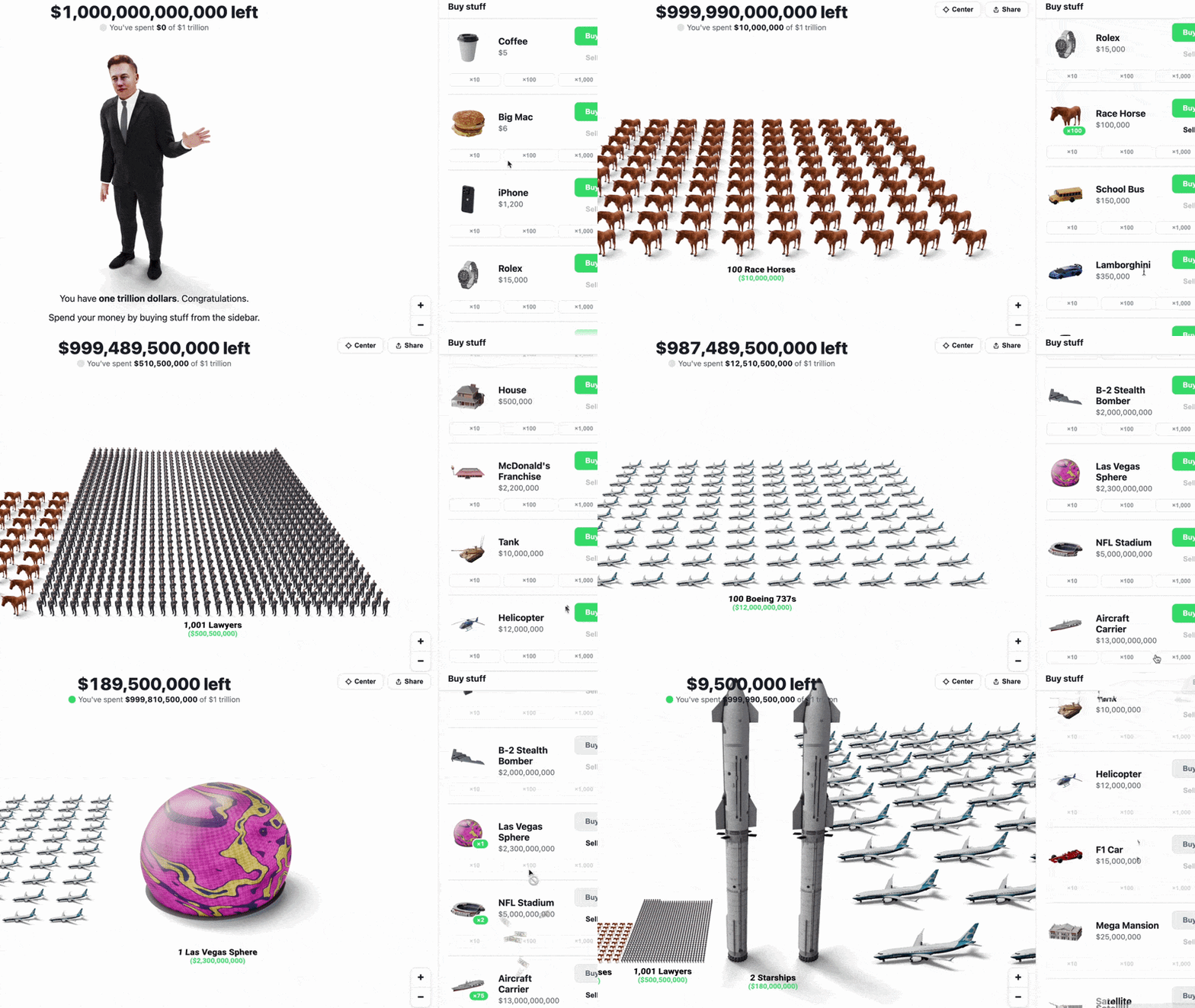
The concept of a trillionaire has shifted from a distant theoretical possibility to a tangible reality, with Elon Musk frequently cited as the world’s first individual to reach this extraordinary financial milestone. While his wealth is predominantly tied to his significant stakes in pioneering companies like SpaceX and Tesla, the sheer scale of a trillion dollars remains profoundly difficult for the human mind to grasp. To bridge this gap between abstract numbers and concrete understanding, a new interactive visualization tool, "Spend Elon Musk’s Money," has been developed in collaboration with Neal Agarwal, the creator of the popular website Neal.fun. This innovative project allows users to virtually spend Musk’s estimated trillion-dollar fortune, offering a powerful and engaging method to comprehend the magnitude of such immense wealth.
The Challenge of Grasping Trillions
Neuroscience research consistently highlights the human brain’s struggle with comprehending exceptionally large numbers. The leap from a billion to a trillion, representing a thousand-fold increase, is often underestimated. Even when attempts are made to contextualize such figures through comparisons to physical spaces or the weight of objects, the abstract nature of trillions often persists. This is where digital tools and interactive visualizations can play a crucial role, transforming daunting numerical concepts into relatable experiences.
"Trillion" is an evocative word, easily spoken and even exciting, yet its true scope remains elusive. The distinction between a billion and a trillion is not merely a matter of adding zeros; it represents an exponential leap in scale. For instance, if one were to count to one billion, it would take approximately 31.7 years of continuous counting. Counting to one trillion would take approximately 31,709 years. This stark difference underscores the cognitive barrier that exists when contemplating such vast sums.
"Spend Elon Musk’s Money": A Digital Sandbox for Immense Wealth
"Spend Elon Musk’s Money" emerges as a direct response to this cognitive challenge. Developed by WIRED in partnership with Neal Agarwal, the tool invites users to engage directly with Musk’s estimated trillion-dollar net worth. The interactive experience allows individuals to select from a wide array of items, ranging from everyday consumer goods to extravagant purchases like private jets and the iconic Las Vegas Sphere. As users "purchase" these items, a running tally dynamically displays how much of Musk’s fortune has been allocated, offering a visual representation of depletion. The items are also rendered in a virtual space, providing a spatial dimension to the expenditure, further enhancing the user’s understanding of the sheer volume of goods and services that a trillion dollars can procure.
This project builds upon Agarwal’s previous successful interactive visualizations, including "Spend Bill Gates’ Money," which allowed users to explore the impact of a $100 billion fortune. The evolution to a trillion-dollar scenario reflects the changing landscape of global wealth and the increasing prominence of individuals with unprecedented financial accumulation.
Neal Agarwal: A Digital Cartographer of Concepts
Neal Agarwal, the architect behind Neal.fun, has established a reputation for creating engaging and educational online experiences. His website is described as a digital journal, a catalog of his diverse interests spanning visualizations, scientific concepts, and unique game mechanics. Agarwal, who began developing content for the web at the young age of 19, views the internet as a continually evolving medium with vast untapped potential.
"I never wanted to constrain the site to one thing, so it ended up being almost like a journal at this point," Agarwal explained in a recent interview. "I’ve been running it since I was 19, and it’s kind of a catalog of everything I’m interested in: visualizations, science, weird game mechanics. For me, it’s mostly an exploration of what you can do with a website."
Agarwal’s deep connection to the internet, having grown up immersed in its digital communities, fuels his passion for exploring its unique capabilities. "I grew up on the web; I was 8 years old on forums," he shared. "I probably spent more time in Club Penguin than any real-world walls. I’m definitely a child of the web, and it’s interesting that I’m around the same age as it. It’s a privilege. Painters are working in a medium that’s a thousand years older, a million years older, so a lot of things have already been found out, been fleshed out. But on the web there’s so much that we haven’t figured out yet. I think there’s still a lot of new stuff to discover, and that’s really interesting to me."
He emphasizes that each digital medium possesses distinct strengths. Just as a book cannot perfectly replicate the cinematic experience, the web offers unique possibilities for interactivity and visualization that cannot be replicated in print or other formats. "I think every medium has distinct things you can do with it. You can turn a book into a movie but it’s not quite the same. There are some things a book is always going to be better at, and vice versa. I think that’s true of the web too. This visualization we’re working on, you can’t print it in a newspaper."
Agarwal’s portfolio includes several viral projects that have captured widespread attention, such as "The Password Game," "Space Elevator," "The Deep Sea," and "Infinite Craft." The success of these projects often lies in their ability to foster unexpected user engagement and community formation.
"I think each project has been very different," Agarwal noted when asked about the viral phenomenon. "The ones that excite me the most now are where a lot of people play it and start doing things with it that I did not expect or intend. Within a few days of Infinite Craft launching, people started crafting Japanese words within the game. And they crafted enough Japanese words that they could play the whole game in Japanese. I’ve never released a game before where they unlocked a language."
He further elaborated on how these platforms can become hubs for emergent behavior and community building. "I had another one called Internet Road Trip; it’s like a simulated road trip but through Google Street View. A Discord formed around that, and people started backseat driving and arguing over which city to go to next, should they make a pit stop here so they can see this monument. People started birdwatching within that game. All these emergent things started happening, and I think the web is really good at that, too. It’s really good at forming communities out of the silliest things, which I find really exciting."
A Legacy of Visualizing Wealth: From Billions to Trillions
The "Spend Elon Musk’s Money" project is a direct successor to Agarwal’s earlier work, "Spend Bill Gates’ Money." This initial project, launched with the Neal.fun website itself, aimed to illustrate the magnitude of $100 billion. At the time, this figure represented an astronomical sum, but in the context of today’s trillion-dollar valuations, it appears almost modest.

"That actually launched with the website itself," Agarwal recalled. "I just wanted to showcase how much $100 billion was, which I guess now seems like a little amount of money compared to the trillion we’re working with."
The original "Spend Bill Gates’ Money" featured a counter for $100 billion and a curated list of purchasable items with their associated costs. These ranged from the everyday, like Big Macs and flip-flops, to luxury goods such as diamond rings and Ferraris, and even significant assets like a McDonald’s franchise and the Mona Lisa. The interactive element allowed users to incrementally add items, visually depleting the $100 billion total.
The response to this initial project was overwhelmingly positive, solidifying its impact. "It was one of the biggest things I’ve launched, and it was really nice to see that the point got across," Agarwal stated. "People understood that this is a way to visualize wealth that isn’t just graphs and bar charts. The game kept finding a new audience over and over again; it was an idea that kept being interesting to people."
The emergence of a trillionaire in the current economic climate prompted a natural progression to revisit this concept. "Yeah, I think so," Agarwal responded when asked if the time was right for a trillion-dollar visualization. "There’s a lot more you can do to visualize that, too. That’s why this one is 3D. I think one thing with Spend Bill Gates’ money is, yeah, you can buy 10,000 cars, but it’s still a number on a screen. With Spend Elon Musk’s Money, I want you to see the cars you’re buying on a screen. The amount of physical stuff you can buy—it is an empire."
Technical Innovations and the Psychology of Spending
The transition from a 2D to a 3D visualization for "Spend Elon Musk’s Money" was a deliberate choice to enhance the immersive experience. While the 2D format of "Spend Bill Gates’ Money" effectively conveyed numerical scale, the 3D rendering of purchased items aims to create a more visceral understanding of the sheer volume of physical goods that a trillion dollars can acquire.
"I think that’s one thing the web is actually really good at, is that you have infinite space," Agarwal explained. "You can visualize these numbers in ways that you can’t do in the physical world. Even for my project The Deep Sea, it’s a 1:1 of the ocean. If you wanted to print that out on paper, it would be a mile long, but on the web you can just keep scrolling and scrolling. So it’s kind of fun to have this infinite scroll mechanic to visualize these huge numbers."
The selection of items for the trillion-dollar visualization focused on more tangible and visually impactful goods. Agarwal noted the difficulty in identifying purchasable items once wealth reaches such stratospheric levels. "This time I was going for more tangible things, so you can visualize it. It’s honestly hard to think of items; once you get to $100 million, there are only so many things out on the market that you can buy. So we have the Las Vegas Sphere in there, and aircraft carriers."
The project also delves into the psychological aspect of extreme wealth and the potential for futility in expenditure. "After a point it’s kind of interesting that you’re like, OK, I could buy 1,000 more tanks, what would that really get me? Part of the fun of this one is just the futility of it. At a certain point, what more could a person need?"
Agarwal also touched upon the technical hurdles encountered during development, particularly in rendering a massive quantity of 3D models. "Initially I wanted everything to be 3D models on the site. But if you try to get your laptop to render a million monster trucks, it’s just going to freeze. So I had to do a lot of trickery to get this 3D effect without actually using 3D models."
Inflation and the Evolving Cost of Goods
A fascinating element highlighted by the "Spend Elon Musk’s Money" project is its implicit commentary on inflation and the changing cost of everyday items over time. By comparing the prices of goods in the new visualization to those in the original "Spend Bill Gates’ Money," a clear picture of price increases emerges.
"I looked back at the original Spend Bill Gates’ Money, and the Big Mac was $2. It’s $6 now," Agarwal observed. "For anything where there’s a direct parallel, you’ve captured a real price jump." He confirmed that the pricing is indeed inflation-adjusted, noting the significant changes even within the relatively short period since the initial project’s launch. "It’s very inflation-adjusted. Which is crazy, because it’s only been six or seven years."
This attention to detail underscores the project’s commitment to reflecting real-world economic shifts, making the visualization not just an abstract exercise in spending but also an educational tool about economic realities. Agarwal also extended an open invitation for suggestions, stating, "If anyone has any recommendations about other items we should add to this, just let me know."
The "Spend Elon Musk’s Money" visualization serves as a powerful testament to the capabilities of the web in making complex financial concepts accessible and engaging. By allowing users to actively participate in the act of spending an unimaginable fortune, the project demystifies the notion of a trillionaire and offers a profound, albeit virtual, glimpse into the sheer scale of such wealth.
