

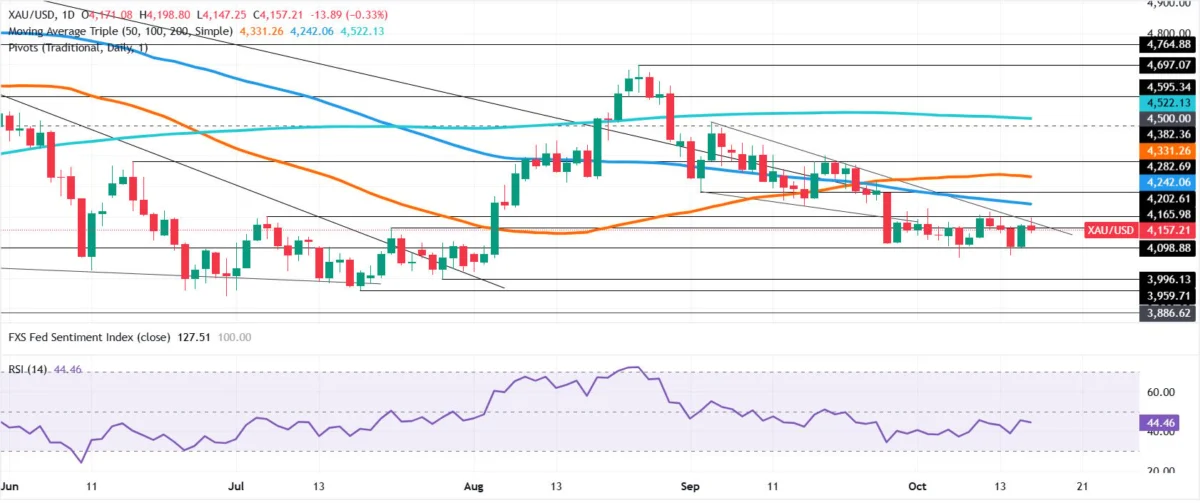
Gold (XAU/USD) prices experienced a notable retreat on Friday, dipping approximately 0.10% to trade at $4,163, setting the precious metal on course for a weekly loss. This downturn comes as market participants diligently assess the implications of recent US inflation data, which, despite registering higher than anticipated figures, paradoxically led investors to temper their more aggressive hawkish expectations regarding the Federal Open Market Committee’s (FOMC) October meeting. The intricate interplay of elevated US Treasury yields and evolving monetary policy outlooks has created a challenging environment for bullion, traditionally seen as an inflation hedge.
Inflationary Pressures and the Evolving Fed Narrative
The economic spotlight this week was firmly fixed on US inflation data, with two pivotal releases shaping market sentiment. The Consumer Price Index (CPI) for September revealed a year-over-year increase of 3.7%, surpassing economists’ forecasts of 3.6% and marking an acceleration from August’s 3.4% rise. This broad measure of inflation, encompassing a basket of consumer goods and services, indicated persistent price pressures within the economy. Following closely, the Producer Price Index (PPI), which tracks inflation from the perspective of producers, delivered an even more striking surprise, climbing 6.3% year-over-year, significantly crushing expectations of a 5.3% increase. The PPI’s robust rise often serves as a leading indicator for consumer inflation, suggesting that cost pressures at the producer level could eventually filter through to consumers.
Initially, the robust CPI figures prompted a swift reaction from market participants, who significantly increased the perceived likelihood of a Federal Reserve rate hike in October, with probabilities nearing 60% post-release. This immediate response reflected concerns that the Fed might feel compelled to act decisively to curb persistent inflation. However, as the trading session progressed and analysts had more time to digest the data’s nuances, a collective reassessment began. Many prominent investment banks updated their forecasts, with a growing consensus shifting towards a more likely rate hike in December rather than October. Money market pricing, as reported by Prime Terminal, now indicates only a 16% chance of a 25 basis point move by the FOMC at its October meeting. In stark contrast, the odds for a rate increase in December have surged to a robust 89%, signaling a clear shift in market expectations. This recalibration suggests that while inflation remains a concern, investors may be interpreting the data as not immediately necessitating an emergency or accelerated hike in October, preferring to give the Fed more time to assess the broader economic landscape.
The Enduring Strength of Treasury Yields and Gold’s Dilemma
Despite gold’s historical reputation as a reliable hedge against inflation, its recent performance has been significantly undermined by the relentless ascent of US Treasury yields. The yellow metal, which offers no inherent yield, becomes less attractive when alternative, risk-free assets like government bonds provide increasingly higher returns. This week, the benchmark US 10-year Treasury yield continued its upward trajectory, gaining three basis points to reach 5.106%. Such elevated yields represent a significant opportunity cost for investors holding non-yielding assets like gold, diverting capital away from bullion and into fixed-income securities.
This phenomenon creates a direct headwind for gold prices. When real yields (nominal yield minus inflation expectations) rise, the appeal of holding gold diminishes, as investors can achieve a positive real return elsewhere. The current environment, characterized by strong nominal yields, makes gold a less compelling investment despite the presence of inflation.
Interestingly, this surge in Treasury yields has not translated into a corresponding boost for the US Dollar (Greenback). The US Dollar Index (DXY), which measures the dollar’s strength against a basket of six major currencies, was down 0.10% at 101.87. This divergence suggests a complex market dynamic where higher US rates are not uniformly strengthening the dollar against all counterparts, potentially due to broader global economic factors or a perception that other central banks might also be on a tightening path. For gold, a weaker dollar typically provides some support, as it makes dollar-denominated assets cheaper for international buyers. However, the overwhelming gravitational pull of surging Treasury yields appears to be overriding any potential dollar-related tailwinds for gold at present.
Federal Reserve Communications and the Path Forward
Amidst the swirling currents of inflation data and shifting market bets, statements from Federal Reserve officials are scrutinized for any clues regarding future monetary policy. This week, comments from Fed Chair Kevin Warsh, though not providing explicit forward guidance on future interest rates, did acknowledge the underlying strength of the US economy. While his remarks offered little in the way of concrete policy signals, they underscore the Fed’s ongoing assessment of economic conditions. The central bank operates under a dual mandate: achieving maximum employment and maintaining price stability. The recent inflation data clearly challenges the latter, making the Fed’s upcoming decisions particularly crucial.
The FOMC’s next meeting in October will be closely watched, even with reduced expectations for a rate hike. The official statement and subsequent press conference will provide critical insights into the committee’s thinking, their assessment of the inflation trajectory, and their readiness to potentially act in December. The Fed’s communication strategy aims to guide market expectations without causing undue volatility, a delicate balance given the current economic uncertainties. The current market pricing for a December hike suggests that investors believe the Fed will maintain its data-dependent approach, allowing time for more economic indicators to emerge before committing to further tightening.
Broader Economic Context and Upcoming Data Points
Beyond inflation and interest rate expectations, other economic indicators provide a broader picture of the US economy’s health. On the data front, US Industrial Production showed robust growth in September, rising 0.7% month-over-month. This figure comfortably exceeded estimates of 0.4% and represented a significant acceleration from the prior month’s modest 0.1% expansion. Strong industrial production suggests resilience in the manufacturing and industrial sectors, contributing to the narrative of a robust economy, which Fed Chair Warsh referenced. A healthy industrial sector can support employment and overall economic activity, potentially giving the Fed more flexibility in its policy decisions, even as it battles inflation.

Looking ahead, the US economic calendar for the coming week features several data releases that will be closely monitored by investors and Fed watchers alike. Housing data, including figures on new home sales and existing home sales, will offer insights into the health of the crucial housing market, which is sensitive to interest rate changes. Initial Jobless Claims, a weekly measure of new unemployment filings, will provide an up-to-the-minute gauge of labor market health. A sustained low level of jobless claims would indicate continued strength in employment, while any significant uptick could signal a weakening economy. Finally, Flash PMIs (Purchasing Managers’ Indexes) for both manufacturing and services sectors will offer preliminary snapshots of economic activity in October, providing leading indicators of business sentiment and output. These data points collectively contribute to the Fed’s comprehensive assessment of the economy and will undoubtedly influence future monetary policy decisions, and by extension, gold’s performance.
Gold’s Enduring Role and Current Challenges
Historically, gold has played a multifaceted role in human civilization, serving not only as a medium of exchange and a store of value but also as a cultural and economic touchstone. In modern financial markets, the precious metal is widely regarded as a safe-haven asset, attracting investment during periods of geopolitical instability, economic uncertainty, or financial market turmoil. Its appeal as an inflation hedge stems from its inherent scarcity and the fact that it is not subject to the same inflationary pressures as fiat currencies, which can be devalued by government printing.
Central banks globally are significant holders of gold, often diversifying their reserves with bullion to bolster the perceived strength and stability of their national currencies and economies. The World Gold Council reported that central banks added a staggering 1,136 tonnes of gold, valued at approximately $70 billion, to their reserves in 2022—the highest yearly purchase on record. Emerging economies, notably China, India, and Turkey, have been particularly active in increasing their gold holdings, signaling a broader trend towards de-dollarization and reserve diversification.
Despite these fundamental appeals, gold faces a significant challenge in the current environment. Its price tends to exhibit an inverse correlation with the US Dollar and US Treasuries, both of which are also considered major reserve and safe-haven assets. A strong dollar typically weighs on gold prices, as it makes gold more expensive for holders of other currencies. Similarly, rising Treasury yields, as seen this week, diminish gold’s attractiveness as a non-yielding asset. Gold is also inversely correlated with risk assets; a rally in stock markets often weakens gold prices, while sell-offs in riskier markets tend to favor the precious metal. The current scenario, where inflation is high but yields are even higher, presents a unique dilemma for gold, as its inflation-hedging qualities are being overshadowed by the opportunity cost presented by high-yielding government bonds.
Technical Analysis: Gold Struggles for Direction
From a technical perspective, Gold (XAU/USD) continues to exhibit sideways trading behavior, largely confined within the established $4,100-$4,200 range. This consolidation suggests a period of indecision among traders, with neither bulls nor bears able to firmly seize control. The price appears to have established a temporary floor near the lower boundary of this range, hinting at potential underlying support.
Momentum indicators provide mixed signals. The Relative Strength Index (RSI), a popular oscillator used to measure the speed and change of price movements, currently leans bearish, indicating that selling pressure might still be dominant. However, a mild positive divergence has been observed on the RSI. A positive divergence occurs when the price makes a lower low, but the RSI makes a higher low, often interpreted as a signal that the downward momentum is waning and a potential bullish reversal could be on the horizon. This suggests that while the immediate trend is weak, there might be underlying strength building up that could open the door for an upside move.
For a decisive bullish reversal, XAU/USD would first need to clear the immediate resistance level at $4,200. A sustained break above this psychological barrier would pave the way for a test of the 100-day Simple Moving Average (SMA), currently positioned at $4,242. Overcoming the 100-day SMA, a key indicator of the medium-term trend, would be a significant bullish development. Further upside targets would then include the 50-day SMA at $4,331, followed by the more substantial $4,500 mark, which represents a crucial psychological and historical resistance level.
Conversely, if XAU/USD fails to maintain its current levels and continues its downward trajectory, initial support lies at $4,100. A decisive breach below this level would be a bearish signal, potentially triggering further declines. Such a move would bring the October 14 low of $4,073 into immediate focus. Should this level also fail to hold, the next significant support would be the July 29 cycle low at $3,996, followed closely by the July 17 low at $3,959. A break below these levels could see gold testing its yearly low at $3,941, signaling a more significant capitulation in price. The daily chart clearly illustrates this critical juncture, with traders closely watching for a breakout in either direction to confirm the next dominant trend.
Outlook: A Tug-of-War for Gold’s Direction
The immediate outlook for gold remains a complex tug-of-war between competing forces. On one side, persistent inflation pressures and geopolitical uncertainties continue to underpin gold’s traditional safe-haven appeal. The sheer volume of central bank purchases also provides a long-term structural demand for the metal. On the other side, the formidable rise in US Treasury yields presents a compelling alternative for investors seeking returns, diminishing gold’s relative attractiveness. The Federal Reserve’s evolving monetary policy stance, characterized by a data-dependent approach and a clear bias towards curbing inflation, will continue to exert significant influence.
As markets digest upcoming economic data and await clearer signals from the FOMC, gold’s ability to break free from its current trading range will depend heavily on the perceived trajectory of interest rates and the dollar’s performance. A sustained cooling of inflation combined with a softening labor market could prompt the Fed to pause its tightening cycle sooner, potentially reducing yield pressures and benefiting gold. Conversely, if inflation remains stubbornly high and the Fed is forced to maintain a hawkish stance for longer, gold could face continued headwinds. For now, the precious metal navigates a landscape where its inherent value as a hedge is challenged by the powerful forces of a high-yield environment, underscoring the dynamic nature of its price discovery.
