

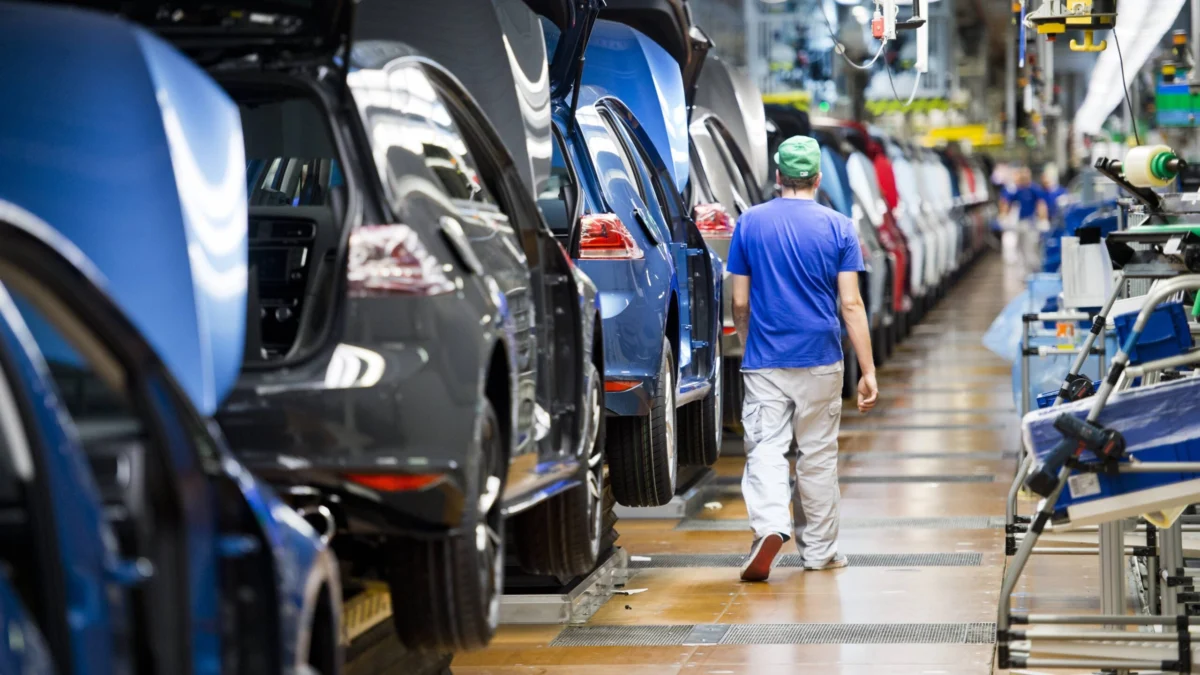
A critical safety recall initiated by Volkswagen Group of America has brought to light a widespread issue concerning a specific steering component, identified by the part number N10552402. The report, filed on September 11th with the U.S. National Highway Traffic Safety Administration (NHTSA) under report number 26V590, details a potentially dangerous flaw that could affect steering control in a significant number of vehicles across multiple brands within the Volkswagen Group.
The standard-looking, five-page "Part 573 Safety Recall Report" belies the gravity of the situation for Volkswagen. At its core is a screw, N10552402, located near the steering mechanism. This seemingly simple component, manufactured with Volkswagen’s characteristic engineering, is susceptible to corrosion and eventual breakage. In the worst-case scenario, a fractured screw could compromise the integrity of the steering system, leading to a loss of steering control and posing a serious risk to drivers and other road users.

This issue has escalated to involve the entire Volkswagen Group, reaching even the supervisory board. In Germany alone, the Kraftfahrtbundesamt (KBA), the Federal Motor Transport Authority, recently recalled nearly 900,000 vehicles. The affected models include popular bestsellers like the Golf and Tiguan, as well as family cars such as the Caddy and Touran. This extensive recall highlights the pervasive nature of the problem, stemming from a single component.
While the NHTSA estimates that only about one percent of the registered vehicles are likely to exhibit the defect, the sheer scale of the recall positions it as potentially the largest for Volkswagen since the diesel emissions scandal. Industry insiders and dealerships have expressed significant concern, with one dealer describing it as a "huge image damage" and noting the recall’s "unusual dimension."
Tracing the Origin: A Detailed Chronology of the N10552402 Defect
The extensive nature of this recall is not a sudden development. Volkswagen has been aware of the problem with component N10552402 for a considerable period, as revealed by the detailed chronology within the NHTSA report. The fact that the history of this major recall can be so thoroughly reconstructed through a U.S. regulatory body is a direct consequence of mandated reporting requirements. Manufacturers are obligated to provide comprehensive documentation of safety defects to the NHTSA, and the Part 573 report includes an in-depth timeline of the issue’s development.
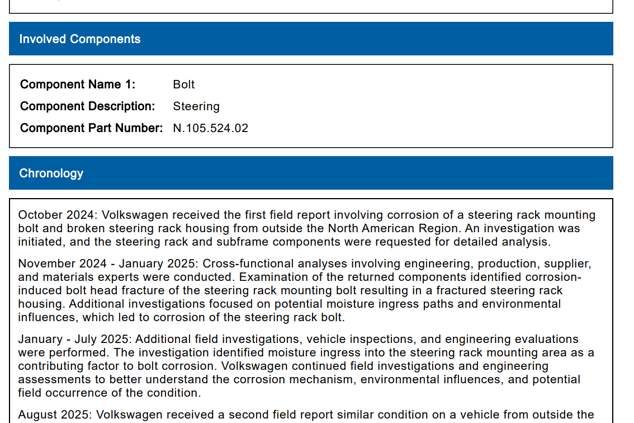
Volkswagen states that the chronology primarily documents the company’s internal technical investigation and evaluation process. However, this internal process reveals a concerning timeline of awareness and action.
According to the report, Volkswagen received its first known field report concerning N10552402 in October 2024. This initial incident, which occurred in a vehicle outside of North America, involved a corroded fastening screw of the steering gear. Critically, the screw head had broken, and the housing of the steering gear was also damaged. Volkswagen initiated an investigation at that point, submitting components for analysis.
Further incidents followed. In August 2025, a second case was reported, again outside North America. While Volkswagen has not disclosed the exact locations of these initial incidents, insiders suggest the problem might be more prevalent in regions where extensive road salting occurs during winter months.

One month later, in September 2025, Volkswagen began testing alternative surface coatings designed to enhance the screw’s corrosion resistance. By December 2025, a third similar case was documented, reinforcing the growing concern within the company.
Understanding the Failure Mechanism: What Happens When the Screw Breaks
The investigations then shifted from understanding the cause of the corrosion to assessing the consequences of a potential screw failure. By the spring of 2026, Volkswagen conducted vehicle tests to evaluate the potential impact of a broken steering gear screw. Early findings indicated that a failure of the steering gear housing was most likely to occur during low-speed maneuvers such as parking, situations where significant forces are applied to the steering system. The company initially considered such a scenario unlikely during normal driving. Nevertheless, the investigations continued to explore all potential failure modes.
In May and June of that year, the product safety committees of Volkswagen and Audi convened to discuss the escalating issue. A significant shift in risk assessment occurred in August 2026: it was determined that a driver might not immediately detect a broken steering gear housing. This realization prompted further escalation of the matter to higher safety review bodies.

On September 4th, 2026, the decision was made: the safety committees concluded that a safety-relevant defect was present. Volkswagen and Audi subsequently decided to initiate a voluntary recall. This decision was made three weeks before the issue gained widespread public attention in Germany.
One week later, on September 11th, 2026, Volkswagen officially reported the recall to the NHTSA in the United States. The U.S. recall encompasses the Volkswagen Atlas and Tiguan models, as well as the Audi Q3. Volkswagen anticipates that approximately one percent of these vehicles will actually exhibit the defect. As of the report’s filing, no accidents or injuries directly attributed to this specific issue had been reported. The identified problematic part remains N10552402.
The MQB Platform: How a Single Part Becomes a Group-Wide Problem
The transformation of a single screw defect into a company-wide crisis is intrinsically linked to one of Volkswagen’s strategic strengths: its modular toolkit strategy, commonly known as the MQB platform. "This appears to be an MQB problem," noted an individual on the day of the recall announcement. The MQB platform, which has been the foundation for dozens of Volkswagen Group internal combustion engine models for years, relies heavily on shared components across various brands.

While this shared component approach offers significant advantages in terms of development cost reduction and purchasing power, it also magnifies the impact of a single part defect. The logic is straightforward: a common part utilized across a wide range of models means that a single flaw can affect a substantial number of vehicles.
Consequently, the recall extends beyond the Volkswagen brand to include Skoda, Seat, and the Audi Q3, all of which are built on MQB architecture. Larger Audi models and Porsche vehicles, which utilize different technical platforms, are not included in this specific recall. This underscores the interconnectedness of the group’s manufacturing processes and the potential for systemic issues.
Adding to this complexity, Volkswagen’s current cost-saving initiatives, part of a broader efficiency program, include plans to increase the number of shared components. This strategic direction, while aimed at financial efficiency, could inadvertently increase the risk of future widespread recalls if similar component issues arise. "Until the next recall comes," speculated one insider, reflecting a concern about the potential for recurring problems.

Addressing the Immediate Issue: Temporary Fixes and Long-Term Solutions
Currently, Volkswagen faces a more immediate challenge: the availability of replacement parts for the N10552402 defect. The permanent technical solution involves a new, more corrosion-resistant screw, designated WHT 013461. However, at the commencement of the recall action, these improved screws were not available in sufficient quantities.
As an interim measure, workshops are temporarily permitted to re-install the original N10552402 screw. A Volkswagen spokesperson emphasized that the existing screw in every recalled vehicle will be replaced as a precautionary measure, irrespective of whether corrosion is already visible.
This interim solution, however, creates an inconvenience for customers. They will need to return to the workshop for a second visit once the improved screw becomes available. The process of replacing the screws initially required workshops to order them individually for each vehicle, a laborious task given the nearly 900,000 affected cars in Germany alone. "A lot of fun with 900,000 cars," remarked one VW dealer sarcastically. Efforts are underway to increase production of the new screw and supply workshops with larger batches to streamline the repair process. Dealers anticipate a potential easing of the situation within one to two months.

The Financial Ramifications of the Recall
The cost of this massive recall is a significant consideration for Volkswagen. While the repair time for each individual vehicle is estimated to be relatively short – approximately half an hour, involving lifting the car, removing the underbody, and replacing the screw – the cumulative cost is substantial.
Dealerships estimate the cost for a straightforward repair to be at least €100 per vehicle, potentially doubling if complications arise. With an estimated four million potentially affected vehicles across various markets, the total cost could quickly approach half a billion euros.
This financial burden is further complicated by the fact that a second workshop visit may be necessary for the final repair. The final cost will also depend on factors such as the actual number of vehicles that present for the recall, variations in labor rates across different regions, and potential contributions from suppliers.

Volkswagen aims to minimize the need for this second visit and avoid further complications. Dealers, too, are eager to resolve the issue efficiently, especially as they are currently in the midst of the seasonal tire change period, which typically demands significant workshop capacity.
Concerns have been raised by dealerships regarding the communication surrounding the recall. In a communication to Volkswagen and Audi dealerships, it was stated that the recall was announced without prior information on "concrete content, framework conditions, and implications." This lack of early communication prevented businesses from accurately assessing the potential impact. Volkswagen maintains that dealerships received "comprehensive technical product information along with detailed work instructions." However, the company did not provide specific details regarding the exact timing of when dealerships were informed about the scope and conditions of the action.
The voluntary recall, initiated by Volkswagen and Audi, underscores the company’s commitment to addressing potential safety risks. However, the extensive nature of the recall, the historical timeline of the defect’s discovery, and the logistical challenges associated with its resolution highlight the complexities of managing a global automotive conglomerate. The situation also raises questions about the long-term implications for Volkswagen’s brand reputation and its ongoing efforts to streamline production through shared components.
